


A flat battery can derail a cold morning, a long trip, or a week of parked-car storage. You need the right equipment for the job: a maintenance charger protects a stored battery, while a portable jump box restores a vehicle after the engine goes silent. These picks cover lithium systems, lead-acid batteries, freezing weather, large engines, and mixed garage emergencies.
The Essentials At A Glance
CTEK 56-926 Lithium US LiFePO4 Battery Charger 5.0Ah-60Ah

BatteryMINDer 1500 12V 1.5A Trickle Charger and Maintainer
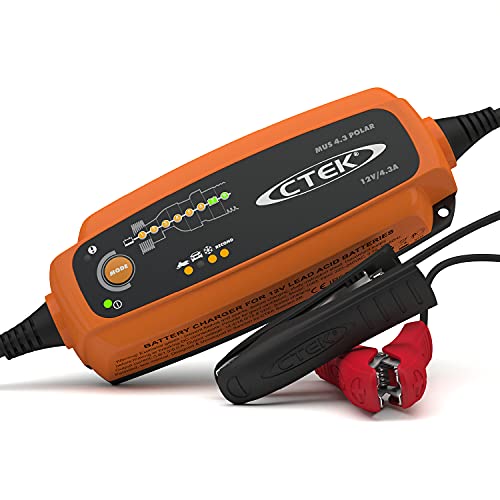
CTEK 56-958 MUS 4.3 Polar Extreme Charger

AstroAI S8 1500A 12V Lithium Jump Starter with Flashlight and Power Bank

HPBS 5000A Jump Starter with 150 PSI Air Compressor for Large Gas and Diesel Engines

HPBS H50 5000A 12V Jump Starter with 3.0-Inch LCD Display

HPBS 5500A 12V Jump Starter with 3.0-Inch LCD Display
More Details On Our Top Picks
Your vehicle battery chemistry determines the charger you need, and this model concentrates on lithium iron phosphate, or LiFePO4. Its automatic recovery, charging, and maintenance process suits a dedicated lithium setup rather than an ordinary lead-acid battery. That specificity is the main reason it stands apart from BatteryMINDer 1500 and the two CTEK lead-acid options.
You’ll find this format useful in a home garage where battery access is routine and the wiring setup remains consistent. The broad 5.0Ah-to-60Ah charging range covers many smaller LiFePO4 packs, while the maintenance function reaches packs stated up to 120Ah. In view, that flexibility appears useful, though actual fit depends on matching your battery’s chemistry and charging requirements.
The Helpful Details
- Automatic recovery, charging, and maintenance reduce manual battery monitoring.
- The 5.0Ah-to-60Ah charging range accommodates a broad group of LiFePO4 batteries.
- Maintenance charging extends to batteries up to 120Ah for compatible setups.
- Spark-free operation and reverse-polarity protection support safer terminal connections.
Points To Keep In Mind
- This dedicated chemistry makes it unsuitable for conventional lead-acid batteries.
- Long storage periods call for a clean, dry location and periodic connection checks.
Key Specs
Built With In Mind
You benefit most with a compatible LiFePO4 vehicle or equipment battery managed in a fixed garage location.
A Better Fit Elsewhere
CTEK 56-958 MUS 4.3 Polar Extreme Charger suits you better when you maintain conventional lead-acid batteries in severe cold.
Long-term storage calls for a maintainer rather than a high-output jump box, and BatteryMINDer 1500 serves that narrower purpose. It uses a 1.5-amp trickle to counter discharge while its high-frequency pulse system targets sulfation, the lead sulfate buildup associated with aging lead-acid batteries. The result is most relevant to 12V vehicles left through winter or an extended off-season.
Compared with CTEK 56-926 Lithium US, you’re choosing lead-acid storage care instead of a dedicated LiFePO4 charging profile. Its continuous maintenance design should suit a garage vehicle that receives few starts, though you may prefer the Polar’s cold-weather circuitry for a location exposed to severe temperatures.
Why It Works Well
- Continuous trickle charging helps offset natural battery discharge during storage.
- High-frequency pulses are designed to address sulfation buildup in lead-acid batteries.
- Plug-and-run operation reduces day-to-day maintenance for a stored vehicle.
- The 1.5-amp output fits the slower, longer-duration purpose of storage care.
Small Caveats
- Its 1.5-amp output is better suited to storage than rapid recovery.
- You’ll need a safe outlet and a dry location for extended connected use.
- Corroded terminals may require cleaning before the maintainer works as intended.
Quick Facts
Made For
You’ll get the most value with a 12V lead-acid car or recreational vehicle battery stored for weeks or months.
Another Choice May Suit
AstroAI S8 suits you better for roadside emergencies because it combines jump-starting, lighting, and portable power.
Cold changes how readily a lead-acid battery accepts a charge, which gives the CTEK 56-958 Polar a clear reason to exist. Its eight-step automatic process covers recovery, charging, and maintenance, while the stated operating range reaches down to -22°F. You gain a practical option for a car parked outdoors through a harsh northern winter.
The safety-orange housing and cold-rated cables improve handling and visibility, which matters around a dark garage or snow-covered driveway. Unlike the AstroAI S8 and other portable jump boxes later in this list, Polar belongs beside the battery rather than in your emergency kit. BatteryMINDer 1500 remains simpler for routine storage, but Polar adds stronger cold-weather focus.
Useful Touches
- The stated -22°F charging capability supports deeply cold environments.
- Eight automatic stages handle recovery, charging, and maintenance in one process.
- Bright orange casing remains easier to locate in a crowded garage.
- Low-temperature cables retain flexibility during cold-weather connections.
Worth Noting
- The extreme-cold focus is unnecessary for a temperate garage or occasional short trip.
- Its battery-side placement means you need workable access to the terminals.
- You should confirm the battery type and follow the supplied charging sequence.
Who Will Love This
You’ll appreciate Polar most as a winter vehicle owner exposed to sustained cold and variable lead-acid battery condition.
Swap It Out When
BatteryMINDer 1500 makes more sense for uncomplicated 12V lead-acid storage in a moderately cold garage.
Moving from fixed chargers to portable rescue changes the decision entirely, and the AstroAI S8 fits a glove box more naturally than the CTEK models. Its 1,500-amp peak output targets 12V gasoline engines up to 6.0 liters and diesel engines up to 3.0 liters. You also get three flashlight modes and power-bank functions, turning one emergency pack into a broader roadside companion.
The stated engine limits make this a sensible fit for many cars, SUVs, motorcycles, and pickups, though the later HPBS options cover larger displacement. In view, the S8 feels less burdened by oversized power specifications and more focused on portability. You may find it easier to organize in a center console or weekend bag than the compressor-equipped HPBS model.
A Favorable Mix
- The 1,500-amp peak output targets common gasoline and diesel vehicles.
- Three flashlight modes add visibility during nighttime roadside work.
- Power-bank functionality extends usefulness beyond battery starting.
- The smaller engine target keeps the unit focused on portable emergency use.
Trade Offs
- Its stated engine capacity falls short of the larger HPBS models.
- Lithium jump packs benefit from periodic charge checks during long storage.
- Clamp cleanliness and terminal contact remain important before use.
Feature Snapshot
Travel Ready
You’ll find the S8 especially convenient for commuting, compact vehicles, and a portable roadside kit with several secondary functions.
Where Another Pick Shines
HPBS H50 suits you better for gasoline engines up to 10.0 liters or diesel engines up to 8.0 liters.
Large pickups, heavy SUVs, and diesel work vehicles create a different roadside scenario, and this HPBS pack is built around that scale. Its stated 5,000-amp peak output supports gasoline engines up to 10.0 liters and diesel engines up to 8.0 liters. You also gain a 150 PSI air compressor, so a low tire and a discharged starting battery can be handled with one device.
Compared with HPBS H50, the meaningful addition is tire inflation rather than only a more prominent LCD. That extra capability takes up space and may make this model less convenient for a small trunk, though it can reduce the number of emergency items you carry. The later 5,500A pack offers more peak output, but not the stated air-compressor feature.
Real Benefits
- The 5,000-amp output targets larger gasoline and diesel engines.
- A built-in 150 PSI compressor handles a common roadside tire need.
- One combined unit simplifies packing for long-distance travel.
- The stated operating range extends from -4°F to 140°F.
Practical Considerations
- Added compressor hardware likely increases bulk for limited storage spaces.
- You should inflate tires according to vehicle and equipment guidance.
- The internal battery needs regular charging between extended storage periods.
Core Details
Right Fit For
You’ll value this combination with large vehicles, diesel equipment, or frequent travel where tire pressure also matters.
Consider Something Else When
AstroAI S8 fits you better for smaller vehicles and a simpler, more compact roadside kit.
The H50 concentrates on starting power without adding a tire compressor, making it a cleaner choice for owners who already carry separate inflation equipment. Its 5,000-amp peak output addresses 12V gasoline engines up to 10.0 liters and diesel engines up to 8.0 liters. The 3.0-inch LCD presents operating information in a larger format, which can be easier to check during a roadside stop.
You’re choosing a dedicated jump box here, not the continuous storage support offered by BatteryMINDer 1500. Against the HPBS compressor model, H50 preserves the same stated large-engine capacity while shedding the inflator. In view, that trade can produce a simpler setup for a truck owner, although the compressor-equipped option remains more convenient after a puncture-related delay.
What It Does Well
- The stated engine range supports large pickups and diesel vehicles.
- A 3.0-inch display improves visibility of operating information.
- The dedicated jump function keeps roadside equipment straightforward.
- One charge is stated to provide as many as 40 jump starts.
Some Limits To Know
- The H50 does not provide the built-in tire inflation offered by the earlier HPBS model.
- Stored lithium packs may lose charge and need occasional maintenance charging.
- Engine-capacity figures don’t replace checking your vehicle’s starting requirements.
Who Should Grab It
You’ll appreciate the H50 with a heavy truck or diesel vehicle that prioritizes jump capacity and display visibility.
Look Elsewhere When
HPBS 5500A 12V Jump Starter suits you better when greater stated peak output matters more than built-in tire inflation.
This final HPBS model moves the stated peak output to 5,500 amps while retaining the large 3.0-inch display. Its stated engine coverage extends to all gasoline engines and diesel engines up to 10 liters, creating a broad fit for heavy vehicles. You might favor it for frequent commercial use, but the headline figures don’t eliminate the need to follow your vehicle manufacturer’s starting guidance.
The jump capacity exceeds HPBS H50 on paper, yet the H50’s stated 1-to-2-second starting claim and jump-count details are more clearly supplied here, so you shouldn’t treat both listings as equivalent feature sets. This pack also lacks the 150 PSI compressor offered by HPBS 5000A. That makes it a focused starting choice rather than the broader roadside tool.
Benefits That Matter
- The 5,500-amp peak output supports demanding starting applications.
- Diesel coverage extends to engines up to 10 liters.
- The large display gives roadside operating information more visual presence.
- One full charge is stated to support as many as 60 jump starts.
Potential Compromises
- No built-in tire inflation is identified in the supplied information.
- The larger electrical specification may add unnecessary weight for smaller cars.
- You’ll still need to inspect the clamps and maintain the internal charge.
Technical Reference
Whose Shelf It Belongs On
You’ll find this model most relevant in a commercial garage or household that regularly supports large trucks, diesel vehicles, or fleet equipment.
Reach For A Different Pick When
HPBS 5000A Jump Starter with 150 PSI Air Compressor fits you better when carrying one combined starting and inflation tool matters.
Choosing Between Battery Care and Roadside Rescue
Start by separating charging from emergency starting. A battery charger connects to a depleted battery over time, while a jump box delivers a concentrated burst of current so you can operate the engine. Your storage habits and battery chemistry should determine which category belongs in your garage.
Match the Battery Chemistry
LiFePO4 uses a different internal chemistry from conventional lead-acid batteries and needs a compatible charge process. The CTEK 56-926 Lithium US targets LiFePO4 systems, while BatteryMINDer 1500 and CTEK Polar focus on 12V lead-acid applications. Confirm the battery label and your vehicle documentation before connecting a charger.
Consider Your Weather and Storage
Extreme cold reduces lead-acid battery performance and narrows your margin for error. CTEK Polar is designed around charging down to -22°F, making it a focused cold-climate option. For moderate storage conditions, BatteryMINDer 1500 offers a simpler continuous-maintenance format.
Size the Jump Box to the Vehicle
Peak current, engine displacement, and cable design all affect fit. AstroAI S8 targets common gasoline and diesel vehicles with a more portable profile, while the HPBS models cover progressively larger stated engine classes. Choose the smallest capacity that comfortably covers your vehicles and storage space.
Keep It Charged and Clean
A portable jump box is less useful after months without charging. Recharge it on a sensible schedule, inspect the housing and cables, and clean corrosion from battery terminals before connection. Keep air-compressor hoses and accessories dry after roadside use.
Common Ownership Pitfalls and Useful Upgrades
Mistakes Worth Dodging
You can damage charging electronics by using a lead-acid profile on a lithium battery or confusing 12V and higher-voltage systems. You can also underestimate jump-box bulk and forget to maintain its internal charge. Match battery chemistry, voltage, and vehicle size before making a selection.
What Separates Premium From Basic
Higher-end models add cold-weather capability, large displays, substantial peak-current claims, or built-in air compressors. Those additions suit frequent road travel and demanding vehicles, while a basic maintainer can handle routine storage. Extra capability helps only when it matches your actual vehicle mix.
Frequently Asked Questions
Can a battery charger jump-start a car?
Most chargers restore a battery gradually rather than supplying the immediate concentrated current required to start an engine. You need a compatible jump box for the moment a vehicle won’t crank.
Can I use LiFePO4 and lead-acid chargers interchangeably?
No, you should match the charger to the battery chemistry. The CTEK 56-926 Lithium US targets LiFePO4 batteries, while the other charging picks focus on conventional 12V lead-acid systems.
Do I need a compressor in a jump box?
You’ll need one occasionally for a suitable tire-pressure adjustment during a trip. The HPBS 5000A model provides a stated 150 PSI inflator, while dedicated jump boxes keep packaging simpler.
How should I store a portable jump box?
Keep the unit dry, away from extreme heat, and charged before long storage periods. Periodically inspect the housing, cables, and clamps for visible wear.
Which charger works in freezing weather?
CTEK Polar is designed around severe cold, with a stated charging range down to -22°F. Battery chemistry and your vehicle’s charging guidance still determine the correct setup.
Final Verdict
Choose CTEK 56-926 Lithium US for LiFePO4 charging, BatteryMINDer 1500 for continuous lead-acid storage, or CTEK Polar for harsh cold. Pick AstroAI S8 for a portable everyday kit, while the HPBS options suit larger vehicles, higher stated peak output, or built-in tire inflation. Match the tool to your battery, engine size, weather, and storage space.
