


Battery capacity matters most when your phone carries you through a commute, a long workday, or a trip far from an outlet. The Samsung models here pair sizeable batteries with adaptive power management, while the portable chargers add backup power for phones and tablets. Your actual charging needs determine which option makes the most sense.
A Quick View Of The Lineup
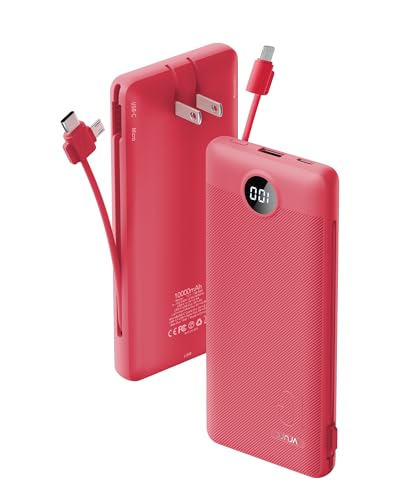
VRURC 10,000mAh Portable Charger, Viva Magenta

VRURC Slim Portable Charger with Built-In Cables

VRURC 10,000mAh Portable Charger, Green

Samsung Galaxy S23 FE 128GB Graphite

NOBIS 90W 20,000mAh Power Bank

Samsung Galaxy S24 FE 128GB Graphite

Samsung Galaxy S21 FE 5G 128GB Graphite
Why These Options Stand Out
Built for trips where loose charging cables turn into clutter, this VRURC combines a 10,000mAh capacity with Micro USB, USB-C, and another attached data cable. Its integrated wall plug also lets you refill it without carrying a separate adapter, making it useful during airport waits, business travel, or an unreliable campsite charging area.
The reserve looks sensible for topping up a smartphone, although actual runtime depends on your phone, screen brightness, and network conditions. Compared with the NOBIS 20,000mAh model, it prioritizes compact cable management over maximum reserve capacity.
The Practical Payoff
- Attached cables reduce packing loose adapters and cords.
- The 10,000mAh reserve suits routine smartphone top-ups.
- The folding wall-plug design supports hotel and airport recharging.
- USB-C input and output expand charging compatibility.
Points To Note
- Its smaller reserve cannot cover as many full charges as the NOBIS option.
- Owners should keep exposed connectors clear of grit before attaching devices.
Quick Facts
Made For
Frequent travelers who want one compact reserve with several charging connections.
Another Choice May Suit
The NOBIS 90W 20,000mAh Power Bank serves people who need more capacity and laptop charging.
At 5.9 by 2.8 by 0.7 inches and eight ounces, this VRURC emphasizes portability over large capacity. For a workday spent moving between meetings, its built-in Micro USB, USB-C, and standard cable can cover several connection types without turning a bag pocket into a cable drawer.
The direct wall-plug recharge adds useful flexibility, though the unspecified capacity deserves attention for anyone expecting multiple laptop charges. The Viva Magenta VRURC 10,000mAh Portable Charger may fit your planning better when a stated battery figure matters.
Points In Its Favor
- The slim profile fits easily into small handbags and laptop sleeves.
- Three attached cables cover common everyday connections.
- The eight-ounce weight suits trips that call for minimal packing.
- Direct wall recharging removes the need for a separate plug.
Small Caveats
- No capacity figure is provided, making runtime harder to compare.
- The slim body may be less comfortable for users who favor larger grips.
- Attached cable ends need occasional checks for lint or debris.
Feature Snapshot
Right Fit For
Minimal-packing travelers who value cable convenience more than a published reserve size.
Consider Something Else When
The VRURC 10,000mAh Portable Chcharger, Green offers a clearer capacity figure for overnight travel planning.
Functionally, the green VRURC follows the same practical template as the Viva Magenta version: 10,000mAh of portable power, attached charging leads, and an integrated wall plug. That familiar design suits daily commutes and weekend trips, especially for someone tired of choosing between several loose cables at the bottom of a bag.
Your choice between the colors is mostly personal. Capacity and connection coverage are the meaningful distinctions here, while the unspecified dimensions make a direct size comparison with the slim VRURC Portable Charger with Built-In Cables uncertain.
Good Reasons To Consider
- Its stated 10,000mAh capacity supports routine top-ups.
- Built-in cables simplify packing for mixed device use.
- The integrated plug supports convenient overnight recharging.
Worth Noting
- Capacity may be insufficient for people away from outlets for several days.
- The attached leads add rigidity compared with separate silicone cables.
- Dimensions and weight are absent from the available details.
- Color choice does not change the core charging design.
Built With In Mind
Commuters and occasional travelers who prefer a published reserve and all-in-one cord design.
A Better Fit Elsewhere
The NOBIS 90W 20,000mAh Power Bank suits heavier laptop use and longer outings.
The Galaxy S23 FE targets people who want a phone battery rather than a separate emergency reserve. Adaptive usage management conserves power according to your activity, while the 128GB storage capacity leaves room for downloaded media and offline apps. That balance fits full days built around messaging, photography, streaming, and navigation.
Compared with the older Galaxy S21 FE 5G 128GB Graphite, this model offers a newer platform and Galaxy AI tools. Specific battery-hour figures are absent, so heavy gaming or continuous video may still call for the NOBIS 90W 20,000mAh Power Bank.
Key Advantages
- Adaptive power management supports ordinary full-day routines.
- 128GB storage accommodates apps, photos, and downloaded media.
- Galaxy AI adds search, note formatting, and call interpretation tools.
- A 50MP rear camera serves everyday photography without a portable battery.
- The unlocked US version offers broader carrier selection than a locked model.
Potential Drawbacks
- No exact battery capacity or charging figures are provided.
- Power-intensive gaming may reduce runtime compared with lighter use.
- A protective case remains sensible during everyday drops and commuting.
Essential Details
Who Will Love This
Samsung users who want intelligent battery management, storage, and advanced tools in one everyday phone.
Where Another Pick Shines
The Samsung Galaxy S21 FE 5G 128GB Graphite favors established FE hardware and a 120Hz display.
This is the substantial power option in the group, with twice the stated capacity of the 10,000mAh VRURC models. Its output reaches 90W, a figure that matters when your mobile setup includes a laptop rather than only a phone. The larger reserve also makes more sense for road trips, remote workdays, and crowded venues with limited charging access.
Fast charging means the battery pack can accept up to 65W while recharging, subject to the connected device and cable. Compared with the VRURC Slim Portable Charger with Built-In Cables, you gain capacity and laptop support at the likely cost of extra bulk, though dimensions are not provided.
Benefits That Matter
- The 20,000mAh reserve supports heavier multi-device routines.
- Up to 90W output suits compatible laptops and demanding devices.
- It also supports smartphones and Bluetooth headsets.
- Up to 65W input can shorten the pack’s own recharge under suitable conditions.
Practical Considerations
- Actual laptop compatibility depends on ports, protocols, and power draw.
- Its greater capacity may feel excessive for light phone-only travel.
- Keep the pack dry and inspect cables during long mobile workdays.
Technical Reference
Who Should Grab It
Mobile professionals and travelers who regularly charge a laptop alongside one or more phones.
Reach For A Different Pick When
The VRURC 10,000mAh Portable Charger, Viva Magenta suits people prioritizing compact cable storage over laptop power.
The Galaxy S24 FE extends the FE formula with a bright AMOLED display and newer Galaxy AI tools for translation and photo assistance. Its long-battery positioning favors users who split their day between work calls, photography, messaging, and streaming without constantly seeking an outlet.
Relative to the Galaxy S23 FE 128GB Graphite, the newer model introduces additional AI-oriented functionality, but the supplied details do not establish a precise runtime gain. Power-heavy travelers may still want the NOBIS 90W 20,000mAh Power Bank as backup.
Useful Touches
- Galaxy AI supports real-time translation and photo suggestions.
- The AMOLED display suits everyday media viewing.
- Long-battery design supports typical commuting and work routines.
Honest Caveats
- No exact battery capacity or charging-speed figures are provided.
- AI features add more software demands than a simpler phone interface.
- Screen replacement costs deserve consideration because the display is a central component.
The Right Fit
Everyday users who value newer Galaxy AI features alongside a long-battery smartphone format.
Another Choice May Suit
The Galaxy S21 FE 5G 128GB Graphite serves people who prioritize a 120Hz display and older FE hardware.
This older FE model combines intelligent battery management with a high-refresh display, making it interesting for people who spend long periods scrolling, messaging, or playing supported mobile games. Dynamic AMOLED 2X technology provides the vivid color and brightness emphasized for outdoor visibility, while 128GB handles everyday storage needs.
You sacrifice the newer AI feature set found in the Galaxy S24 FE 128GB Graphite, but the combination of smooth scrolling, a triple-camera arrangement, and battery-aware controls remains practical. For prolonged trips, pairing it with a 10,000mAh VRURC charger may provide useful reserve.
Everyday Perks
- The 120Hz display makes frequent scrolling feel smooth.
- Intelligent battery controls adapt to changing usage demands.
- The triple rear-camera system includes ultra-wide, wide-angle, and telephoto lenses.
- A 32MP front camera supports detailed selfies and video calls.
- The unlocked US version expands compatible network choices.
Factors To Consider
- Exact battery capacity and charging figures are absent.
- As an older model, it lacks the newest Galaxy AI tools.
- Its 120Hz screen can demand more power than a lower-refresh display.
Core Details
Whose Shelf It Belongs On
Longtime Android users who value a smooth display, capable cameras, and intelligent battery controls.
Skip It When
The Samsung Galaxy S24 FE 128GB Graphite makes more sense for newer AI-oriented software.
Matching Phone Power to Daily Demands
Start with the gap between your normal charging time and the longest period away from an outlet. A commuter with predictable access to a desk charger may need less reserve than a field technician working across locations. Treat stated mAh figures as comparable capacity indicators, though actual phone runtime varies with the device, display, network, and workload.
Next, identify what must recharge. A 20,000mAh pack with high output makes more sense for laptops than a compact 10,000mAh option intended mainly for phones. Battery output in watts also matters because a larger battery paired with an undersized charger can take longer to refill. Compatibility with the ports and charging protocols on your devices matters more than a headline number.
Built-in cables can reduce travel friction, while an integrated wall plug eliminates one more adapter. The trade-off is that fixed leads may be less flexible than detachable silicone cables, especially in a tightly packed bag. Look for accessible ports that let you keep your most frequently used connection exposed.
For phones, consider efficiency management rather than battery size alone. Adaptive controls can reduce background consumption, although gaming, video recording, navigation, and weak cellular signals place additional demands. Owners of the older Galaxy S21 FE 5G may still value a portable reserve for long days away from an outlet.
Matching Your Daily Charging Pattern
Compare the Galaxy S23 FE and S24 FE by workload, software needs, and device age rather than battery claims alone. The older S21 FE can suit users focused on its 120Hz display and camera system, while the newer FE models add Galaxy AI functionality. Exact runtime comparisons require identical tests that aren’t included here.
Separating Capacity From Charging Speed
Capacity tells you how much energy is stored; output wattage tells you how quickly compatible devices may accept it. The NOBIS 20,000mAh model serves high-output laptop setups, while the 10,000mAh VRURC choices prioritize portability and integrated connections.
Avoiding Battery Capacity Mistakes
Mistakes Worth Dodging
Don’t assume every 20,000mAh power bank delivers the same number of phone charges. Conversion losses, device draw, and screen use affect the result, so a realistic model should be part of your planning. Also check whether your laptop supports the pack’s output and charging protocols.
What The Higher Tier Buys
Higher output and larger capacity usually serve heavier setups rather than making every phone charge faster. A 90W laptop-capable pack pays off for mobile work; a compact integrated-cable model is more useful for casual travel. Paying more makes sense only when that extra capability matches your devices and routines.
Frequently Asked Questions
Does a larger smartphone battery always mean longer runtime?
No. Battery capacity helps, but display refresh, processing load, signal strength, and app activity also affect runtime.
Is 20,000mAh better than 10,000mAh for travel?
The larger reserve suits longer trips and multiple devices, while the smaller pack takes less room.
Can a power bank charge a laptop?
Only with compatible ports, cables, protocols, and sufficient output, which is why the NOBIS model targets laptops.
Are built-in cables more convenient than separate cords?
They reduce packing clutter, although attached cables can be less flexible and harder to replace.
Which Samsung model has the best battery outlook?
All three FE models emphasize intelligent power management, but newer models provide more advanced software features.
Final Thoughts
Choose a Samsung FE model for integrated phone power and software features, or add a portable charger for dependable backup. The 10,000mAh VRURC options favor travel simplicity, while the NOBIS pack serves heavier laptop routines. Match the equipment to your longest realistic day away from an outlet.
