


Laptop power comes in two very different forms: a portable power bank for long commutes, flights, and remote work, or an internal replacement battery for restoring a compatible machine. Capacity alone tells only part of the story, since output, connector support, portability, and model compatibility determine which option actually fits your setup.
The AsperX choices cover several laptop-charging scenarios, from compact 10,000mAh units to 27,600mAh models with USB-C power delivery. The two ZAYAUPVL batteries serve a narrower purpose, replacing specific HP notebook batteries rather than charging devices from an outlet or your own battery.
The Main Contenders
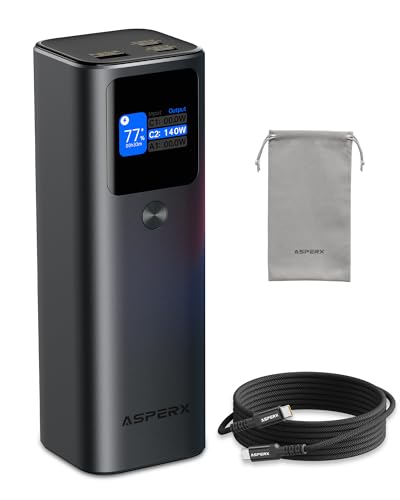
AsperX Power Bank 27,600mAh 162.5W

AsperX 165W 20,000mAh Power Bank

AsperX 27,600mAh 140W Power Bank

AsperX 165W 20,000mAh Retractable Cable Power Bank

RORRY CharmGo 30W 10,000mAh Power Bank

ZAYAUPVL LA03DF Battery for HP 15-F Series
ZAYAUPVL JC04 Battery for HP 15-bs and 17-bs
Inside Each Recommended Option
The 27,600mAh reservoir gives this AsperX model more staying power than the smaller RORRY option, while its aluminum unibody shell suits a professional desk setup or shared travel kit. PD3.1, or Power Delivery 3.1, is a fast-charging standard used to negotiate suitable power levels with compatible devices.
That combination makes sense for remote workers who spend hours away from an outlet and still need to recharge a demanding laptop. Depending on your laptop’s power draw and battery condition, 162.5W of rated output provides meaningful headroom, though the largest chargers are not automatically the easiest to carry.
Real Benefits
- 27,600mAh offers substantial reserve for long flights and multi-device workdays.
- 162.5W output targets demanding USB-C laptops rather than serving only phones.
- Aluminum construction gives the enclosure a more durable feel than a lightweight plastic shell.
- Portable power reduces dependence on wall outlets during mobile work.
Practical Considerations
- The higher capacity adds weight, making it less convenient for pocket-sized everyday carry.
- Owners should keep contacts and ports free of debris and store the unit away from moisture.
Quick Facts
Made For Mobile Power
You gain the most from this model during long remote workdays, travel schedules, or locations with unreliable outlet access.
Consider Something Else When
RORRY CharmGo 30W 10,000mAh Power Bank suits you better when a lightweight phone and earbud charger matters more than laptop runtime.
The second AsperX option trades some of the first model’s 27,600mAh capacity for 165W output and a TFT status display. That screen can be useful in a busy terminal or shared office because it gives you a more informative view of operating conditions than a simple four-light battery indicator.
Its dual USB-C arrangement supports simultaneous charging, with listed outputs reaching 100W and 65W at the same time. You may find the smaller 20,000mAh reservoir easier to manage in a daily laptop bag, although long-haul travel may expose its shorter runtime before a laptop consumes it.
Standout Benefits
- 165W total output targets performance laptops with substantial charging demands.
- Two USB-C ports allow a laptop and phone to charge together.
- The TFT display presents operating information at a glance.
- 20,000mAh sits between compact daily packs and the higher-capacity AsperX models.
Smaller Caveats
- Its capacity is lower than the 27,600mAh AsperX choices.
- Screen brightness may be less useful in direct sunlight, depending on your travel conditions.
- Multiport charging depends on compatible cables and appropriate device requests.
Right Fit For
You benefit most from this option while traveling with one demanding laptop and a smaller device that needs concurrent charging.
A Better Fit Elsewhere
AsperX Power Bank 27,600mAh 162.5W offers a larger reserve for workdays where access to an outlet is especially limited.
This AsperX model combines the same 27,600mAh class of capacity with 140W maximum output and an integrated USB-C cable. Multiport power allocation, meaning the total output shared among connected devices, supports laptop, tablet, and phone arrangements without treating every port as an independent full-power outlet.
The built-in cable removes one loose accessory from your travel kit, which is a modest convenience rather than a transformation. You may find it especially useful in a carry-on where a loose cable can become tangled or left behind, though laptops needing more than 140W will require another option.
Positive Points
- 27,600mAh supports extended use away from an outlet.
- The integrated USB-C cable reduces packing clutter.
- Up to 100W two-way charging on either USB-C port covers many demanding laptops.
- The USB-A port adds 22.5W charging for compatible accessories.
- A TFT display adds useful operating information.
Areas To Watch
- The 140W ceiling is lower than the 162.5W and 165W alternatives here.
- The fixed cable cannot replace every connector type you may need.
Technical Highlights
Who Will Love This
You benefit most from this model when your travel bag holds a USB-C laptop, phone, and several smaller accessories.
Where A Sibling Pick Shines
AsperX 165W 20,000mAh Power Bank better serves high-output laptop setups that value a screen over an integrated cable.
A retractable cable addresses a specific recurring annoyance: loose cords becoming tangled in a laptop bag. Pulling out the integrated connector keeps the common USB-C charging path ready, while 165W output gives the unit enough capability for many demanding notebooks.
Compared with AsperX 165W 20,000mAh Power Bank, this version trades a TFT display for cable storage. Depending on how you work, that is a sensible exchange, but its 20,000mAh capacity remains below the 27,600mAh models for extended travel away from power.
A Few Strong Suits
- 165W output supports high-power USB-C laptops.
- The retractable cable reduces loose-cord clutter.
- 20,000mAh suits regular workdays and shorter trips.
- The aluminum unibody shell adds a rigid exterior.
Trade Offs
- The lower capacity can run short during a long flight with heavy laptop use.
- Cable retraction needs occasional care to avoid sharp pulls or connector wear.
- It may carry more weight than a basic 10,000mAh phone pack.
The Right Fit
You benefit most from this pick as a mobile professional who wants laptop-capable output without carrying a separate USB-C cable.
Another Choice May Suit
AsperX Power Bank 27,600mAh 162.5W suits you better when battery reserve outweighs the compact convenience of a stored cable.
The CharmGo is built around a smaller premise than the AsperX laptop models: easy everyday charging for phones and compact accessories. Its 30W USB Power Delivery output targets compatible devices such as recent iPhones, AirPods, and smaller tablets rather than high-draw notebooks.
For a short commute or a day with several top-ups, 10,000mAh can remain useful. You should not expect it to serve as a laptop power reserve, though, especially under heavy workloads or on a long journey where a larger bank would be the more realistic choice.
Where It Delivers
- 30W PD output provides fast charging for compatible phones and tablets.
- 10,000mAh keeps pack size and weight comparatively modest.
- The unit suits pockets, small handbags, and minimal travel kits.
Minor Gripes
- 30W is below the laptop-focused output of every AsperX option.
- The 10,000mAh capacity offers limited headroom for prolonged device use.
- You may need a separate cable, depending on the charging setup.
At A Glance
Who Should Grab It
This charger fits you best when your travel routine centers on topping up a phone and earbuds rather than powering a notebook.
Not Your Match When
AsperX 27,600mAh 140W Power Bank is the better fit for laptop-focused travel and mixed-device charging.
This ZAYAUPVL LA03DF is an internal notebook battery, not a portable charger. Its 31Wh rating and 11.1V voltage target specific HP 15-F systems, including the listed 15-f272wm, 15-f233wm, and 15-1272wm models, so model verification is essential before purchase.
The replacement role makes it useful for extending the usable life of a compatible laptop rather than escaping outlets with a bank. Installation requires opening the notebook and routing the battery connector, which can be demanding without prior experience.
What Pays Off
- A 31Wh rating restores a removable power source in compatible laptops.
- The three-cell black pack matches common internal replacement formats.
- Multiple listed part numbers support identification before installation.
Practical Considerations
- Compatibility is narrow and depends on your exact HP model and part number.
- The 31Wh rating is lower than the 38Wh JC04 replacement below.
- Opening a laptop introduces a real installation risk for inexperienced hands.
- Owners should power the laptop down and disconnect accessories before servicing it.
Core Details
Built With In Mind
You benefit most when you own one of the listed HP 15-F models and want to replace a worn internal battery.
Skip It When
ZAYAUPVL JC04 Battery for HP 15-bs and 17-bs suits you better for a compatible JC03 or JC04 notebook.
The JC04 carries a 38Wh rating across four cells and serves compatible HP 15-bs and 17-bs notebook families. It is designed to replace 919700-850 and 919701-850 batteries, with the listing also identifying JC03 cross-compatibility and several related part numbers.
Compared with the LA03DF, this pack offers more stated energy but belongs to a different HP hardware family. Checking the battery label and system model before ordering will prevent an expensive mismatch, particularly across similarly named notebook generations.
The Practical Payoff
- 38Wh provides more capacity than the 31Wh LA03DF option.
- Four cells fit the specified HP battery format.
- The listing supports identification through numerous compatible part numbers.
- An instruction manual is included with the battery.
Points To Note
- JC03 and JC04 labeling does not guarantee that every similarly named laptop is compatible.
- The listed 14.8V JC04 specification also mentions 10.95V JC03 compatibility, so verify the exact battery identity.
- Internal installation requires careful access to the battery compartment and connector.
Key Product Details
Whose Shelf It Belongs On
You benefit most when your HP notebook uses a listed 919700-850, 919701-850, JC03, or JC04 battery.
Reach For A Different Pick When
ZAYAUPVL LA03DF Battery for HP 15-F Series fits better when your computer belongs to the separate 15-F family.
Matching Power to Your Actual Workflow
Capacity and runtime
Capacity is the amount of energy a portable battery can store, while watt-hours indicate a larger energy total than raw milliamp-hours alone. Your laptop’s screen size, processor load, battery condition, and brightness all change real runtime, so treat capacity as a planning signal rather than a fixed charge count.
Output and connector support
Wattage describes charging power, not stored energy. A higher-output laptop charger can replenish a compatible machine faster, but it still needs enough capacity to last through the day. USB-C Power Delivery is widely used with modern notebooks, while older models may require different ports.
Portability versus reserve
The 10,000mAh RORRY model favors small size, while the 27,600mAh AsperX banks offer more reserve for long mobile sessions. A 20,000mAh option can provide a middle ground, especially for people who carry a laptop bag but rarely travel overnight.
Internal Batteries Demand Exact Identification
An internal replacement must match both connector layout and electrical specifications. The LA03DF and JC04 options serve different HP notebook families, and watt-hours alone cannot establish compatibility.
Confirm the full notebook model, current battery part number, voltage, connector shape, and physical dimensions. Shut down the laptop, disconnect mains power and accessories, and use a repair guide suited to your experience level.
Choosing Without Guessing
What Separates Portable Banks From Replacements
Portable power banks sit outside your laptop and replenish its internal battery through a cable. Internal replacement batteries sit inside the notebook and restore its built-in power system, making them a repair part rather than a travel accessory. Start by identifying which of those jobs your situation requires.
Capacity is only half the decision
A large capacity cannot compensate for an incompatible connector or a connector arrangement that cannot deliver enough power. Match the charging port first, then check output and capacity according to the length and intensity of your mobile workday. The right balance is the one that supplies enough runtime without burdening your bag unnecessarily.
Caring for high-capacity banks
Store portable batteries in a dry, moderate environment and avoid leaving them in direct sun or extreme cold. Use compatible cables and clean the charging contacts occasionally, since pocket lint can interrupt an otherwise healthy connection.
Frequently Asked Questions
Which capacity is best for a laptop?
A larger power bank generally supports longer periods away from an outlet, but laptop compatibility matters more than size alone. Check charging power, connector type, and your typical workload before deciding.
Can a 10,000mAh power bank charge a laptop?
A 10,000mAh bank can charge some compatible laptops, but the RORRY CharmGo’s 30W output is primarily suited to phones and smaller accessories. Higher-wattage AsperX models make more sense for notebook charging.
Is 27,600mAh excessive for travel?
It can be unnecessary for short outings or phone-only charging. You’ll gain useful capacity during long flights, remote workdays, or multi-device trips where an outlet is unavailable.
Are the ZAYAUPVL batteries portable chargers?
No, the LA03DF and JC04 are internal laptop replacement batteries. They require compatible HP hardware and installation inside the notebook rather than a cable connection.
How do I choose between LA03DF and JC04?
Compare the part number printed on your current battery with the supported model numbers. The LA03DF targets the listed HP 15-F family, while the JC04 serves the listed HP 15-bs and 17-bs families.
Closing Thoughts
The right choice depends on whether you need portable energy or an internal replacement. AsperX covers high-output laptop charging across several capacity and convenience levels, RORRY handles smaller everyday devices, and ZAYAUPVL supports two distinct HP battery families after exact model verification. Start with the connector or part number, then let your daily workload determine the capacity you truly need.
