


A dependable battery cable connection begins with a terminal sized and shaped for the job. Heavy-duty vehicles, marine electrical systems, trailers, and home projects each demand slightly different stud sizes, wire gauges, insulation, and crimping methods, so the wrong terminal can leave a connection loose or difficult to install. These seven options cover focused single-size repairs, mixed-size assortments, heat-shrunk protection, and complete crimping kits.
Your Options, Compared

AIRIC 1/0 AWG 3/8-Inch Copper Battery Cable Lug

haisstronica 100PCS 12-10 AWG #10 Yellow Ring Terminals

Twidec 230PCS Battery Cable Ends and 10-Ton Hydraulic Crimper
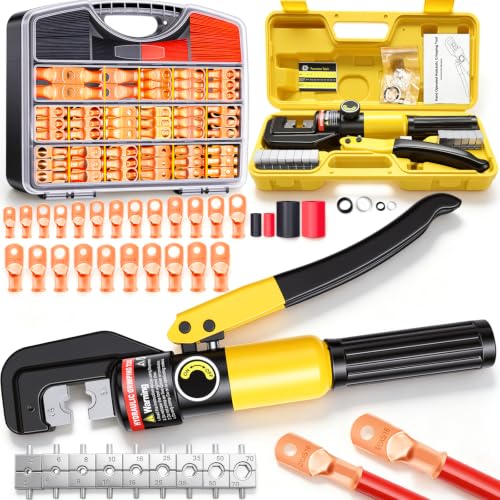
Twidec 230PCS Battery Cable Ends and 10-Ton Hydraulic Crimper

Twidec 230PCS Battery Cable Lug Crimping Tool Kit

Twidec 230PCS Battery Cable Ends with Heat Shrink

Twidec 1530PCS Heat Shrink Wire Connectors Kit
What Each Pick Brings To The Table
A single heavy cable repair calls for fewer pieces and more certainty, which is where AIRIC’s focused set stands apart from the broad Twidec assortments. Ten 1/0 AWG copper ring terminals target large battery cables, while the flared barrel helps the stripped conductor enter evenly during crimping or welding.
For a truck, marine deck run, or substantial home-project battery lead, the 3/8-inch M10 stud opening supplies a defined fit that can reduce guesswork. The included dual-wall heat-shrink tubes add insulation after the mechanical connection is made, so your workflow stays compact.
Practical Advantages
- The focused 1/0 AWG size supports heavy cable applications without a mixed terminal case.
- Ten lugs and ten shrink tubes support several repairs or matching cable ends.
- The 3:1 dual-wall tubing provides a substantial insulating layer around the crimp.
- Copper construction suits high-current battery and marine wiring work.
Small Caveats
- The single wire size and fixed 3/8-inch stud limit flexibility across mixed projects.
- Correct crimper sizing and surface preparation remain essential during installation.
Key Specs
Built For Heavy Cable Work
You benefit most from this set when replacing 1/0 AWG leads with 3/8-inch studs on heavy vehicles, marine systems, or stationary battery banks.
A Better Fit Elsewhere
Choose the Twidec 230PCS Battery Cable Ends with Heat Shrink instead when your workshop regularly handles several wire gauges.
For smaller electrical systems, haisstronica offers a more manageable alternative to AIRIC’s heavy 1/0 AWG set. These terminals accept 12 through 10 AWG wire and use a #10 ring opening, making them relevant to smaller automotive circuits, marine equipment, control panels, and trailer wiring.
The 100-piece quantity is useful for a busy garage, particularly for repairs involving multiple grounds or accessory circuits. Heat-shrink insulation seals the wire-to-terminal junction after crimping, though the narrower wire range keeps this package outside the territory covered by the larger Twidec crimping kits.
A Few Highlights
- One hundred terminals support repeated maintenance without tiny leftover pieces.
- Copper construction favors efficient current flow in low-voltage electrical circuits.
- The yellow finish makes 12-10 AWG applications easier to identify at a glance.
- Heat-shrink coverage helps protect the crimped area from dust and moisture exposure.
Trade Offs
- These terminals do not cover the heavier 4 AWG through 2/0 AWG range.
- Stud fit must be confirmed because the supplied size is limited to #10 rings.
Quick Facts
Made For Smaller Wiring Systems
You’ll appreciate this assortment for battery accessories, grounds, marine controls, and other compact 12-10 AWG circuits.
Consider Something Else
The AIRIC 1/0 AWG 3/8-Inch Copper Battery Cable Lug is the better fit for large starter or alternator cables.
Repeated cable fabrication calls for more than a drawer full of loose terminals, and this Twidec bundle pairs 230 copper connectors with a hydraulic crimper. A hydraulic crimper uses controlled mechanical pressure to deform a terminal around its conductor, which is useful when you want repeatable compression across several cable sizes.
The stated 10-ton force and 0.45-inch stroke give the tool a clear identity, while its 12 AWG through 2/0 AWG range spans common battery cable work. The closed-end terminals also support crimping and welding, although proper tool-die matching remains central to a sound connection.
Advantages To Know
- Combining the crimper and 230 terminals reduces separate-tool and connector shopping.
- The 12 AWG to 2/0 AWG range covers many automotive, marine, and equipment cables.
- Hydraulic compression offers consistent force during repetitive fabrication.
- Closed-end construction helps limit exposure at the cable entry.
Points To Note
- The 10-ton tool adds weight and storage needs compared with a simple hand crimper.
- Using the correct die and a sound crimp is essential; tool force alone does not confirm fit.
Feature Snapshot
Who Should Grab It
You gain the most from this kit as a technician or serious hobbyist who repeatedly fabricates battery cables in a workshop.
Reach For A Different Pick
The haisstronica 100PCS set is more practical for occasional 12-10 AWG repairs that do not justify a hydraulic tool.
Another Twidec bundle targets the same fabrication-heavy territory as pick 3, with 230 copper ring terminals paired to a 10-ton hydraulic crimper. The useful distinction is largely positional: this option fits workshops focused on service leads and replacement cables rather than someone assembling a broad inventory of unrelated connector styles.
A 0.45-inch stroke and a 12 AWG to 2/0 AWG crimping range give you useful coverage across common battery conductors. In a truck garage or equipment repair shop, keeping the tool and matching terminals together can streamline cable fabrication, though the kit remains bulkier than a terminal-only purchase.
Bright Spots
- The crimper and 230-piece terminal supply are packaged for immediate cable work.
- Pure copper terminals support high-current electrical paths.
- The broad crimping range accommodates starter, accessory, and equipment cables.
- Closed-end terminals accept crimping or welding approaches.
Some Limits To Know
- The hydraulic tool takes more space than a compact crimping solution.
- Repeated heavy-gauge work makes die alignment and maintenance more important.
- Terminal stud sizes must be checked separately from wire gauge.
Right Fit For
You’ll find this bundle most useful in a vehicle or equipment workshop that regularly replaces large battery cables.
Another Choice May Suit
The Twidec 1530PCS Heat Shrink Wire Connectors Kit offers broader styles for non-battery repair work.
Moving from loose terminals to a matched fabrication setup changes the ownership experience, and that is the purpose of this Twidec kit. It combines 230 copper battery cable ends with an HX-50B crimping tool, creating a more integrated package than the terminal-only AIRIC and haisstronica selections.
Its closed-end terminal design helps protect the cable entry, while the option to crimp or weld supports different workshop habits. You may find the included tool especially useful for home garage projects involving multiple cable sizes, provided the tool and terminal profiles are matched correctly during use.
Points In Its Favor
- Two hundred thirty terminals support multiple cables and future repairs.
- Copper construction provides a practical conductor-to-terminal material pairing.
- Closed-end barrels help shield the cable entry from exposure.
- The included HX-50B crimper reduces the need to source a separate tool.
Possible Compromises
- The source data does not detail the crimper’s force or verified gauge range.
- A large mixed assortment can remain partly unused in a narrowly specialized shop.
Whose Shelf It Belongs On
You’ll get the most use from this kit on a home garage bench where multiple terminal sizes and regular cable fabrication are expected.
Look Elsewhere
The Twidec 230PCS Battery Cable Ends and 10-Ton Hydraulic Crimper provides clearer published force data for heavy-gauge work.
After several Twidec kits centered on tools, this terminal-focused assortment is the cleaner choice for maintaining an existing cable inventory. Its published size run covers 8, 6, 4, 2, 1, 1/0, and 2/0 AWG, giving you one case for many common conductor diameters.
That gauge spread makes it useful for projects ranging from accessory cables to heavy battery leads. The included heat-shrink tubing adds a protective finish, while the copper closed-end terminals support crimping or welding and help shield the wire entry from exposure.
Notable Gains
- Seven listed wire sizes make the assortment practical for mixed electrical projects.
- Heat-shrink tubing helps complete the connection after terminal installation.
- The 230-piece count supports vehicle fleets, workshop stock, or multiple builds.
- Copper closed-end terminals accommodate crimping and welding methods.
Details To Watch
- Wire gauge does not confirm the required stud opening, so both dimensions need checking.
- Heat-shrink tubing must be installed before the connection is placed in a cramped routing path.
The Numbers That Matter
Best Suited To
You’ll benefit most from this assortment while maintaining several vehicles, marine circuits, or mixed-gauge battery leads.
Where A Sibling Pick Shines
The AIRIC copper lug is the simpler choice for a known 1/0 AWG and 3/8-inch repair.
Not every electrical repair revolves around a large battery post, so Twidec’s 1,530-piece kit broadens the category well beyond ring terminals. It includes cable lugs, insulated crimps, spade and fork connectors, T-taps, butt splices, and male and female connectors, all within one maintenance-oriented assortment.
The spade connectors use tin-plated copper, while the range of insulated and heat-shrunk styles suits vehicle wiring, control cabinets, and general low-voltage repairs. Compared with the 230-piece ring-terminal kits, the larger assortment is easier to justify for a technician who handles varied connector types rather than dedicated battery cables.
What Helps Most
- Multiple connector styles cover more repair situations than a ring-terminal assortment.
- The large quantity supports fleet, workshop, and hobby-project inventory.
- Tin-plated copper provides a conductive surface with added surface protection.
- Heat-shrink insulated connectors help organize and protect finished joints.
Things That May Matter
- The assortment does not concentrate on heavy battery-cable fabrication.
- A crimper is not included, so tool compatibility must be handled separately.
Essential Details
Built With In Mind
You gain the most from this kit as a vehicle technician, workshop maintainer, or serious DIYer handling mixed electrical repairs.
A Better Fit Elsewhere
The Twidec 230PCS Battery Cable Ends and 10-Ton Hydraulic Crimper suits dedicated large-gauge cable fabrication.
Matching Terminals to Your Wiring Work
Wire gauge, stud size, and construction method determine whether a terminal fits your project cleanly. AWG, or American Wire Gauge, becomes a smaller number as conductor diameter increases, so matching it to the existing cable matters. The stud opening must also match the battery post or connection point.
Heat-shrink insulation adds protection around the wire entry, while closed-end terminals help limit exposure after installation. Copper supports efficient electrical conduction, and the number of pieces should reflect repeated maintenance rather than raw quantity alone.
A crimper should match the terminal’s size and profile. Hydraulic tools suit repetitive heavy-gauge fabrication, while smaller hand tools can be sufficient for occasional lighter work. Use the tool and terminal as a matched system rather than assuming crimping pressure alone creates the correct connection.
Lessons That Prevent Rework
Common Shopping Slip Ups
Wire gauge and stud size are separate measurements, and one does not determine the other. Measure the conductor and connection post before ordering, and check whether your repair needs a bare lug, an insulated ring terminal, or another connector style.
What The Higher Tier Buys
A larger kit may add more sizes, connector styles, insulation, or a dedicated crimping tool. Those additions make sense for frequent vehicle or workshop work, while a focused terminal pack is usually easier to manage for a single known repair.
Frequently Asked Questions
What gauge battery cable lug should you use?
You should match the lug to the cable’s AWG size and the connection stud’s diameter. Both measurements must agree before installation.
Are heat-shrink ring terminals suitable for battery cables?
Yes, they suit suitable battery and electrical connections when the terminal, wire, and stud sizes match. Proper crimping and surface preparation remain necessary.
Do I need a hydraulic crimper for battery cable ends?
You need one for frequent heavy-gauge fabrication, though lighter work may use a suitable hand crimper. The tool and terminal must support the same wire range and profile.
Can closed-end battery cable ends be welded?
These copper closed-end terminals support crimping and welding according to the product details. Correct preparation and compatible equipment remain important for a sound joint.
How many battery cable ends should you keep?
Your stock should cover current repairs plus likely future projects. A mixed-gauge assortment is useful for varied maintenance, while a small focused set handles known cable sizes.
Final Verdict
The AIRIC set is the clearest choice for a known 1/0 AWG, 3/8-inch repair, while haisstronica favors smaller 12-10 AWG systems. Twidec dominates the larger selections, with hydraulic bundles for heavy fabrication, mixed-gauge terminal sets for broader stock, and a 1,530-piece assortment for varied electrical work. Match the gauge, stud, connector style, and installation method before choosing.
