


A dependable lug crimper turns a loose battery connection into a finished electrical repair. The right tool matters most when you’re rebuilding a cable, attaching a ring terminal, or connecting heavy-gauge wiring in a vehicle, workshop, marine system, or solar setup. Battery Cable Crimping Tools range from compact open-barrel presses to hydraulic models that reduce hand strain. Your priorities should include cable capacity, terminal compatibility, ease of use, and whether the tool can handle copper or aluminum connectors without unnecessary setup.
A Quick View Of The Lineup

Growlush Hammer Lug Crimper 8 AWG to 4/0

IWISS iCrimp Battery Cable Lug Crimper HX-50BI

IWISS Heavy-Duty Copper Lug Crimper 8 to 1 AWG

IWISS Battery Cable Lug Crimper Kit 8 AWG to 4/0

LFGUD 10 Ton Hydraulic Crimping Tool Kit

CHANHYD Hydraulic Crimper and Cable Cutter
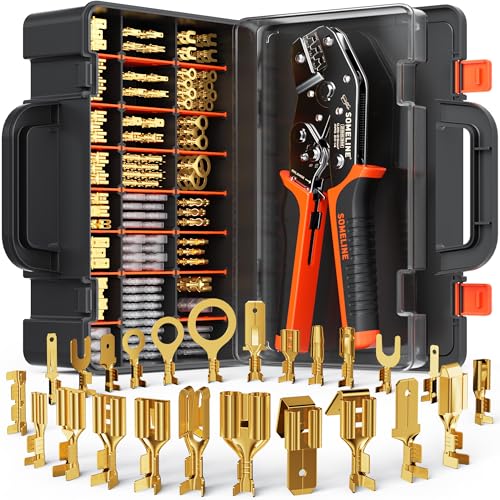
SOMELINE Spade Terminal Crimping Tool Kit 24-14 AWG
The Picks, Examined More Closely
Hammer crimping suits workshop setups where you already have a suitable mallet and need a straightforward way to form lugs from 8 AWG through 4/0 cable. You place the terminal in the V-groove and deliver controlled blows to the spring-loaded plunger, so this style suits repeatable vehicle and equipment repairs more than delicate electronics work.
The composite body keeps the tool lighter than a fully metal hammer crimper, while the broad range gives you room to move between smaller accessory leads and substantial battery cables. Depending on your terminal style, practice on spare pieces before committing to a critical connection.
Strengths Worth Knowing
- Covers 8 AWG through 4/0 AWG for broad battery-cable work.
- Works with copper or aluminum cable applications.
- The V-groove and spring-loaded plunger support repeatable placement.
- Composite construction reduces the weight carried during repeated strikes.
Things To Consider
- It depends on a separate hammer, so placement and striking force require care.
- Its size and impact-oriented design make it less convenient for small panel wiring.
Key Attributes
Made For
This tool fits vehicle, marine, and workshop technicians who regularly attach large copper or aluminum battery lugs.
A Better Fit Elsewhere
For smaller cable work without hammer strikes, the SOMELINE Spade Terminal Crimping Tool Kit is a more natural match.
Compared with the Growlush hammer crimper, this IWISS model puts the force in your hands and adds a wire shear cutter. That makes it a more practical bench tool for technicians who repeatedly terminate cable between 8 AWG and 1/0 AWG without setting up a separate hammer.
The rotating die arrangement is designed to make gauge selection more direct, while the cutter keeps cable preparation close at hand. It suits auto-electric work, control panels, and equipment wiring, though its upper capacity stops below the broad 4/0 range offered by the hammer-style option.
Useful Strengths
- Covers 8, 6, 4, 2, 1, and 1/0 AWG cable.
- Rotating dies help keep gauge selection visible during a repair.
- Integrated cutter reduces tool changes while preparing cable.
- The manual design avoids pump maintenance and hydraulic fluid handling.
Worth Noting
- Its capacity is narrower than the Growlush and IWISS kit options.
- Confirm the lug barrel and wire size match before ordering, since crimper ranges do not guarantee universal connector compatibility.
Who It Suits Best
It works well for vehicle repair technicians who want a manual, mid-range cable crimper with an integrated cutter.
Consider Something Else When
Choose the IWISS Battery Cable Lug Crimper Kit 8 AWG to 4/0 instead for projects using 2/0 through 4/0 cable or a radial wire stripper.
The steel-bodied IWISS crimper focuses on copper ring terminals from 8 AWG through 1 AWG, making it a solid bench option for stranded battery and welding cable. Its built-in cutter keeps the work focused, while the anti-slip handle adds control during repeated terminations.
Compared with the HX-50BI, this model emphasizes a simpler fixed gauge range and a heavier steel structure rather than rotating dies. You may find it more comfortable for a home garage where 1 AWG is the practical upper limit and cable cutting is part of the job.
The Case For It
- Handles common 8 AWG through 1 AWG copper terminals.
- SCM-40 hardened steel supports repeated workshop use.
- Rubber-coated grip improves control and reduces slipping.
- Built-in cutter handles cable preparation without another large tool.
Small Caveats
- It does not cover the 1/0 to 4/0 range.
- Its copper-terminal focus makes it less flexible for mixed connector work than the larger IWISS kit.
Right Fit For
This model suits garage projects involving copper lugs and stranded cable from 8 AWG to 1 AWG.
Another Choice May Suit
For broader gauge coverage, the IWISS Battery Cable Lug Crimper Kit 8 AWG to 4/0 is the better fit for larger cable runs.
This IWISS kit covers the full run from 8 AWG to 4/0 AWG, so it bridges the gaps between smaller manual crimpers and the more compact hydraulic models. A radial wire stripper is included, which helps prepare round conductors without accidentally nicking the strands.
That combination makes it useful for battery banks, starter cables, marine wiring, and welding-cable repairs. Compared with the IWISS Heavy-Duty Copper Lug Crimper 8 to 1 AWG, the kit accepts a much wider gauge range and adds copper or aluminum connector versatility, although the broader tooling may take more space at a crowded bench.
Real-World Strengths
- Covers 8 AWG through 4/0 AWG, including 1/0, 2/0, 3/0, and 4/0.
- Supports copper and aluminum lugs and splice connectors.
- Radial wire stripper helps remove insulation without stray strand damage.
- One kit covers several common battery and welding-cable gauges.
Practical Considerations
- The wide range and separate striper require more storage and setup than a compact open-barrel tool.
- Match the connector material and diameter to the terminal barrel before crimping.
Built With In Mind
It fits installers, marine technicians, and serious home garage users who regularly move between light and heavy cable sizes.
Where A Sibling Pick Shines
The LFGUD 10 Ton Hydraulic Crimping Tool Kit is a better fit for users who prefer powered squeezing over a manually operated long-reach press.
Hydraulic force is the key change here: the LFGUD kit uses a 10-ton pressing system rather than relying on a long mechanical lever. That design is useful for high-current cable work, where repeated manual squeezing can become tiring and a controlled ram helps keep the die aligned.
The nine-die set covers 12, 10, 8, 6, 4, 2, 1/0, and 2/0 AWG, plus a 1/8-inch stainless steel wire rope size. It suits installers and workshop users who want several connector sizes in one package, though the hydraulic mechanism requires more care around the fluid system and die seating.
What It Does Well
- Hydraulic operation reduces the leverage demand of manual crimpers.
- Nine dies cover a useful range from 12 AWG through 2/0 AWG.
- #45 steel construction gives the tool a substantial frame.
- Includes a die size for 1/8-inch stainless steel wire rope.
Trade Offs
- Hydraulic tools need more attention to clean, correctly aligned dies and stored fluid handling.
- Its listed capacity ends at 2/0 AWG, below the IWISS 4/0 AWG kit.
Who Will Love This
It is well suited to professional installers and fabricators who make many high-current terminations during a workday.
Look Elsewhere When
For a wider cable range and a radial striper, choose the IWISS Battery Cable Lug Crimper Kit 8 AWG to 4/0.
The CHANHYD package combines a hydraulic press, cable cutter, and nine dies in one focused setup. Its automatic return spring lets the handle reset after a crimp, which can reduce repositioning during repetitive work and keep the tool manageable with one hand.
Compared with the LFGUD hydraulic kit, the listed 10-ton range and 12 AWG-to-00, or 2/0, coverage are similar. The built-in cutter is the clearer distinction for field service, where carrying one compact assembly beats managing a separate cutting tool, though its cable range still does not extend to 4/0 AWG.
The Good Stuff
- Automatic handle return supports fast repeated cycles.
- Built-in cable cutter streamlines preparation.
- Nine dies cover common electrical cable sizes from 12 AWG to 2/0.
- Hydraulic operation lowers the force required at the handle.
Details To Watch
- Keep the die cavity clear of wire fragments so small terminals do not shift.
- The listed range is not suitable for 3/0 or 4/0 cable terminations.
- Its hydraulic mechanism requires more careful storage than a basic plier crimper.
Made For
It suits mobile technicians and installers who repeatedly crimp medium-gauge cable and need cutting close at hand.
Swap It Out When
Use the IWISS Battery Cable Lug Crimper Kit 8 AWG to 4/0 instead when your wiring extends beyond 2/0 AWG.
Not every connector job involves thick battery cable. For control wiring, small harnesses, and accessory circuits, the SOMELINE kit handles 24-14 AWG non-insulated open-barrel terminals, including male and female quick-disconnect styles.
Its adjustable ratchet and pressure-release mechanism help control the crimp while keeping the jaws responsive. Compared with the IWISS options, this is a different instrument rather than a smaller substitute: it focuses on fine-wire terminals and open barrels, making it useful for electronics, controls, and compact vehicle wiring.
Points In Its Favor
- Covers 24-14 AWG fine-wire terminals and splices.
- Handles non-insulated male and female quick-disconnect connectors.
- Includes connector sizes measured at 2.8, 3.9, 4.8, and 6.3 mm.
- The pressure-release function helps correct a crimp before the tool locks closed.
Honest Caveats
- It is not a replacement for a battery-cable crimper covering heavy gauge wire.
- Barrel width and insulation position must match the selected terminal for a clean connection.
Who Should Grab It
It fits technicians working on control panels, small harnesses, accessory wiring, and fine-wire quick disconnects.
Another Choice May Suit
For thick battery leads, the Growlush Hammer Lug Crimper 8 AWG to 4/0 is the better-suited tool.
What Matters Before You Choose a Cable Crimper
Cable gauge and terminal type
Start with the conductor size and the terminal barrel, not the tool’s broad headline range. AWG means American Wire Gauge, where larger physical wire generally corresponds to a lower gauge number. A lug must match both the cable diameter and the die cavity; a tool that fits the wire may still be wrong for the connector shape.
Force and operating style
A hand crimper is simple, portable, and easy to maintain for occasional work. Hammer crimpers trade precision for strong impact force, while hydraulic presses reduce hand effort and suit repeated jobs. The best choice depends on your cable size, number of terminations, and available workspace.
Cable preparation and finishing
Strip the conductor cleanly, remove only the needed insulation, and check that the strands remain intact. A built-in cutter or striper helps reduce tool changes, but keep blades free of metal fragments. After crimping, inspect the terminal for movement, uneven compression, or exposed conductor.
Battery Cable Crimper Buying Details
Common Shopping Slip Ups
A mismatch between gauge and die is the most common avoidable error. Do not treat a wide capacity claim as permission to use any terminal shape, and check whether the barrel is sized for copper or aluminum before crimping.
What The Higher Tier Buys
Hydraulic and wide-range manual tools can offer greater force, more gauges, and more integrated functions. The extra capability matters when you work with 2/0 or heavier cable, produce repeated terminations, or want less hand fatigue during long sessions.
Frequently Asked Questions
What size crimper do I need for battery cable?
Choose the range that includes your cable gauge and terminal barrel. Most automotive work falls within the listed AWG ranges of these tools, while heavy battery banks may require coverage up to 4/0 AWG.
Can I crimp copper and aluminum terminals with the same tool?
Only when the die and terminal are designed for that material and size. Copper and aluminum terminals often need different crimping specifications, so confirm compatibility before assembly.
Is a hydraulic crimper better for battery cables?
It can be useful for repeated heavy-gauge work because the powered force reduces manual squeezing. A quality manual crimper can still serve many garage projects and has fewer hydraulic components to maintain.
Do battery crimpers strip wire?
Some kits include a stripper or cutter, but the crimper itself does not guarantee clean stripping. Remove insulation carefully so the conductor strands remain intact for the terminal.
Which tool works for small control wiring?
A fine-wire open-barrel crimper, such as the SOMELINE Spade Terminal Crimping Tool Kit 24-14 AWG, fits quick-disconnect terminals better than a heavy battery-cable press.
Closing Thoughts
Choose by cable gauge, connector design, and the amount of force your workflow needs. The IWISS kits cover broad manual ranges, the hydraulic options reduce squeezing effort, and the SOMELINE kit serves smaller open-barrel work. Check compatibility carefully, maintain the dies, and practice on scrap cable before making a critical connection.
