


A MacBook Pro can go all day without a wall outlet, but demanding projects still drain its battery faster than many compact alternatives. You need enough stored energy, proper USB-C power delivery, and a charger you can carry without giving up your working space. These options range from laptop-focused units with large displays to smaller models made for phones, tablets, and short laptop sessions.
A Side-By-Side Look
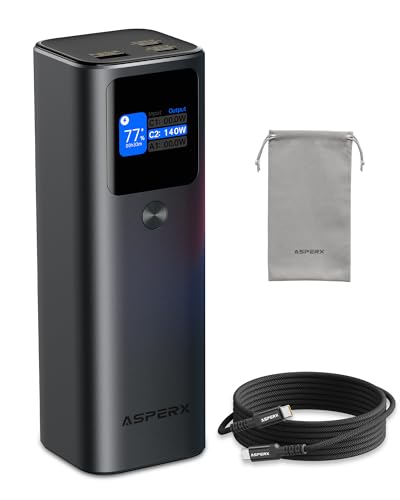
AsperX 27,600mAh 162.5W Laptop Power Bank

AsperX 20,000mAh 165W Laptop Power Bank

AsperX 27,600mAh 140W Built-C-Cable Power Bank

LJEHC 10,000mAh 22.5W Mini Power Bank

Anker 10,000mAh 30W USB-C Power Bank

AsperX 20,000mAh 165W Retractable-Cable Power Bank

Belkin 25K 158W Integrated-Cable Power Bank
What Each Pick Brings To The Table
For a MacBook Pro that spends long hours away from an outlet, this AsperX model has the scale to matter. Its 27,600mAh capacity and 162.5W output target demanding laptop use, while the aluminum unibody keeps the enclosure substantial and easy to handle. That extra bulk is a fair trade for people working through train rides, airport lounges, or a full day of presentations.
Compared with the 20,000mAh models later in the list, it carries a larger reserve and higher stated output. The trade-off is portability: this is less natural for a slim everyday pocket, though more sensible in a backpack or laptop sleeve.
Where It Helps
- 27,600mAh provides a larger energy reserve for extended laptop sessions.
- 162.5W output is suited to power-hungry MacBook Pro configurations.
- Aluminum construction gives the housing a premium, rigid feel.
- One power bank can cover a laptop plus smaller devices during a mobile workday.
Worth Noting
- Its larger capacity and output make it heavier to carry than the smaller options here.
- Laptop charging depends on compatible USB-C power delivery and the MacBook Pro configuration.
Core Details
Built With In Mind
You benefit most from this pick when your MacBook Pro runs demanding software and you regularly work away from a wall outlet.
A Better Fit Elsewhere
Anker’s 10,000mAh model is easier for phone-first trips, while AsperX’s 20,000mAh TFT Display unit offers a smaller high-output alternative.
The 165W output makes this a strong fit for frequent MacBook Pro travel, particularly when you move between meetings, flights, and client sites. The aluminum housing feels more like a compact desktop accessory than a small phone charger, which is sensible for anyone carrying a cable and several devices. The TFT display adds a practical way to check remaining charge and operating information, though the exact menu is less important than having visible status.
Unlike the 27,600mAh AsperX pick, this model trades some stored capacity for a more compact package and a higher stated maximum output. That balance feels useful for a traveling professional who values fast replenishing more than maximum reserve.
What Helps Most
- 165W output handles high-demand USB-C laptop charging.
- TFT display gives you a quick visual check of battery status.
- 20,000mAh capacity is substantial enough for travel and workdays.
- Aluminum unibody construction suits frequent transport.
Small Caveats
- The display and aluminum body add bulk compared with a plastic, phone-sized pack.
- Multiple-device output may reduce the power available to the laptop.
Feature Snapshot
Who It Suits Best
This is a strong match for mobile professionals who need laptop-class output and want charge status visible without opening an app.
Look Elsewhere When
Choose the Belkin 25K 158W model instead when USB-A, pass-through charging, and a broader multi-device setup matter more than the largest wattage.
Built-in cable management gives this 27,600mAh model a distinct practical edge on trips where every loose accessory matters. You can charge a phone or laptop without packing a separate USB-C lead, while the TFT display provides a visible status reference. The 140W output still sits in laptop territory, so it is more useful for MacBook Pro use than a typical compact phone pack.
The built-in cable removes one item from your bag, but it does not make the enclosure small. Compared with the 10,000mAh Anker and LJEHC choices, this is clearly the more substantial travel companion.
Well-Handled Touches
- Integrated USB-C cable reduces cable clutter.
- 27,600mAh capacity supports extended mobile work.
- 140W maximum output covers demanding laptop profiles.
- TFT display helps you monitor charge status.
Practical Considerations
- The integrated cable is fixed, so a damaged cord limits repair flexibility.
- Its larger body takes more room than the compact models in this list.
Made For
You benefit most from this model during travel days where carrying fewer separate cables is worth the extra weight.
Where Another Pick Suits Better
The LJEHC 10,000mAh 22.5W model is easier for quick phone top-ups, while the Belkin 25K unit adds pass-through charging.
This LJEHC model is built around portability rather than laptop-scale reserves. The 10,000mAh capacity and 22.5W USB-C output suit phones, small tablets, and short top-up sessions, while the compact body is easier to keep in a jacket pocket or small work bag. You shouldn’t treat it as a full-day MacBook Pro solution, but it can be useful for keeping essential mobile devices alive between larger charging stops.
That narrower purpose is a strength for commuters. Compared with Anker’s 10,000mAh 30W option, the key differences come down to output and the convenience of the built-in USB-C cable in the Anker model.
Advantages To Know
- 10,000mAh capacity offers a lightweight everyday reserve.
- 22.5W USB-C output supports fast charging for smaller devices.
- Compact construction reduces the space needed in a pocket or small bag.
- Two-way charging helps keep the bank itself ready for use.
Points To Note
- 22.5W output is below the laptop-focused models here.
- Capacity is limited for prolonged MacBook Pro work away from power.
At A Glance
You’ll like this pick for a commute, a weekend outing, or a desk where a small charger is more practical than a laptop bank.
Another Choice May Suit
The AsperX 27,600mAh 140W model fits people who need a real laptop reserve instead of a pocket-sized phone companion.
Anker’s 10,000mAh 30W model makes sense for travel because the built-in USB-C cable removes one loose item from your kit. Its 30W output is higher than the LJEHC mini charger’s stated 22.5W, giving phones and tablets more headroom, yet the capacity remains modest for MacBook Pro work. For short trips, the tradeoff is easy to understand: you carry a tidy everyday charger rather than a laptop-sized reserve.
The integrated cable is listed as 5.4 inches long, which should cover a typical device connection while avoiding a separate accessory. Owners may prefer a detachable cable for replacement flexibility, so consider how often the built-in lead is likely to receive sharp bends.
A Few Highlights
- 30W output provides stronger charging than the smaller LJEHC option.
- Built-in USB-C cable keeps a phone-first travel kit tidy.
- 10,000mAh capacity is easy to carry across a work bag.
Details To Watch
- It is not sized for extended high-power laptop charging.
- A fixed cable can be less flexible than carrying a spare USB-C lead.
Quick Facts
This model fits students and frequent travelers who mainly need reliable phone and tablet charging between outlets.
Consider Something Else When
The Belkin 25K 158W model is the more logical fit when your MacBook Pro needs substantial laptop power during the day.
A retractable cable gives this AsperX model a cleaner travel profile than carrying a full-length USB-C cord. At 20,000mAh and 165W, it stays firmly in laptop-capable territory, making it a sensible middle ground between the larger 27,600mAh AsperX options and the compact phone chargers. The aluminum body adds weight, but the retractable lead can save space inside a crowded laptop sleeve.
The cable mechanism is the central appeal. In a busy airport or shared workspace, not having to search through a pouch for a connector is a real convenience, although you should protect the retractable section from sharp pulls.
Everyday Advantages
- 165W output supports demanding laptop charging profiles.
- 20,000mAh capacity offers a practical travel reserve.
- Retractable cable reduces loose-cord clutter.
- Aluminum housing suits a durable travel-oriented design.
Where It May Fall Short
- The retractable cable mechanism adds another part that can wear with repeated pulling.
- It remains heavier than the 10,000mAh models.
The Right Fit
You benefit most from this pick for mobile offices where laptop output and compact cable storage both matter.
Swap It Out When
The Belkin 25K 158W model is a better alternative for people who want pass-through charging and USB-A alongside an integrated cable.
Belkin’s 25K design balances MacBook Pro power with a more flexible device setup. The 158W output is aimed at laptop use, while the integrated USB-C cable handles the most important connection without another accessory. Additional USB-C and USB-A ports expand the options for a phone, tablet, or second device, and pass-through charging lets the bank power a connected device while it recharges.
That versatility makes it appealing in a mixed-device household. Compared with the 20,000mAh AsperX retractable model, Belkin offers a broader port arrangement and a pass-through function, though neither unit is as small as the 10,000mAh travel choices.
Real Benefits
- 25K capacity provides a large reserve for mobile laptop work.
- 158W output targets higher-powered MacBook Pro configurations.
- Integrated USB-C cable reduces packing clutter.
- USB-C and USB-A ports support a broader device mix.
- Pass-through charging supports a connected device during replenishment.
Trade Offs To Consider
- Its larger capacity and multi-port design make it less pocket-friendly.
- Simultaneous charging can reduce the output available to your MacBook Pro.
Who Will Love This
This model fits people who carry a MacBook Pro, phone, and tablet and want one flexible power source.
Where A Sibling Pick Shines
The AsperX 27,600mAh 162.5W model is the stronger choice for people who prioritize the largest capacity and highest stated output.
What Matters Before You Choose
Choosing for a MacBook Pro starts with output. USB-C Power Delivery is the charging protocol used to negotiate compatible power levels between the charger and device, so a pack with enough capacity can still disappoint when its output does not match your laptop’s needs. Look beyond wattage and consider the charging profile, port arrangement, and the device configuration you regularly use.
Capacity describes stored energy, while wattage describes how quickly power can be delivered. A larger capacity helps with longer workdays, yet excess size becomes a problem in a small bag. For daily commuting, the Anker 10,000mAh 30W USB-C Power Bank is easier to carry. For a full day away from an outlet, a 20,000mAh or 27,600mAh laptop-focused model makes more sense.
USB-C charging and compatibility
MacBook Pro models use USB-C connections, but charging behavior depends on the laptop model, power requirements, and the charger’s supported output. A pack with USB-C ports is more useful than one designed only around legacy connectors, while a built-in cable can save packing space. Treat the stated wattage as a maximum capability rather than a guarantee that every device receives the same level of power.
Cable and port setup
An integrated cable is convenient for travel because it reduces loose accessories. Retractable cables add flexibility, while fixed cables may be easier to deploy. Extra USB-A ports can help with older accessories, although they add size and can complicate a compact travel kit. You’re better off matching the ports to the devices you actually carry.
Common Shopping Slip Ups
A common mistake is choosing capacity alone. A large reserve cannot compensate for weak output or a charger that lacks the right USB-C power profile. Another error is assuming every pack can sustain full laptop charging while simultaneously powering a phone or tablet.
Wrong Turns To Avoid
Check dimensions, cable storage, and replenishment time against your routine. Frequent travelers may favor the 10,000mAh Anker model, while laptop-focused users should prioritize the larger AsperX and Belkin options. Keep in mind that a power bank can be compact on paper yet awkward in a crowded laptop sleeve.
What Separates Premium From Basic
Higher-capacity laptop packs cost more because they include larger cells, higher-output electronics, and features such as displays, integrated cables, or pass-through charging. Those additions help a power bank handle more device types and reduce the need for extra accessories. For a MacBook Pro user working through long travel days, the extra capability can justify the added weight; for occasional phone top-ups, a basic compact model may be more practical.
Frequently Asked Questions
Can a 10,000mAh power bank charge a MacBook Pro?
It can provide a partial top-up in many situations, but the smaller capacity and lower output make it less suitable for sustained laptop work.
What wattage matters most for a MacBook Pro?
Higher wattage helps with faster charging, while compatibility with the laptop’s USB-C charging profile matters more than a headline number alone.
Are built-in cables useful?
They reduce cable clutter and are convenient for travel, though a fixed lead offers less replacement flexibility than a detachable cable.
Should I choose capacity or portability?
Choose capacity for extended work away from outlets, and choose portability for commuting or situations where carrying less equipment matters more.
Can one power bank charge several devices?
Some models support multiple ports, but connected devices share available power, so MacBook Pro charging may slow while other devices are connected.
Final Verdict
Your best fit depends on the workday. Compact 10,000mAh models suit phone-first travel, while the 20,000mAh and 27,600mAh AsperX units and the Belkin 25K provide more room for laptop work. Pay close attention to USB-C output, capacity, ports, and cable storage rather than choosing on capacity alone.
