

A network closet UPS, or uninterruptible power supply, keeps routers, switches, fiber equipment, and storage systems running long enough for a controlled shutdown. The right capacity depends on your equipment load, battery runtime, installation space, and whether your network gear needs pure sine wave output.
Rack-ready models suit managed closets, while compact units fit wall cabinets and small offices. Always compare supported wattage, outlet count, and mounting options with the gear already drawing power inside your cabinet.
Your Options, Compared

CyberPower PR1500RTXL2UN Smart App UPS 1500VA/1500W

CyberPower SL950U Standby UPS

GOLDENMATE 1500VA/1000W Lithium UPS

GOLDENMATE 1000VA/800W Lithium UPS

SKE SK850 850VA/480W UPS with LCD

GOLDENMATE 1000VA/600W Lithium UPS
APC 400VA Back-UPS BV400XU
The Strengths Of Each Pick
Managed closets place more value on capacity and remote control than compact home setups do, and this 1500VA/1500W model is built for that role. Its 2U rack or tower format gives you installation flexibility while the preinstalled RMCARD205 supports remote management.
Unlike the smaller CyberPower SL950U, this unit offers substantially more supported load and a cleaner path toward equipment monitoring. For a closet containing several switches, a NAS, and patch-panel equipment, the extra room appears worthwhile.
A Few Highlights
- The 1500W rating suits a network closet with multiple switches and storage devices.
- Eight outlets reduce the need for a separate surge-protection strip.
- Rack and tower configurations simplify retrofitting in differently sized cabinets.
- Sine wave output provides a stable supply for sensitive electronics.
- The installed management card supports remote oversight.
Practical Considerations
- Its 2U footprint occupies more shelf space than the compact models.
- Management features add setup work compared with a basic standby UPS.
- Battery maintenance and eventual replacement should remain on your service schedule.
Technical Highlights
Built With In Mind
This model fits administrators managing a full closet where uptime, remote visibility, and load headroom matter more than a minimal footprint.
Another Choice May Suit
The CyberPower SL950U suits a small home network that needs fewer outlets and a simpler installation.
A router, modem, and compact switch represent a much easier load than a server-filled rack, making this 950VA/510W standby design a practical small-network option. Standby operation means it switches to battery power after utility power fails, which works well for straightforward electronics.
The simulated sine wave output favors cost-conscious setups with standard routers and consumer hardware, although it is less comfortable for sensitive or power-demanding equipment than the CyberPower PR1500RTXL2UN. You may find the charging ports more useful for occasional mobile-device top-ups than for permanent network connections.
Features That Help
- Five backed outlets preserve runtime for essential network devices.
- Three additional surge-protected outlets expand placement flexibility.
- Widely spaced receptacles accommodate bulky power adapters.
- USB-A and USB-C ports reduce desk clutter around the cabinet.
Worth Noting
- The 510W limit is modest for NAS systems or several powered switches.
- Simulated sine wave output is less suitable for sensitive loads than pure sine wave models.
- Status lights show power and wiring condition but offer less detail than an LCD.
Quick Facts
The Right Fit
You’ll get the most value from this model in a home office or small cabinet serving a router, modem, and basic network accessories.
Look Elsewhere When
The GOLDENMATE 1500VA/1000W Lithium UPS better serves a closet with a heavier mixed load and longer replacement interval.
The largest lithium-backed capacity here targets closets carrying more than a single router. Its 1500VA/1000W rating gives you useful headroom for switches, a NAS, or several powered network accessories, while the white enclosure suits modern office installations.
Lithium iron phosphate, commonly abbreviated LiFePO4, uses a battery chemistry associated with long service life and high cycle endurance. That makes the GOLDENMATE appealing for unattended equipment, although its unspecified form factor and connections require closer fit checks than the clearly rack-focused CyberPower model.
Notable Gains
- The 1000W capacity supports a broader network load than most compact picks.
- LiFePO4 chemistry reduces dependence on frequent battery replacement.
- Battery equalization technology supports longer operating life.
- The capacity suits both home and small business cabinets.
- Surge protection adds a second line of defense around networking equipment.
Trade Offs
- Its larger rating may be unnecessary for a modem and one switch.
- Wall dimensions and mounting provisions are not supplied, so cabinet clearance deserves confirmation.
- Owners should still monitor battery condition and ventilation in a sealed closet.
Who It Suits Best
This model best serves small businesses and advanced home networks that value lithium battery longevity and have room for a higher-capacity unit.
A Better Fit Elsewhere
The APC BV400XU is the cleaner choice behind digital signs or point-of-sale equipment with a much lighter load.
Between the larger 1500VA GOLDENMATE and the lighter 600W version, this 1000VA/800W model offers the most balanced network capacity. It suits mixed loads that include a router, several switches, and lighter storage equipment without approaching the footprint demands of a rack-heavy installation.
The specified LiFePO4 battery is presented as lasting more than 10 years and supporting more than 5,000 charge cycles, useful expectations for equipment expected to remain in service for years. Actual runtime still varies with load, battery condition, and line quality.
Good Reasons To Consider
- The 800W rating provides practical headroom for a multi-device network.
- Long cycle endurance supports installations where battery access is inconvenient.
- Surge protection helps guard connected hardware from power disturbances.
- The midpoint capacity avoids underpowering a full cabinet.
Minor Gripes
- It provides less output than the GOLDENMATE 1500VA/1000W model.
- Rack-mount details and exact outlet configuration are not supplied.
- Long battery claims do not change the need to inspect a tightly enclosed installation.
Feature Facts
Made For Your Cabinet
This is a strong match for home labs and small offices whose combined network load remains below 800 watts.
Where a Sibling Pick Shines
The CyberPower PR1500RTXL2UN suits a full rack where remote management and confirmed 2U installation take priority.
The SKE SK850 works best where the network closet doubles as a home-office power point. Automatic voltage regulation, or AVR, adjusts minor line-voltage fluctuations before they reach connected equipment, while the LCD gives you a more useful view of operating status than basic indicator lights.
Six outlets are enough for a router, modem, and a few essential devices, though the 480W rating is the harder limit. Compared with the GOLDENMATE 1000VA/800W Lithium UPS, it fits lighter installations and prioritizes immediate status information over lithium battery longevity.
The Good Stuff
- The LCD helps you check load and battery conditions at a glance.
- AVR helps stabilize minor input-voltage variations.
- Six outlets cover the core devices in a modest home office.
- The 480W rating suits a router, modem, and selected computer equipment.
Points To Note
- Power-hungry NAS and server equipment can exceed its supported load.
- Its lower wattage leaves less margin than the CyberPower SL950U.
- A rack or wall installation should be checked against the enclosure’s clearances.
- Periodic battery checks remain important in warm network cabinets.
Who Should Choose It
Home-office users with modest network loads and a preference for readable operating data will find this model easy to monitor.
Reach For A Different Pick When
Shoppers managing several switches and a NAS should give the GOLDENMATE 1000VA/800W Lithium UPS more capacity headroom.
A smaller cabinet doesn’t always mean a tiny power need, but many access networks run comfortably under 600 watts. This GOLDENMATE model fits that middle ground, offering more supported load than a compact access-point UPS while remaining below the heavier GOLDENMATE models in this list.
The LiFePO4 battery is specified for more than 10 years of service and over 5,000 cycles, which matters in installations where battery access is awkward. Multi-outlet support and cooling features help it function as a compact network cabinet option, though exact dimensions and outlet count still deserve confirmation.
Standout Benefits
- The 600W rating covers a practical midweight network load.
- Lithium chemistry supports long-term, repeated charge cycles.
- Multiple outlets suit a small bundle of essential devices.
- Cooling design helps manage heat in enclosed cabinets.
Some Limits To Know
- Storage-heavy systems can consume enough power to approach its capacity quickly.
- The listing does not specify the number or placement of outlets.
- Exact dimensions should be measured before installation.
Small-Space Match
This choice suits branch offices, studios, and home cabinets using several low-to-moderate powered network devices.
Swap It Out For
The CyberPower SL950U offers clearer outlet allocation and useful charging ports for a very small network.
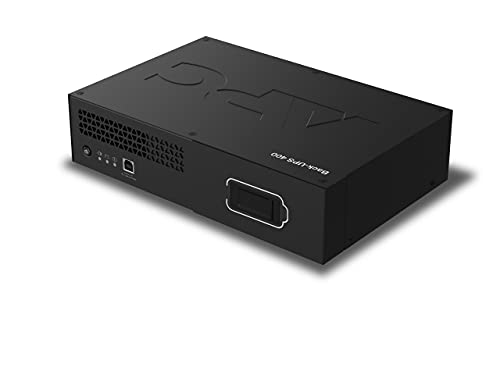
The APC BV400XU is built around a smaller job: keeping digital signs, point-of-sale terminals, and edge devices alive through brief power interruptions. Its 400VA/220W output is modest, so restraint matters when choosing what connects.
Flexible mounting sets it apart from the larger network UPS systems. VESA, DIN rail, and wall mounting allow placement behind a display, inside a kiosk, or within a cabinet, making this a practical fit where floor or shelf space is limited.
Everyday Wins
- Compact mounting suits signs, kiosks, and point-of-sale stations.
- The slim design preserves cabinet space around compact hardware.
- Battery backup supports orderly shutdowns for edge equipment.
- Surge protection adds defense around connected systems.
- Multiple mounting options simplify retrofits behind displays.
Less-Strong Areas
- The 220W rating cannot support a full network closet load.
- Several switches or a NAS may exceed its supported capacity.
- Regular battery inspection remains necessary in warm display cabinets.
Quick Technical Notes
Whose Shelf It Belongs On
Retail operators and signage technicians will value this compact unit behind displays, terminals, and other low-power edge systems.
Not Your Match For
The CyberPower PR1500RTXL2UN is the stronger fit for a rack filled with switches, storage, and conventional IT equipment.
What Fits Your Network Closet Properly
Start With the Connected Load
VA, or volt-amperes, describes apparent electrical capacity, while watts estimate real device demand. Add up the power supplies inside your closet, including routers, switches, fiber converters, and any NAS unit, then leave room above that total for expansion and startup peaks.
Match Runtime to the Actual Outage
A UPS is mainly useful when its battery can support the intended shutdown window. Light network loads receive longer runtime, while storage systems and servers consume capacity quickly. Measure each device during normal operation rather than relying only on the label printed on its power adapter.
Confirm the Form Factor
Rack form, wall placement, and DIN rail mounting solve different space constraints. Confirm cabinet depth, shelf clearance, outlet placement, and cord direction before ordering, since a capable unit can still be awkward in a shallow closet.
Two Details That Prevent Closet Regret
Hidden Buying Traps
The most common mistake is comparing VA numbers while ignoring actual wattage. Another is assuming every outlet provides battery power; some models reserve surge protection for accessories that need no runtime. Check cord reach and ventilation before the unit goes into a closed cabinet.
What The Higher Tier Adds
Higher-capacity models provide more runtime headroom, stronger output, rack mounting, or remote management. Those additions suit busy offices and full racks, while a compact access network may gain little from features it cannot use. Choose for the connected load and outage response you need, not simply for a larger specification sheet.
Frequently Asked Questions
How Long Should A Network Closet UPS Last?
Runtime depends on battery capacity, outage conditions, and connected equipment. A router and modem generally run longer than a cabinet containing a NAS or multiple high-power switches.
Do I Need Sine Wave Output?
Pure or simulated sine wave output can suit different equipment. Sensitive or power-demanding systems favor stable sine wave output, while basic routers may operate adequately on a standby model.
Can A UPS Fit A Standard Network Rack?
A 2U rack model fits a standard equipment rack, while compact units may require a shelf, wall space, or DIN rail. Always verify dimensions and mounting accessories before installation.
Which Capacity Handles A Small NAS?
The NAS alone can account for much of your available wattage. Choose a UPS rated comfortably above the combined load of the NAS, router, switches, and any other powered equipment.
How Often Should You Maintain The Battery?
Inspect the condition indicators and schedule periodic runtime checks according to the manufacturer’s guidance. Warm storage, frequent outages, and heavy discharge conditions can shorten battery service life.
Final Verdict
The CyberPower PR1500RTXL2UN fits full racks and managed installations, while the CyberPower SL950U serves lighter home networks. GOLDENMATE models prioritize lithium battery longevity across several capacities, and the APC BV400XU targets compact signage and point-of-use systems. Match the load first, then confirm mounting, runtime, and outlet needs.
