


A dependable battery backup keeps your phone, laptop, camera, or small appliances running when outlets disappear. The right fit depends on how much power you need, how portable the unit must be, and whether you value USB-C charging, AC outlets, or longer outage coverage. This roundup covers power banks for mobile work and compact travel stations for camping, plus higher-capacity units for home backup and demanding electronics.
The Main Contenders
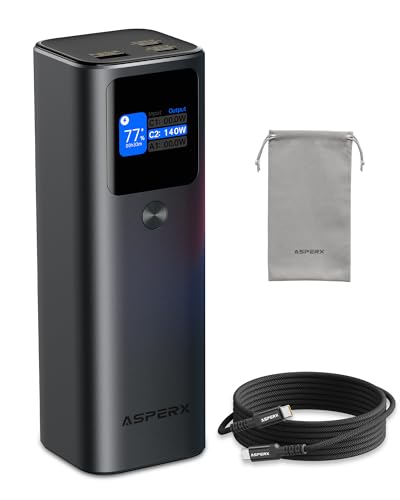
AsperX Laptop Power Bank 27,600mAh 162.5W

Jackery Explorer 300 292Wh Power Station

AsperX Laptop Power Bank 165W 20,000mAh Gray

AsperX 140W 27,600mAh Built-in Cable Power Bank

OUPES Mega 1 Lite 1024Wh 2000W Power Station
Anker SOLIX C300 288Wh Power Station

AsperX 165W 20,000mAh Retractable Cable Power Bank
Taking A Closer Look At The Options
Built for a long flight or a workday away from an outlet, this AsperX combines 27,600mAh of capacity with 162.5W output and an aluminum unibody shell. The high output makes it useful for charging a laptop rather than simply topping up a phone, while the relatively large cell supports several smaller-device charges over a day.
You’ll appreciate the balance for travel, although the higher output can make it less convenient than a small phone bank in a slim everyday pocket. The aluminum body should resist ordinary scuffs better than a plastic shell, but the unit is still a substantial piece of gear rather than a lightweight accessory.
What It Does Well
- 27,600mAh capacity supports extended device use away from outlets.
- 162.5W output is suited to higher-demand USB-C laptops.
- Aluminum unibody construction gives the housing a refined, durable feel.
- Useful for travel, workdays, and emergency device charging.
Things To Consider
- The larger battery and laptop output make it heavier than compact phone banks.
- Cable compatibility and charging speed depend on the device and its power profile.
Feature Snapshot
Made For
It suits travelers, students, and remote workers who need reliable laptop charging away from an outlet.
Consider Something Else When
Jackery Explorer 300 is a better fit for camping users who need AC outlets and a portable power station format.
Unlike the laptop-focused AsperX, the Jackery Explorer 300 is built around a small power-station format for camping, travel, and outages. Its 292Wh lithium iron phosphate, or LiFePO4, battery, AC outlets, and USB charging options make it a broader platform for phones, cameras, small electronics, and lighter household equipment.
For a weekend at a campsite or a power interruption affecting several low-draw devices, that mix is more useful than one high-wattage USB port. Its 7.5-pound weight is manageable for a car or day hike, but you may find the need to manage cables and placement less convenient than a small power bank.
The Case For It
- 292Wh capacity gives you more flexibility than a phone-sized bank.
- AC outlets expand the range of compatible camping gear.
- LiFePO4 chemistry suits frequent cycling and repeated outdoor use.
- Integrated handle keeps transport straightforward.
Trade Offs
- It is larger and heavier than a regular power bank.
- AC output has limits, so high-draw appliances are poor matches.
Key Specs
Who Will Love This
It fits campers, travelers, and households that want AC capability without moving to a full-size generator.
Where Another Pick Shines
OUPES Mega 1 Lite offers substantially more capacity and output for longer outages and higher-draw equipment.
Among the AsperX options, this 20,000mAh model prioritizes charging speed over maximum capacity. Its 165W total output and two USB-C connections, rated at 100W and 65W, can support demanding laptops or a two-device work setup in a compact aluminum body.
The TFT display gives you a visible readout for remaining power and charging information, which is useful when you’re managing a workday rather than a quick phone top-up. Compared with the 27,600mAh model, you sacrifice some reserve capacity for a lighter, more performance-focused design.
Strengths Worth Knowing
- 165W total output supports high-demand USB-C laptops.
- Dual USB-C ports allow two devices to charge at once.
- The display helps you monitor battery status at a glance.
- 20,000mAh capacity is more manageable for daily carry.
Minor Gripes
- Its 20,000mAh capacity is lower than the larger AsperX alternatives.
- Multiple high-output devices can still drain the battery quickly.
The Right Fit
It suits professionals carrying one or two USB-C laptops who value fast charging and clear status information.
A Better Fit Elsewhere
AsperX 140W 27,600mAh Built-in Cable Power Bank is a better fit for trips where longer runtime matters more than maximum laptop output.
The built-in cable makes this 27,600mAh AsperX more practical for travel, where a loose USB-C cord can disappear at the bottom of a bag. Its 140W maximum output, TFT display, and USB-A connection cover phones, tablets, and laptops without requiring a separate cable for the main charging setup.
Compared with the 165W Gray model, this version provides more stored power but lower peak output. That is a sensible trade for a traveler charging a laptop intermittently, while someone restoring a workstation from low battery may prefer the higher-wattage option.
The Value In It
- 27,600mAh capacity supports repeated phone and tablet charging.
- Built-in cable reduces packing clutter.
- 140W output is useful for many USB-C laptops.
- USB-A adds flexibility for older accessories.
Points To Note
- The fixed cable cannot be replaced with a different connector type.
- 140W output is lower than the 162.5W and 165W AsperX models.
At A Glance
Built With In Mind
It is made for travelers who want laptop-capable charging without carrying a separate cable for every trip.
Another Choice May Suit
AsperX Laptop Power Bank 165W 20,000mAh Gray suits people whose devices need more peak power and whose routines can tolerate less reserve capacity.
For a home outage, the OUPES Mega 1 Lite sits closer to a small stationary system than a travel power bank. Its 1,024Wh capacity and 2,000W rated output can serve a broader range of devices, with 4,500W listed as surge capacity, while the 1,400W AC input supports faster replenishment.
That scale makes it useful for keeping laptops, routers, lighting, and selected household equipment running longer than a compact station can. You’ll need to plan around its size and manage heat and ventilation, and high-draw appliances still need careful load checks.
Where It Excels
- 1,024Wh capacity provides a much longer reserve than small stations.
- 2,000W output supports more demanding household devices.
- 1,400W AC input helps reduce recharging downtime.
- Useful for outages, workshops, and emergency household planning.
Practical Considerations
- Its larger battery and power capacity make it less convenient for backpacking.
- AC loads must stay within the station’s rated output.
- Keep ventilation clear during extended high-output use.
Technical Sheet
Whose Shelf It Belongs On
It fits households, hobbyists, and small workshops that need more outage capacity than a camping station provides.
Reach For A Different Pick When
Jackery Explorer 300 is the more manageable option for a weekend camp where portability matters more than runtime.
The Anker SOLIX C300 shares the Explorer 300’s roughly 300Wh class but emphasizes a broad port selection. Its 288Wh capacity, three AC outlets, 120W car socket, two 140W USB-C ports, a 15W USB-C port, and a 12W USB-A port cover phones, laptops, cameras, and camping equipment without requiring a separate adapter for each category.
That makes it a flexible middle ground for a weekend trip, although the extra connection options can make the setup less tidy. Compared with OUPES Mega 1 Lite, it is clearly the easier travel unit, but it offers much less capacity and lower continuous output.
Real Benefits
- Three AC outlets support multiple compatible devices.
- Two high-output USB-C ports suit laptops and modern phones.
- Car socket adds a useful option for road-trip equipment.
- 288Wh capacity works well for portable electronics and moderate loads.
Where It May Fall Short
- Many ports can make the control panel crowded during travel.
- The station is less suitable than OUPES Mega 1 Lite for sustained high-draw loads.
Feature Rundown
The Right Fit
It suits campers, van travelers, and families who want several connection types in one manageable station.
Swap It Out When
AsperX 165W 20,000mAh Gray is a better fit for a carry-on setup centered on USB-C laptop charging rather than AC-powered equipment.
The retractable cable is the defining detail here, keeping the charging lead attached to the power bank and reducing the chance of leaving it behind. Its 165W output and 20,000mAh capacity target a practical middle ground for commuters, students, and mobile professionals.
Compared with the 27,600mAh built-in-cable model, you trade some reserve capacity for a more compact everyday design. The cable mechanism may also require a little more care than a fixed connector, so avoid pulling it sideways and store it neatly in a bag.
Standout Benefits
- Retractable USB-C cable reduces packing clutter.
- 165W output handles demanding USB-C devices.
- 20,000mAh capacity supports a useful balance of weight and runtime.
- Aluminum unibody gives the unit a sturdy, streamlined profile.
Small Caveats
- Capacity is lower than the 27,600mAh AsperX models.
- Retractable cables can be more vulnerable to bending or snagging.
Who Should Grab It
It suits commuters and students who want laptop-capable charging without carrying a separate cable.
Look Elsewhere When
AsperX Laptop Power Bank 27,600mAh 162.5W is the better fit for longer trips where maximum stored capacity takes priority.
Choosing Backup Power By Capacity And Output
Capacity determines how much stored energy you have, while output determines how quickly a device can accept it. A 20,000mAh power bank suits phones, tablets, and occasional laptop charging; a 27,600mAh model gives you more runtime for travel. Power stations add AC outlets, but their larger size makes them less convenient for a backpack.
USB Power Delivery, or USB PD, is a charging standard that negotiates a suitable power level with compatible devices. A 140W to 165W USB-C bank is more useful for demanding laptops than a lower-output model, but your device must support the relevant charging profile. The advertised wattage also does not guarantee the same result on every laptop.
Port selection shapes daily convenience. Two USB-C ports can support multiple modern devices, while AC outlets matter for camping equipment, small appliances, and outage use. A car socket is valuable on road trips, though a station with many ports can feel cluttered. Choose the connection mix your routine actually uses rather than paying attention to every port.
Weight, cable storage, and display controls deserve attention too. A retractable or built-in cable reduces loose accessories, while a TFT display makes remaining power and charging status easier to monitor. For larger stations, leave room around the unit during operation and confirm that your planned equipment stays within the rated output.
Common Mistakes And Upgrade Trade-Offs
Mistakes Worth Dodging
A high wattage rating does not make every device charge quickly, so check the device’s charging requirements first. Also avoid selecting a power bank solely by capacity when you need AC outlets, and account for the extra size of a stationary station before ordering.
What The Higher Tier Buys
Higher-capacity and higher-output models add stored energy, faster laptop charging, AC support, or more connection options. Those upgrades are worthwhile for multi-day travel or outages, while a compact power bank is often the more sensible choice for daily commuting and phone charging.
