


A laptop backup only solves the right problem when its capacity, power delivery, and portability match your routine. Portable power banks keep a notebook running during flights, commutes, conferences, and outages, while stationary UPS units protect desktop setups at home or in an office. These seven options cover everything from compact travel packs to higher-capacity systems for computers, networks, and entertainment equipment.
The Choices Worth Comparing
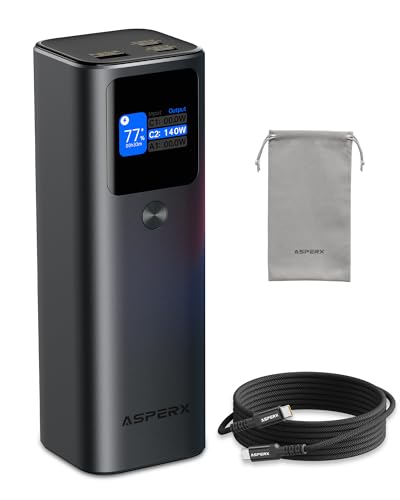
AsperX 27,600mAh 162.5W Laptop Power Bank

APC 850VA/450W UPS Battery Backup

AsperX 165W 20,000mAh TFT Power Bank Gray

AsperX 140W 27,600mAh TFT Power Bank

CyberPower BRG1500AVRLCD2 UPS

AsperX 165W 20,000mAh Retractable Power Bank

APC Back-UPS BE650G1 650VA/390W UPS
The Picks, Examined More Closely
High-power notebooks leave little room for a weak portable charger. The AsperX combines 27,600mAh of capacity with 162.5W output, giving demanding mobile workstations a more substantial reserve than smaller travel packs. That balance makes sense during a long flight or a full day away from an outlet.
The aluminum unibody shell adds a more refined feel, though PD3.1 describes charging protocol compatibility rather than universal output. You’ll still need a compatible USB-C cable and a laptop that accepts the offered power level.
The Good Stuff
- The 162.5W output targets power-hungry laptops better than a typical phone-focused battery pack.
- Its 27,600mAh capacity offers a larger reserve for extended travel and multi-device days.
- The aluminum housing should better tolerate the knocks associated with daily commuting than a plastic-only design, provided it stays away from moisture.
- PD3.1 support makes it relevant for modern USB-C laptops, tablets, and other high-draw devices.
- One high-capacity pack can reduce the number of separate phone and notebook chargers you carry.
Practical Considerations
- Its high capacity means the pack itself may feel substantial compared with the 20,000mAh AsperX models.
- Output varies with the device, cable, and charging protocol, so older hardware may not receive the full rating.
- Owners commonly need to preserve unused capacity by keeping the unit away from excessive heat during travel.
Quick Facts
Who Will Love This
You’ll benefit most from this model as a mobile professional or creator whose laptop requires substantial charging power away from an outlet.
A Better Fit Elsewhere
APC Back-UPS BE650G1 650VA/390W UPS offers a better fit for a stationary desktop that needs automatic outage protection rather than portable charging.
Unlike the AsperX travel pack, the APC Back-UPS BE850G2 stays beside your desktop and keeps essential equipment supplied during short outages. A UPS, or uninterruptible power supply, provides battery power after utility electricity stops, while its 850VA/450W rating supports a modest collection of electronics.
Seven NEMA outlets split into five battery-backed connections and two surge-only connections, giving you room to protect a PC, router, or NAS. The 450W ceiling may feel modest beside CyberPower’s larger system, but it suits smaller offices that focus on continuity rather than extended runtime.
What Helps Most
- Seven outlets reduce the need for an oversized power strip in a compact office.
- The 450W battery rating provides useful headroom for a desktop, network gear, and peripherals.
- Surge-only outlets leave room for nonessential accessories that still benefit from electrical protection.
- Its stationary format works neatly under a desk or beside a network cabinet.
Some Limits To Know
- Runtime depends on how much power your connected equipment draws.
- You’ll need your own compatible power cords and the correct NEMA connections.
- Owners commonly dust the vents and keep the unit unobstructed, particularly in confined office spaces.
- A high-power workstation or large monitor array may exceed the practical capacity.
Built With In Mind
This APC model makes sense for a home office or small workspace that needs to shut down and save work safely during brief outages.
Where A Sibling Pick Shines
CyberPower BRG1500AVRLCD2 UPS provides a stronger fit for heavier desktop equipment, longer backup periods, and users who want an LCD status panel.
The TFT screen gives this 20,000mAh pack a clearer operational role than a small phone-oriented bank. You can monitor charging information without cycling through a phone app, which is particularly useful during airport security or a demanding travel day.
Its 165W total output comes through two USB-C connections capable of supplying 100W and 65W simultaneously. For dual-laptop trips, that arrangement may handle two compatible machines, though actual allocation depends on the devices and their charging requirements.
Reasons It Performs
- The 165W total output supports high-demand laptops rather than only phones and tablets.
- Two USB-C ports can serve two compatible laptops during a long travel day.
- The TFT display keeps power and charging information directly in view.
- At 20,000mAh, it offers a more manageable size than the 27,600mAh AsperX options.
Possible Compromises
- Its 20,000mAh reserve is smaller than the 27,600mAh alternatives in this roundup.
- Two-device charging is most useful when both devices accept the available USB-C power levels.
- The gray aluminum exterior may show scratches over time, so a protective pouch helps during rough commuting.
Feature Snapshot
Made For
This model suits a traveler carrying two compatible laptops or a mobile professional who wants charging information without opening an app.
Another Choice May Suit
AsperX 140W 27,600mAh TFT Power Bank is the stronger option for trips where a larger battery reserve matters more than peak charging speed.
Capacity and cable convenience shape the AsperX 140W 27,600mAh TFT Power Bank. The built-in USB-C cable removes one loose accessory from your bag, while the display keeps charging information visible during transit. That combination works well for a long work trip with several devices.
Unlike the 165W gray model, this one prioritizes its larger 27,600mAh battery and integrated cable over peak output. The two USB-C ports can handle up to 100W each, while the USB-A connection supports up to 22.5W, adding flexibility for older mobile accessories.
Everyday Wins
- The built-in USB-C cable prevents the common problem of arriving with a dead laptop and a missing charger.
- Its 27,600mAh capacity is well suited to tablets, phones, and laptops during long travel days.
- Two 100W-capable USB-C ports provide useful flexibility for power-hungry devices.
- The 22.5W USB-A port accommodates older accessories without requiring another adapter.
Where It May Fall Short
- Its 140W ceiling is lower than the 162.5W and 165W alternatives.
- The built-in cable helps with USB-C connections but does not eliminate every adapter need.
- Owners commonly retract the cable carefully rather than pulling it at an angle, which helps protect the connection over time.
The Right Fit
You’ll appreciate this model most on long flights, field assignments, or workdays spent away from reliable outlets.
Reach For A Different Pick When
AsperX 27,600mAh 162.5W Laptop Power Bank fits better when maximum output for one demanding laptop takes priority over the integrated cable.
The CyberPower steps beyond APC’s compact 850VA model with a larger stationary system and a front LCD. Automatic Voltage Regulation, or AVR, corrects small voltage changes without immediately moving the connected equipment to battery power, potentially conserving reserve during ordinary grid fluctuations.
Its simulated sine-wave output suits computers, workstations, network equipment, and home entertainment systems. The size may feel excessive beside the BE650G1, yet that extra room is valuable for a desktop, monitor, network storage, and several peripherals sharing one protection system.
The Upside
- The LCD gives you visible information about operating conditions and remaining battery use.
- AVR can reduce unnecessary battery transfers during minor voltage changes.
- The larger enclosure is better suited to a workstation and its connected accessories.
- Line-interactive operation provides a practical middle ground for home and office equipment.
Trade-Offs To Consider
- Its footprint exceeds that of APC’s smaller models, so placement needs more thought.
- Simulated sine-wave output may not suit every sensitive or specialized device.
- You’ll need to check each device’s power requirements before adding monitors, storage, and entertainment equipment.
- Owners commonly schedule battery checks and keep ventilation open around the mini-tower enclosure.
Technical Highlights
Best Suited To
You’ll find this CyberPower most useful for a desktop-centered home office that needs greater capacity and clearer local monitoring.
Consider Something Else When
APC 850VA/450W UPS Battery Backup is the better fit for a compact workspace that protects only a few lower-draw essentials.
The defining detail here is the retractable USB-C cable, which can be extended for a phone or laptop and returned inside the aluminum body. That reduces cable clutter during a daily commute or flight, although the attached lead isn’t a substitute for every second cable in your bag.
At 20,000mAh and 165W, the unit lands between the smaller gray display model and the higher-capacity AsperX packs. It may suit you especially well when peak output and packing convenience matter more than carrying a large reserve for several full notebook charges.
Key Advantages
- The retractable cable stays protected inside the enclosure when it isn’t in use.
- Its 165W output targets modern high-draw USB-C laptops.
- The 20,000mAh capacity offers a more compact option for everyday travel.
- The aluminum construction gives the unit a rigid, polished feel.
Details To Watch
- A built-in USB-C lead does not cover devices that require another connector or a full-length cable.
- Its capacity is lower than the 27,600mAh AsperX models.
- Owners commonly extend and retract the cable gently because side loading can wear the small connector.
- Actual laptop charging speed depends on device support and cable capabilities.
Who Should Grab It
This model serves commuters and weekend travelers who want a high-output laptop charger with fewer loose cords.
Swap It Out When
AsperX 140W 27,600mAh TFT Power Bank is a better fit for multi-day travel where battery reserve outweighs peak wattage.
The BE650G1 is the straightforward choice for a modest desk where space and essential-device coverage come first. Its 650VA/390W capacity is smaller than the APC 850VA unit, yet the eight-outlet arrangement can still support a focused setup without crowding the workspace.
Four outlets provide both battery backup and surge protection, while four others offer surge-only protection. You can keep a laptop or small desktop powered alongside network equipment, but a large monitor array, gaming desktop, and NAS together may exceed the unit’s practical limits.
Real-World Strengths
- Eight outlets provide useful flexibility for a compact home office.
- The 390W rating suits lower-draw computers, routers, and essential accessories.
- Its small footprint makes placement easier than with the CyberPower BRG1500AVRLCD2.
- Separate battery-backed and surge-only outlets clarify how connected devices operate.
Small Caveats
- Runtime may be short during an outage with several higher-draw devices connected.
- The 390W limit makes the product unsuitable for a power-heavy workstation without careful load planning.
- You’ll need to check connector types and keep spare device power cords nearby.
- Owners commonly keep the housing clear of stored items so its ventilation remains open.
Right Fit For
The BE650G1 suits a small apartment office or study area where a computer and network equipment need backup during short outages.
A Better Fit Elsewhere
APC 850VA/450W UPS Battery Backup fits a larger setup needing more supported power and more battery-backed outlet connections.
Choosing Between Portable Power and Stationary Backup
Start with where your laptop receives power away from home. Portable power banks suit air travel, commutes, fieldwork, and conference rooms, while UPS systems belong beside a stationary computer. Choosing the wrong format leaves you carrying more weight than needed or installing stationary protection that never fits your routine.
Match Output to the Device
Wattage describes how quickly power can be delivered, while ampere-hours describe stored energy. A demanding notebook benefits from a USB-C power bank with a high output rating, but its battery, charger protocol, and cable must support that level. Check the laptop’s charging requirements before treating a headline number as a promise.
Capacity Changes the Real Experience
A higher-capacity pack can support longer workdays, but it also takes up more space and weighs more. 20,000mAh suits many single-day travel needs, while 27,600mAh offers more reserve for several devices. A UPS works differently because its runtime depends on the connected load, available battery condition, and the electronics it powers.
Connectivity Should Shape Your Choice
Built-in and retractable cables reduce packing friction, while multiple ports support phones, tablets, and laptops together. For a stationary UPS, count the outlets you need and distinguish battery-backed connections from surge-only protection. Compatibility matters more than an impressive headline specification, especially with older devices.
Consider the Full Ownership Routine
Consider charging time, permitted airline capacity, heat exposure, and storage as carefully as peak output. A desktop UPS also needs accessible outlets, ventilation, and periodic battery checks. Choose the setup you can maintain, not simply the one with the largest number on its label.
Making the Right Battery Choice
Common Shopping Slip Ups
A large capacity doesn’t guarantee full-speed laptop charging, so confirm connector type and charging protocol. Avoid choosing a portable bank for a stationary desktop or a UPS expecting it to travel. For a UPS, calculate the combined power draw of your equipment and leave sensible room below its maximum rating.
What The Higher Tier Buys
Higher-output power banks add faster charging for compatible notebooks, while larger capacity extends mobile runtime. Stationary UPS upgrades add supported wattage, outlet control, voltage correction, and more detailed status information. Those gains matter when your device mix demands them; a phone-only routine usually doesn’t need the same hardware.
Frequently Asked Questions
Can a laptop power bank charge every laptop?
No. Compatibility depends on the laptop’s connector, voltage, power requirements, and charging protocol. A USB-C notebook may work, while a proprietary charger or older high-voltage system may require different hardware.
Is a 20,000mAh power bank enough for a laptop?
It can suit many single-day travel needs, though actual runtime depends on battery size, screen brightness, workload, and power efficiency. Check your notebook’s wattage and consider capacity only one part of the calculation.
What does a UPS do for a laptop?
A stationary UPS supplies battery power during outages and voltage interruptions. It can also provide surge protection, making it more suitable for a fixed laptop or desktop setup than a portable travel bank.
Is 162.5W better than 140W?
A higher rating may charge a compatible high-power laptop faster, but the device, cable, and protocol set the actual result. Capacity, portability, and multi-device support may make either rating more appropriate for your routine.
Should I choose a portable power bank or UPS?
Choose a portable power bank for travel, commuting, and outdoor work. Choose a UPS for a stationary computer, router, or NAS that needs protection during household or office power interruptions.
Final Verdict
The AsperX options lead for portable charging, with differences in capacity, peak output, displays, and integrated cables. APC and CyberPower cover stationary protection, ranging from compact setups to larger home offices. Match the system to your device load and routine, then verify connector and charging compatibility before making the final choice.
