


Solar garden lights need dependable cells that can handle partial sun, seasonal temperature changes, and months between uses. The rechargeable AA options below range from compact 1.5V lithium cells for electronics to Ni-MH and Ni-Cd batteries made specifically for solar fixtures. You’ll find the right fit by matching cell chemistry, size, capacity, and charging method to your devices.
The Essentials At A Glance
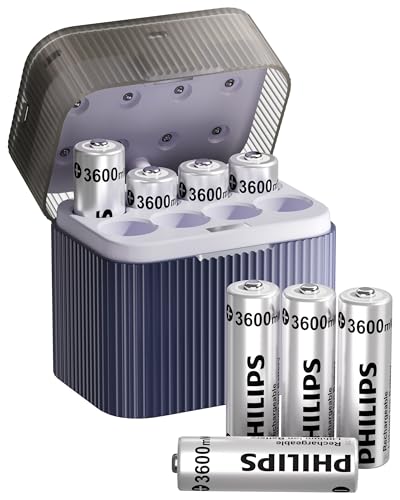
PHILIPS Rechargeable AA Lithium Batteries 8 Pack, 1.5V 3600mWh
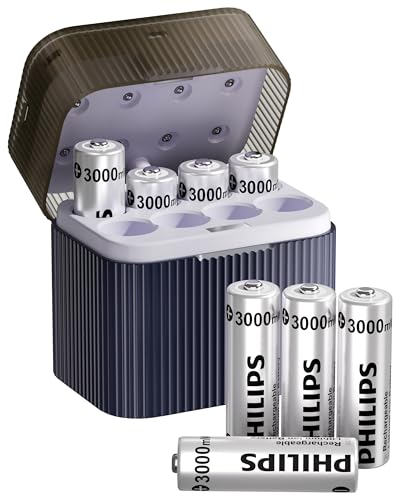
PHILIPS Rechargeable 3000mWh AA Lithium Batteries 8 Pack

GENYESTAR 1500mAh Ni-MH AA Solar Light Batteries, 8 Pack
Betmaxful 200mAh Solar Ni-Cd AA Batteries

FlyGift 800mAh Ni-MH Solar AA Batteries, 12 Pack

PHILIPS Rechargeable AAA Lithium Batteries 8 Pack, 1.5V 1300mWh

PHILIPS Rechargeable AA Lithium Batteries 4 Pack, 1.5V 3600mWh
Meet The Standout Selections
Eight 1.5V lithium cells give demanding AA electronics a high starting voltage and 3600mWh of stated energy. That profile suits game controllers, camera accessories, and remotes that dislike the early voltage decline associated with ordinary rechargeable cells. Compared with the GENYESTAR Ni-MH pack later in this roundup, these are built more for sustained output than solar-fixture charging.
You’ll get the most benefit in a busy household maintaining several high-drain devices. The chemistry may not suit every solar light, because constant-voltage batteries charge differently from 1.2V Ni-MH or Ni-Cd cells. Check your fixture before making the swap.
Strengths Worth Knowing
- Steady 1.5V output supports electronics that expect a fresh alkaline cell’s starting voltage.
- The stated 3600mWh capacity favors controllers, cameras, and other demanding equipment.
- Eight cells reduce replacement interruptions across a busy household.
- Rechargeable lithium chemistry avoids routine alkaline-cell purchases.
Practical Considerations
- Confirm that your charger accepts rechargeable lithium cells.
- Solar-light compatibility depends on the fixture’s charging design and chemistry requirements.
Feature Snapshot
Built With In Mind
You’ll benefit most from these cells in a home with multiple AA controllers, cameras, or remotes that regularly run down disposable batteries.
A Better Fit Elsewhere
GENYESTAR 1500mAh Ni-MH AA Solar Light Batteries, 8 Pack serves outdoor fixtures better because its 1.2V Ni-MH format directly targets solar lights.
The charging case turns battery upkeep into a simpler desk routine. Its eight-slot, USB-C approach keeps eight 1.2V-class lithium AA cells organized while you rotate them through controllers, cameras, and household electronics. Compared with PHILIPS Rechargeable AA Lithium Batteries 8 Pack, 1.5V 3600mWh, the case is the clearer reason to choose this set.
For most mixed-electronics households, you’ll appreciate having charging and storage in one enclosure. You may find the 3000mWh rating less compelling for solar fixtures, since many garden lights are engineered around low-voltage Ni-MH cells. The case, rather than raw capacity, drives this recommendation.
The Helpful Details
- USB-C charging reduces cable friction during regular top-ups.
- The integrated case stores all eight cells in one place.
- Constant 1.5V output suits AA devices that prefer fresh-cell voltage.
- A full eight-cell set supports staggered device rotation.
Small Caveats
- The charging case takes desk or shelf space.
- Compatibility with solar lights depends on their required cell chemistry.
- Some legacy AA chargers may not support lithium chemistry.
Quick Facts
Made For
You’ll get the smoothest routine with these cells if your household already uses AA controllers, cameras, and remotes beside one charging station.
Consider Something Else
FlyGift 800mAh Ni-MH Solar AA Batteries, 12 Pack fits larger outdoor-light collections better and supplies enough cells for several fixtures.
Eight 1.2V Ni-MH cells make this a natural fit for solar lanterns, string lights, and garden fixtures that accept standard rechargeable AA batteries. Ni-MH chemistry is widely used in solar lighting because it can accept repeated charging cycles, while the stated 1500mAh rating offers more capacity than the smaller Ni-Cd and FlyGift sets here.
For shaded paths or fixtures that receive only partial sunlight, the higher capacity may translate into longer runtime. Actual illumination also depends on panel placement, weather, and the light’s LED draw. Clean the panel and replace corroded contacts before blaming the battery.
A Few Highlights
- The 1500mAh Ni-MH format supports higher-capacity solar fixtures.
- Low self-discharge helps cells retain charge between sunny periods.
- Eight cells cover several pathway lights or one larger installation.
- The stated temperature range supports seasonal outdoor use.
Worth Noting
- Not every solar light accepts 1.2V Ni-MH cells.
- Overcast stretches reduce charging, so runtime may vary by season.
- A separate compatible charger may be required.
Right Fit For
You’ll find these cells most useful in a garden with several AA solar lanterns or string lights that use rechargeable 1.2V batteries.
Swap It Out When
Betmaxful 200mAh Solar Ni-Cd AA Batteries suit older fixtures with modest energy demands and compatible Ni-Cd charging.
The 200mAh Ni-Cd format targets older solar landscape lighting rather than power-hungry electronics. A twelve-cell quantity gives you broad coverage across inexpensive path markers and low-drain fixtures. Compared with GENYESTAR 1500mAh Ni-MH AA Solar Light Batteries, 8 Pack, these cells prioritize charging-system compatibility over capacity.
You’ll find the chemistry helpful when replacing cells in older fixtures that specifically call for Ni-Cd batteries. The lower energy rating may prove limiting in brighter lamps, and mixed chemistries can charge poorly in fixtures not designed for them. Owners commonly see best results after clearing corrosion and confirming polarity.
The Value In It
- Twelve cells support a sizable group of low-drain landscape lights.
- The solar-focused Ni-Cd format suits compatible legacy fixtures.
- Precharged cells reduce the need for an initial charger session.
- The AA dimensions support straightforward replacement.
Trade-Offs
- The 200mAh rating is modest beside 800mAh and 1500mAh alternatives.
- Mixed Ni-Cd and Ni-MH replacement can affect charging behavior.
- Ni-Cd disposal requires responsible recycling.
Technical Highlights
Who Should Grab It
You’ll appreciate this set while replacing low-drain AA cells in older solar lights that explicitly support Ni-Cd chemistry.
Another Choice May Suit
FlyGift 800mAh Ni-MH Solar AA Batteries, 12 Pack offers a better fit for compatible, higher-draw garden fixtures.
Twelve precharged 1.2V Ni-MH cells give you a practical replacement set for garden lights, landscape markers, and outdoor string fixtures. The stated 800mAh capacity sits neatly between Betmaxful’s 200mAh Ni-Cd set and GENYESTAR’s 1500mAh Ni-MH pack, offering a middle ground for compatible fixtures.
For most backyard installations, the twelve-cell quantity is the decisive feature because mixed replacement dates are common. Low self-discharge also helps cells hold charge during storage, although long cloudy stretches still matter. Keep these batteries paired by chemistry rather than combining them with older Ni-Cd cells.
Strong Points
- Twelve cells cover multiple fixtures or staggered replacements.
- The 800mAh rating supports small-to-moderate solar lighting loads.
- Low self-discharge suits lights that remain idle for months.
- Precharged cells can be installed without waiting for an initial charge.
Possible Compromises
- Capacity trails the GENYESTAR 1500mAh Ni-MH option.
- Solar panels still need unobstructed exposure for dependable charging.
- Use a compatible Ni-MH charger for off-grid top-ups.
Core Details
Whose Shelf It Belongs On
You’ll find this pack useful in a busy garden with numerous compatible AA solar fixtures and limited appetite for frequent battery changes.
Reach For A Different Pick
GENYESTAR 1500mAh Ni-MH AA Solar Light Batteries, 8 Pack better serves shaded fixtures that need greater stored energy per cell.
Eight AAA lithium cells bring 1.5V output and a stated 1300mWh capacity to devices too compact for AA batteries. The eight-slot Type-C charging station keeps charging and storage together, making this more relevant to controllers, remotes, and small household electronics than to solar lights that use AA cells.
You’ll benefit most in a mixed-device setup already using AAA power. The smaller format reaches tight remotes and compact controllers without changing the charging routine, but the lower energy figure reflects the physical limits of AAA cells. Verify the device’s battery marking before ordering.
Good Reasons To Consider
- Constant 1.5V output suits compact electronics expecting fresh-cell voltage.
- The eight-slot Type-C station streamlines charging.
- Eight AAA cells cover several remotes or controller packs.
- Stored energy supports regular high-drain device use.
Less-Strong Areas
- AAA size excludes most AA solar-light fixtures.
- Lithium chemistry may not suit older Ni-MH chargers.
- The station occupies additional shelf space.
Made For
You’ll find these batteries most useful with AAA game controllers, remote controls, and similarly sized household electronics.
Another Choice May Suit
PHILIPS Rechargeable AA Lithium Batteries 8 Pack, 1.5V 3600mWh fits AA-powered controllers and provides more energy per cell.
Four cells trim the package size of PHILIPS’s eight-battery lithium set without sacrificing the stated 3600mWh capacity or constant 1.5V output. That makes this a neat fit for one game controller, a camera, or a small group of AA remotes. The integrated smart charging box adds convenient storage without the footprint of a full eight-slot set.
For occasional high-drain use, four cells are enough. You’ll find the eight-cell version more practical for maintaining several devices, so this is primarily a focused household option. As with the other constant-voltage lithium picks, confirm that the charger and device accept rechargeable lithium cells.
Noteworthy Benefits
- The stated 3600mWh energy supports demanding AA devices.
- Constant 1.5V output matches common battery expectations.
- Four cells keep storage and replacement compact.
- The combined charging box reduces loose-cell clutter.
A Few Limitations
- Four cells provide less rotation across multiple devices.
- Most solar garden lights use AA Ni-MH or Ni-Cd batteries instead.
Feature Facts
Built With In Mind
You’ll benefit most with one AA-powered controller or camera and a preference for keeping a rechargeable four-cell set compact.
Where A Sibling Pick Shines
PHILIPS Rechargeable AAA Lithium Batteries 8 Pack, 1.5V 1300mWh better serves households with several AAA remotes or controllers.
Choosing Cells That Match Your Lights
Start with the required chemistry
Solar fixtures usually specify either 1.2V Ni-MH or Ni-Cd chemistry. Constant-voltage 1.5V lithium cells serve many electronics but may not charge correctly in a fixture built for Ni-MH. Read the battery compartment and manual before replacing cells.
Capacity reflects more stored energy
Capacity indicates how much charge a cell stores under its specified conditions. Higher capacity can improve runtime in shaded fixtures, yet panel size, LED demand, wiring, and sunlight often matter just as much. Match like capacities within a fixture for more predictable charging behavior.
Match size to the compartment
AA is the main size here, while PHILIPS Rechargeable AAA Lithium Batteries 8 Pack, 1.5V 1300mWh fits only AAA devices. Measure the compartment and check polarity markings before ordering. A battery can meet the voltage requirement and still be physically unusable.
Think beyond the battery
A dirty panel limits charging more than a small difference in cell capacity. Clean the glass, keep contacts free of corrosion, and place lights where they receive direct sun. For weekly replacements, the integrated cases offer convenience; for large outdoor installations, a larger loose-cell pack may be easier to organize.
Practical Battery Selection Checks
Mistakes Worth Dodging
Don’t treat 1.5V lithium cells as automatic replacements for 1.2V solar cells. Charging chemistry, polarity, and physical size must all align. Mixing Ni-Cd, Ni-MH, and lithium cells in one fixture can produce uneven charging, so replace them as a matching set.
What Separates Premium From Basic
The extra spend usually buys higher stated energy, constant-voltage output, or an integrated charging case. Those features suit high-drain controllers and compact households, while outdoor path lights often care more about compatible chemistry and pack quantity. Choose the feature your fixtures actually need.
Frequently Asked Questions
Can 1.5V lithium batteries replace solar-light batteries?
Usually not. Most solar fixtures are designed for rechargeable 1.2V Ni-MH or Ni-Cd cells. Lithium chemistry has different charging requirements, so follow the fixture’s specified battery type.
Are higher-capacity solar batteries always better?
Not always. Higher capacity stores more charge, but panel exposure and LED demand still govern runtime. It helps most in shaded fixtures or climates with shorter charging seasons.
Can Ni-MH and Ni-Cd batteries be mixed?
Avoid mixing them within one fixture. Different voltage curves and charging behavior can leave some cells undercharged or overcharged. Use one matching chemistry across the set.
Do AAA batteries work in solar garden lights?
Only fixtures designed for AAA cells can use them. Most garden lights take AA batteries, and physical fit matters as much as the stated voltage.
How should rechargeable solar batteries be stored?
Keep them clean, dry, and away from prolonged heat. Remove them from fixtures during extended storage, and use the same chemistry and charging method recommended by the light manufacturer.
Final Verdict
For solar lights, chemistry and fixture compatibility come first, making the GENYESTAR, FlyGift, and Betmaxful Ni-MH or Ni-Cd sets the most relevant choices. The PHILIPS lithium packs serve a different role: high-drain AA and AAA electronics with constant 1.5V output. Match the battery to the equipment, keep contacts clean, and let sunlight do the charging work.
