

A charger earns its place by handling mixed battery sizes, controlling each channel independently, and showing charging progress clearly. That matters in a busy household where toy batteries, remote controls, cameras, and small electronics accumulate different AA and AAA cells over time. This roundup covers compact two-slot charging, high-capacity stations, and kits that include batteries, helping you choose a practical setup for your desk, utility room, or travel kit.
The Leading Options At A Glance

Bonai 16+2 Bay AA AAA 9V NiMH Battery Charger

POWEROWL Pro 20 Bay AA AAA NiMH Charger

Ostation 2 Pro Charging Station with 24 Batteries

Ansmann Comfort Mini Automatic Battery Charger

Ostation 1.5V AA Lithium Batteries 2100mAh 8 Pack

Ostation 2 Charging Station with 24 Batteries
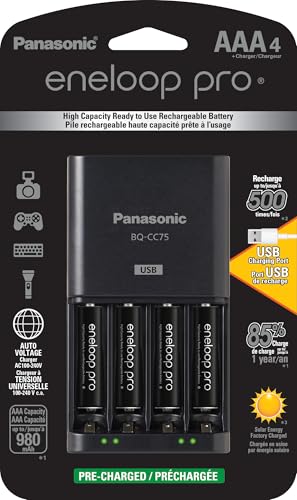
Panasonic K-KJ75K3A4BA Charger with 4 AAA eneloop pro Batteries
Inside Each Recommended Option
The Bonai 16+2 Bay gives a household room to recharge AA, AAA, and 9V rechargeable cells in one place. Individual controls remove the need for empty neighboring slots, a useful advantage when your collection contains only a few batteries at a time.
A wall adapter keeps the station usable without another cable, while the LCD display provides a central place to monitor progress. Compared with the compact Ansmann Comfort Mini, this model suits families maintaining a larger and more varied battery inventory.
Positive Points
- Sixteen AA or AAA positions accommodate a substantial mixed collection.
- Two dedicated 9V positions add uncommon format support.
- Independent channels let you charge occupied slots without pairing cells.
- The LCD display simplifies routine charging checks.
Things To Consider
- It supports 1.2V NiMH AA and AAA cells, not 1.5V lithium or 3.7V lithium batteries.
- No discharge function is available, and batteries are not included.
- The larger footprint may suit a utility shelf better than a small apartment desk.
Quick Facts
Who It Suits Best
This station fits households that regularly cycle many NiMH AA, AAA, and 9V batteries across several devices.
Another Choice May Suit
The POWEROWL Pro 20 Bay suits households wanting only AA and AAA positions with more detailed live charging information.
Twenty independently controlled bays make the POWEROWL Pro 20 Bay a natural fit for a busy charging shelf. You can place cells in any available AA or AAA position rather than filling matched pairs, which prevents one occupied slot from wasting the other.
The display is the main distinction from the Bonai 16+2 Bay. Voltage, current, elapsed time, and channel status appear individually, giving you clearer information during long charging sessions, although the extra detail matters mainly to people managing frequent battery turnover.
Everyday Wins
- Twenty bays support substantial AA and AAA collections.
- Independent controls provide flexible slot placement.
- Per-channel voltage and current readouts reveal charging conditions.
- Time and status information reduces the need to guess when charging is complete.
Practical Considerations
- The large display and broad base require a stable shelf with room for all 20 cells.
- It is limited to AA and AAA NiMH batteries.
- Detailed readouts may be more than a small two-cell charger needs.
Feature Snapshot
Made For
This charger suits active households that cycle many rechargeable cells and value detailed charging information.
A Better Fit Elsewhere
The Bonai 16+2 Bay fits homes that also need dedicated charging positions for rechargeable 9V batteries.
The Ostation 2 Pro combines charging, battery testing, and organized storage for as many as 24 cells. That hands-free arrangement works well near a television, office, or entryway cabinet, where loose batteries often spread across drawers and become difficult to track.
Smart sorting, temperature-adaptive charging, and real-time monitoring make this more than a basic row of slots. The included 24 batteries also make a fresh setup easier, though you still need compatible AA and AAA rechargeable cells to realize the station’s full potential.
The Practical Payoff
- Twenty-four positions consolidate a large battery collection.
- Charging, testing, and organization share one station.
- Smart sorting reduces guesswork during routine battery changes.
- Twenty-four rechargeable batteries are included.
Honest Caveats
- The battery count makes this a bulk setup with a larger storage footprint.
- Smart sorting and temperature adaptation are useful for frequent users but add complexity beyond a basic two-slot charger.
- Owners should keep the station on a stable shelf because the full battery load is substantial.
The Right Fit
This station fits homes and offices that want one central place to charge, inspect, and store numerous rechargeable batteries.
Look Elsewhere When
The Ansmann Comfort Mini suits travelers carrying only one or two cells who value repair mode and a compact footprint.
The Ansmann Comfort Mini keeps the basic charging equation small: two AA or AAA cells, automatic operation, and no requirement to fill both slots. That makes it practical for a carry-on, weekend bag, or a home that recharges batteries two at a time rather than running large batches.
Repair mode is the notable extra. It applies reduced current to deeply discharged cells, while reverse-polarity protection, a safety timer, and defective-cell detection provide practical safeguards. Compared with the Ostation stations, it prioritizes careful handling of a small number of batteries rather than household-scale storage.
Why It Works Well
- Two independent slots accept AA and AAA NiMH or NiCd cells.
- Automatic per-slot monitoring accommodates mixed sizes and charge levels.
- Repair mode gives deeply discharged rechargeable cells a controlled start.
- Trickle charging supports cells kept in the station.
Small Caveats
- Two slots make it unsuitable for high-volume battery collections.
- It cannot serve as a central organizer for 9V cells.
- Repair mode may take longer than a normal charge, so it works best for occasional cell recovery.
Key Product Details
Best Suited To
This charger suits travelers, apartment residents, and occasional users who need careful charging for only two batteries.
Reach For A Different Pick When
The POWEROWL Pro 20 Bay suits high-volume households that need more slots and individual charging readouts.
These eight Ostation cells serve a narrower purpose than a conventional NiMH charger: they provide 1.5V AA power for compatible devices. Each battery has a smart-management chip that monitors current and temperature, so the charging format must support this lithium chemistry.
The 2100mAh rating and eight-cell pack suit a household replacing several loose batteries at once. The trade-off is chemistry compatibility: Bonai 16+2 Bay explicitly excludes 1.5V lithium AA cells, while the compatible Ostation charging station supports the correct setup.
What Earns Its Place
- Eight AA cells provide a convenient starting inventory.
- Each 2100mAh cell targets devices that accept 1.5V lithium AA batteries.
- Embedded chips manage charging current and temperature.
- Compatibility extends across chargers designed for 1.5V lithium cells.
A Few Limitations
- These batteries are not interchangeable with 1.2V NiMH AA cells.
- A compatible 1.5V lithium charger is still needed.
- Storage arrangements should keep all eight cells together so chemistry labels do not get separated from the batteries.
Core Details
Built With In Mind
This battery pack suits households with several compatible 1.5V AA devices that are ready to move beyond NiMH cells.
Where Another Pick Shines
The Ostation 2 Charging Station with 24 Batteries serves users who need both a charger and a broader rechargeable battery collection.
The Ostation 2 turns battery charging into a centralized household routine. Up to 24 cells can charge, test, and remain organized in one station, reducing the loose drawer pile that forms around remote controls, flashlights, toys, and cameras.
Unlike the Bonai 16+2 Bay, this station supports AA and AAA NiMH cells plus compatible Ostation 1.5V lithium rechargeable batteries. Thermal-adaptive charging and real-time monitoring matter for frequent users, while the included 24 batteries make it a broad starting setup.
Notable Gains
- Twenty-four positions support extensive mixed-format charging.
- Smart sorting combines charging, testing, and storage.
- Real-time monitoring keeps charging status visible.
- Compatibility spans major AA and AAA rechargeable formats.
- Twenty-four rechargeable batteries are included.
Things That May Matter
- The full station needs a sturdy shelf and more room than a two-cell model.
- Battery chemistry must match the supported charging format.
- The 24-cell package may be more than a small household needs.
Essential Details
Whose Shelf It Belongs On
This station fits shared homes, offices, and hobby rooms where many rechargeable AA and AAA cells need one organized charging point.
Swap It Out When
The Ansmann Comfort Mini fits compact spaces where two cells, repair mode, and minimal shelf space matter more than bulk charging.
The Panasonic K-KJ75K3A4BA package centers on four ready-to-use AAA eneloop pro batteries rather than a high-capacity charger station. That focus works well for a travel pouch, camera bag, or compact household needing dependable NiMH power without stocking dozens of cells.
Each AAA cell has a typical capacity of 980mAh and a minimum rating of 930mAh, giving you a clear capacity class for devices that draw from AA or AAA batteries. The recharge-cycle specification reaches 500 cycles, though long-term performance still depends on usage, temperature, and charging habits.
What Pays Off
- Four AAA NiMH cells cover several common device requirements.
- The 980mAh typical capacity supports power-hungry electronics.
- Cells arrive ready for use, simplifying initial setup.
- The four-cell format remains manageable for travel.
Worth Noting
- The bundle centers on AAA batteries and does not cover a large AA and AAA collection.
- Capacity and cycle figures do not guarantee identical runtime in every device.
- Travelers should store the four cells together to prevent mixed battery sizes from being mixed in a device compartment.
Who Should Grab It
<p This set suits travelers and camera users who need four compact AAA NiMH cells with a documented capacity class.Consider Something Else When
The POWEROWL Pro 20 Bay suits a household station that prioritizes many independent AA and AAA charging positions.
Choosing the Right Charging Setup
Start with battery chemistry
NiMH describes a rechargeable battery chemistry used in common AA and AAA formats. Most chargers in this roundup focus on 1.2V NiMH cells, so check the markings on your existing batteries before connecting anything. A charger designed for NiMH is generally not the correct choice for 1.5V lithium AA cells.
Count the batteries you actually cycle
A two-slot model offers the simplest approach for occasional charging. Larger households, studios, or offices benefit from 16 to 24 bays because mixed sizes can share a single station without repeatedly shuffling cells into paired positions.
Decide how much feedback you need
Basic automatic charging suits many people, while per-channel voltage, current, time, and status displays provide a more detailed view. Repair mode adds value for deeply discharged rechargeable cells, but those features matter most in a smaller setup rather than a high-volume station.
Consider storage and charging together
Charging stations with testing and organization features can reduce clutter around shared electronics. They also occupy more shelf space, so balanced charging and compact storage are worth comparing before settling on a larger station.
Practical Charging Decisions
Mistakes Worth Dodging
The most consequential mistake is ignoring battery chemistry because the AA or AAA shape looks identical. Voltage and charging requirements differ, and a NiMH charger may not suit a 1.5V lithium cell. Check every battery’s label and avoid mixing formats beyond what the charger explicitly supports.
What The Upgrade Payoff Buys
Larger stations add capacity, detailed monitoring, repair functions, and built-in organization. Those extras suit frequent charging, while a compact charger remains more sensible for travel or a home that regularly uses only a few cells.
Frequently Asked Questions
Can one charger handle both AA and AAA NiMH batteries?
Yes, several picks support both sizes through size-specific slots or automatic detection. Confirm that the charger controls mixed cells independently, especially for charging only one or two batteries at a time.
Are 1.5V lithium AA batteries the same as NiMH batteries?
No. The 1.5V lithium format uses different charging requirements from 1.2V NiMH cells. Use a charger explicitly compatible with the lithium chemistry listed on the battery or product documentation.
Is a 20-bay charger useful for a small household?
It can be useful once you count the rechargeable cells regularly in use. A two-slot model may serve a smaller home more conveniently, while 20 bays reduce repeated handling in a busy household or office.
What does independent channel control mean?
Independent control lets each charging position operate according to the cell placed in it. You can often charge one battery or use nonadjacent slots without needing to match pairs, depending on the charger’s design.
Can batteries remain in the charger after charging?
Some models provide trickle charging for storage, while others are intended primarily for completed charge cycles. Follow the charger’s instructions and avoid leaving cells connected longer than the manufacturer recommends.
Final Verdict
Choose the Bonai 16+2 Bay for mixed AA, AAA, and 9V charging, the POWEROWL Pro 20 Bay for detailed channel information, or an Ostation station for large organized collections. Compact users and travelers may prefer the Ansmann Comfort Mini or Panasonic four-cell set. Match the charger to your battery chemistry, then size the station around how many cells you cycle each week.
