


A dead remote-control battery can look identical to a healthy one until the device stops responding. These compact meters help you check common AA, AAA, C, D, 9V, and button-cell batteries at home, cutting down on avoidable replacements and helping you isolate weak cells before they complicate a battery swap.
The first five options suit everyday household troubleshooting, while the final two serve a separate role: truck and heavy-equipment diagnostics. Their inclusion reflects their battery-related DPF and diesel functions, but they don’t test AA or AAA cells. Most households will want one of the dedicated battery meters, whereas technicians need the ANCEL scanners for vehicle systems.
The Main Contenders

DLYFULL Battery Tester for 9V Batteries
DLYPOW Magnetic Tester for 9V Cells

Rongon BT-168 Universal Battery Checker

UMLIFE Two-Pack Digital Battery Checker

DLYPOW Magnetic Battery Checker

ANCEL HD430 Heavy Duty Truck Scanner
ANCEL HD3600 Heavy Equipment Diagnostic Tool
More On The Choices That Made The List
A cluttered utility drawer is exactly where the DLYFULL B1L earns its place. It accepts 1.5V AA, AAA, C, and D cells, 9V batteries, and 1.5V button cells, covering the formats most likely to appear in remote controls, clocks, flashlights, and small household devices.
Its straightforward format suits people who want a quick answer without navigating complicated menus. The included manual adds useful context, although the supplied information gives no screen type or detailed readout, so you may prefer one of the LCD models for a numerical voltage view.
What Stands Out
- Supports common cylindrical, 9V, and button-cell formats.
- Saves money by identifying weak cells before replacement.
- Its simple format fits occasional household troubleshooting.
- A second unit allows storage in separate household areas.
Things To Consider
- The supplied details don’t identify the display type or displayed measurements.
- Button-cell support is specified for 1.5V cells rather than every coin-cell chemistry.
- Keep the tester away from loose metal and moisture during storage.
Key Specs
Made For
This option suits households that want one uncomplicated meter for common disposable batteries and occasional remote or flashlight troubleshooting.
A Better Fit Elsewhere
Rechargeable-heavy households may prefer the DLYPOW Magnetic Tester, which covers several rechargeable voltage classes.
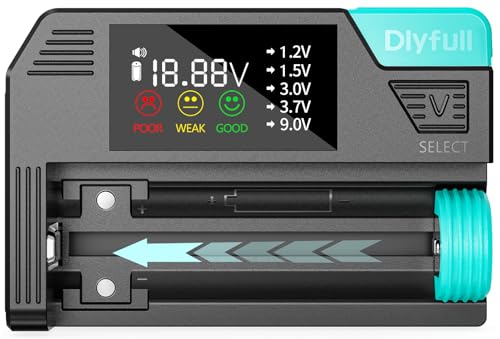
The DLYPOW expands beyond ordinary alkaline cells, making it the most chemistry-conscious household option here. It supports 1.2V Ni-MH and CD cells, 3.0V lithium, 3.7V lithium-ion, and 9.0V batteries, plus AA, AAA, C, SC, D, N, 18650, CR123A, LR44, CR2032, CR2450, CR2, and CRV3 formats.
Voltage, meaning the electrical potential that powers a cell, appears on an LCD after you select the appropriate range and observe the polarity mark. That extra setup is worthwhile for a mixed battery drawer, though the DLYFULL B1L is less involved for standard household cells.
The Value In It
- Covers several rechargeable and primary-cell voltages.
- Accepts cylindrical cells, 18650 cells, 9V batteries, and button cells.
- Displays voltage and battery status on an LCD.
- Useful for cameras, flashlights, toys, and rechargeable household equipment.
- Polarity guidance helps prevent an incorrect setup.
Practical Considerations
- Range selection adds a step compared with simpler analog meters.
- Compatibility depends on both cell size and voltage class.
- Store removable cells separately to prevent accidental terminal contact.
Feature Snapshot
Right Fit For
This is a practical fit for photographers, hobbyists, and households storing several rechargeable sizes alongside standard alkaline cells.
Consider Something Else When
People checking only disposable household batteries may find the Rongon BT-168 easier to use with its direct charge-status display.
Rongon BT-168 focuses on the information most household users need: whether a common battery is poor, weak, or good. Its metered LCD translates cell condition into an easy-to-read status, which is more useful than relying on a vague illuminated indicator after a device fails.
You can use it with AA, AAA, C, and D cylindrical cells, 1.5V 9V batteries, and 1.5V button cells without installing a separate operating battery. That self-contained design suits travel, but the narrower voltage coverage makes it less useful than the DLYPOW for rechargeable packs.
Useful Strengths
- Provides poor, weak, and good charge-status categories.
- Supports the batteries commonly kept in household drawers.
- Needs no separate battery for operation.
- The portable format fits easily into a toolbox or travel pouch.
Small Caveats
- Its stated range doesn’t include lithium-ion or Ni-MH classes.
- Button-cell support is limited to the specified 1.5V format.
- Clean the contacts gently before checking a used cell to maintain reliable contact.
Who It Suits Best
This meter suits beginners and occasional users who want a clear condition label for ordinary disposable batteries.
Another Choice May Suit
The UMLIFE Two-Pack Digital Battery Checker offers a similar household format in a dual set for separate storage locations.
UMLIFE pairs a digital battery checker with a compact ABS body, giving you two small meters without adding bulk to a drawer. That arrangement works well for a home office, workshop, or travel kit where the batteries and devices are kept in different places.
The listed formats include AAA, AA, C, D, 18650, 9V alkaline or dry cells, rechargeable batteries, and small button cells. The display gives an immediate power indication, although the supplied details don’t specify whether it reports an exact voltage or uses a status scale.
Where It Excels
- Two units support separate storage areas.
- The lightweight ABS body suits drawers and portable kits.
- Supports common cells, 18650 batteries, and rechargeable formats.
- A digital display is easier to interpret than an uncertain visual guess.
Details To Watch
- The exact display readout isn’t described in the supplied information.
- Compatibility claims don’t provide specific voltage limits for every rechargeable format.
- Wipe the compact contacts occasionally, especially after handling dusty batteries.
Quick Facts
Built With In Mind
The dual format is useful for people who keep batteries beside separate workspaces, gadgets, or travel equipment.
Reach For A Different Pick When
The DLYPOW Magnetic Tester is the stronger choice when exact voltage ranges and explicit support for several rechargeable chemistries matter most.
A magnetic tip gives the DLYPOW a different handling advantage from the digital models: the cell can be held in position while you read the result. That stability is helpful with short cylindrical cells and keeps your fingers away from the contact area, particularly in a busy workshop or garage.
The classic analog display favors quick interpretation, with one-step operation replacing the range selection required by the LCD-equipped DLYPOW. Its listed coverage includes AAA, AA, C, D, 9V, and button batteries, though the exact compatibility of every button-cell chemistry remains unclear.
Positive Points
- The magnetic tip helps maintain steady contact.
- A large analog display reduces menu-driven operation.
- The one-step process suits occasional household checks.
- Coverage includes the major cylindrical sizes and 9V cells.
Minor Gripes
- An analog needle provides less detail than an LCD voltage readout.
- The supplied details don’t quantify supported button-cell voltages.
- Remove the battery after use and store the meter away from metal objects.
Core Details
The Right Fit
This design suits people who prefer a direct needle display and magnetic cell retention over menu-based controls.
Where A Sibling Pick Shines
The Rongon BT-168 gives you explicit poor, weak, or good categories, which may be easier to interpret than an analog indication.
The HD430 steps outside household battery checks and addresses diesel vehicle diagnostics. Its DPF functions relate to the diesel particulate filter, while forced regeneration initiates a vehicle-controlled exhaust process rather than checking a loose AA or 9V cell.
Technicians working across 12V and 24V trucks gain access to CAT-9, Diesel 6-pin and 9-pin connectors, plus the OBDII 16-pin connection. Listed protocols include SAE J1939, SAE J1708, SAE J1850 PWM and VPW, ISO 14230-4, ISO 9141-2, ISO 15765-4, and ISO 27145-4.
Notable Upsides
- Supports several diesel connector formats used on trucks.
- Covers common heavy-duty diagnostic protocols.
- DPF reset and forced regeneration functions suit relevant service work.
- English and Spanish availability can help mixed-language shops.
Areas To Watch
- It doesn’t check household AA, AAA, or 9V batteries.
- Vehicle compatibility depends on connector, voltage, and protocol.
- Keep adapters organized and inspect pins for debris before connection.
Whose Shelf It Belongs On
This scanner belongs in a diesel technician’s tool kit supporting compatible 12V or 24V trucks.
Not Your Match When
The Rongon BT-168 is the relevant alternative for checking loose household cells rather than vehicle control systems.
HD3600 serves construction machinery rather than a household battery drawer. Its diagnostic focus includes Caterpillar CDL and manufacturer-specific diesel OBD protocols, making it more relevant to farm, construction, and industrial equipment than the HD430’s broader road-truck orientation.
The stated machinery fit includes Caterpillar, Komatsu, John Deere, Volvo, Hitachi, Bobcat, Yanmar, and Case. DPF regeneration functionality again concerns an engine exhaust system, so this scanner shouldn’t be compared directly with a meter that evaluates the voltage of a remote-control battery.
What Helps Most
- Targets construction machinery across several named brands.
- Supports standard and manufacturer-specific diesel protocols.
- DPF regeneration suits compatible heavy-equipment service tasks.
- The broad machinery focus serves mixed equipment fleets.
Possible Compromises
- It has no stated purpose for AA, AAA, C, D, or household button cells.
- Brand fit doesn’t establish compatibility with every model or year.
- Technicians should keep adapters dry, labeled, and properly seated.
Built With In Mind
HD3600 makes sense for technicians maintaining compatible construction or agricultural machinery.
Look Elsewhere When
The ANCEL HD430 is the more suitable road-truck option for diesel vehicles using 12V or 24V diagnostic connections.
What Matters Before Choosing a Battery Meter
Start with the formats already taking up space in your home. A basic household model needs AA, AAA, C, D, 9V, and perhaps button cells. Rechargeable users should look beyond size alone, because 18650 cells can contain different chemistries and nominal voltages.
The display should match the depth of information you need. A basic status indicator answers a simple good-or-weak question, while an LCD may show voltage or descriptive charge states. Voltage is the electrical potential stored in a cell, and comparing it with the cell’s rated voltage can provide more detail without replacing the battery management found in some devices.
Compatibility also depends on proper contact and polarity. Magnets, clips, and spring contacts each suit different cell shapes, so a stable hold is especially valuable with short button cells. Confirm that the intended battery chemistry, voltage class, and terminal arrangement are actually supported.
Portability matters for people who check equipment in several rooms or take batteries on trips. A compact ABS meter can live in a drawer without taking much space, while a two-pack makes sense for separate workspaces. Store loose cells away from keys, tools, and other conductive metal, and clean the meter’s contacts whenever residue could interfere with a reading.
Lessons From The Shortlist
The dedicated meters fall into three practical groups. Basic household units prioritize straightforward use, LCD models add status or voltage information, and magnetic or analog designs emphasize stable contact and quick interpretation.
Choose based on your battery drawer rather than feature count alone. A mixed collection of rechargeable cells calls for broader voltage support, while mostly AA and AAA use favors a simpler meter.
Mistakes Worth Dodging
Hidden Buying Traps
Don’t assume a tester covers every battery sharing the same physical size. Nominal voltage and chemistry can differ, especially among rechargeable cells and button batteries. Read the compatibility list carefully and match both the format and voltage class before storing a tool you may not use.
What Separates Premium From Basic
A higher-tier model may earn its place through exact voltage readings, broader chemistry coverage, magnetic contact, or multiple units. The extra capability matters when you routinely handle 18650 cells, rechargeable packs, or several household workspaces; simpler formats can be sufficient for occasional remote and flashlight checks.
Frequently Asked Questions for Aa Aaa 9v Battery Testers
Can a battery tester check a 9V battery?
Yes, the first five dedicated meters list 9V compatibility. Match the cell’s chemistry and voltage class, then observe the meter’s polarity guidance.
Do battery testers damage household cells?
These meters are designed to evaluate common battery voltage, but you should follow their contact and polarity instructions. Avoid leaving a cell connected longer than necessary or using the meter on a battery with visible leakage.
Can one tester handle rechargeable batteries?
The DLYPOW Magnetic Tester explicitly supports several rechargeable voltage classes, including Ni-MH and lithium-ion formats. Other models may cover only selected rechargeable cells, so verify the listed compatibility first.
Why choose an LCD model?
An LCD can provide exact voltage or a clearer charge-state label than an analog needle. That’s useful when you want more detail, although it may involve extra range selection.
Are the ANCEL scanners suitable for AA batteries?
No. The HD430 and HD3600 address diesel vehicle diagnostics and DPF functions. Use a dedicated meter such as the DLYFULL or Rongon model for household batteries.
Closing Thoughts
Choose the DLYPOW Magnetic Tester for broad rechargeable coverage, the Rongon BT-168 for clear household status labels, or the DLYFULL B1L for uncomplicated checks across common disposable batteries. The UMLIFE two-pack makes sense when separate storage locations matter most, while the magnetic analog DLYPOW suits users who prefer stable contact and a needle display. Reserve either ANCEL scanner for compatible vehicle diagnostics, not loose household cells.
