


A rechargeable 9V battery can simplify everything from smoke detectors to wireless microphones, but chemistry, capacity, charging method, and pack size determine which model fits your setup. This guide covers Ni-MH options alongside higher-capacity rechargeable lithium batteries and one disposable lithium alternative, helping you match power needs without paying for unnecessary extras.
Your Options, Compared

KOSHARE 280mAh 9V Ni-MH Battery 4 Pack
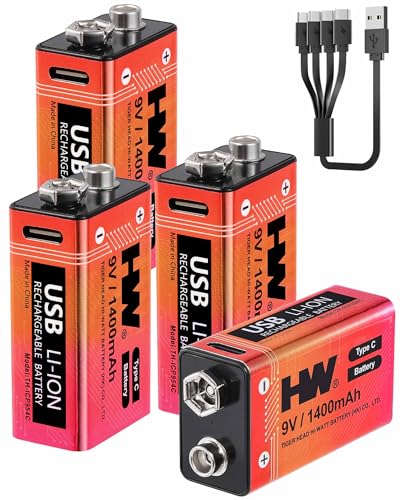
HW 1400mAh USB-C 9V Battery 4 Pack

PHILIPS 1200mAh 9V Lithium 4 Pack

HW 1400mAh USB-C 9V Battery 8 Pack

HW 1400mAh USB-C 9V Battery 12 Pack

Powerex MHR9V 9.6V 230mAh

AccuPower 300mAh NiMH 9V Battery
Taking A Closer Look At The Options
The KOSHARE set pairs four 280mAh rechargeable Ni-MH batteries with a dedicated charger, giving you a complete rotation for compatible household electronics. Ni-MH chemistry is rechargeable, meaning you repeatedly place these cells back into service rather than discarding them after use.
For a home maintaining several battery-powered devices, the four-pack format allows staggered charging without leaving everything depleted. The honest catch is that 280mAh sits well below the 1400mAh HW options, so this set may suit lower-drain equipment more naturally.
Notable Gains
- Four batteries support staggered replacements across several devices.
- The included charger removes the need for a separate compatible charger.
- A green flashing LED signals a completed charge.
- A red flashing LED identifies cells that cannot be charged or appear damaged.
- The stated rechargeable cycle life exceeds 1,000 charges.
Worth Noting
- Its 280mAh rating provides less runtime than the 1400mAh HW models.
- Owners should use separate slots during charging to maintain a reliable rotation.
Key Specs
Who It Suits Best
This set suits households with several compatible, moderate-drain 9V devices that need a simple rechargeable rotation.
Where Another Pick Suits Better
HW 1400mAh USB-C 9V Battery 4 Pack offers a better fit for power-hungry household equipment that needs longer runtime.
USB-C charging makes the HW 4 Pack easier to keep ready than a Ni-MH setup that requires a dedicated multi-cell charger. Each battery has a built-in port, so you connect the included cable and charge cells individually.
Its stated 1400mAh capacity is the main attraction for smoke detectors and other equipment that draws power steadily. For a home replacing several disposable cells, you gain a convenient rotation, although device compatibility remains essential for rechargeable models.
The Practical Payoff
- The 1400mAh rating supports longer operating time than lower-capacity alternatives.
- Built-in USB-C ports eliminate a separate battery charger.
- The included four-in-one cable handles charging from one source.
- An LED keeps charging status visible.
Practical Considerations
- Charging cells separately takes more attention than using a multi-bay charger.
- Compatibility should be confirmed with your smoke detector before regular use.
- For extended outages, keeping spare cells charged matters more than pack size alone.
Feature Snapshot
Made For
You benefit most from this pack in a home with multiple compatible smoke detectors or similarly steady household electronics.
Consider Something Else When
Powerex MHR9V 9.6V 230mAh suits higher-voltage equipment where its 9.6V output is more useful than maximum capacity.
The PHILIPS pack offers the straightforward ownership experience of disposable lithium power: install the cells and replace them when depleted. Unlike the rechargeable choices here, these batteries are not designed to return to a charger.
That makes them useful for smoke alarms, carbon monoxide detectors, and emergency equipment where you want stored cells without regularly monitoring a recharge schedule. Depending on your device, its low-battery warning can set a useful replacement routine.
Advantages To Know
- The 1200mAh capacity targets steady, high-drain operation.
- Lithium chemistry provides another option for home safety devices.
- A four-pack covers several compatible devices or reserves replacements.
- No charger or charging cable adds to the setup.
Trade-Offs To Consider
- These are non-rechargeable, so routine replacement eventually returns.
- Disposable cells suit devices designed for battery replacement.
- The 1200mAh rating trails the rechargeable HW 1400mAh sets.
At A Glance
Built With In Mind
This pack suits homes prioritizing maintenance-free power in compatible smoke alarms and carbon monoxide detectors.
Another Choice May Suit
KOSHARE 280mAh 9V Ni-MH Battery 4 Pack offers a better fit for devices you can recharge regularly and want to keep out of the disposal stream.
Eight cells turn the HW rechargeable platform into a practical rotation for a pedal board or home studio. You can keep replacements spread across active devices and still have several cells ready for recharging.
The 1400mAh rating is more relevant than raw pack size for sustained pedal operation, while USB-C simplifies top-ups. Compared with the HW 4 Pack, nothing changes in the core format, but the doubled quantity reduces the interruption caused by depleted batteries.
What Pays Off
- Eight cells support multiple pedals without a tiny inventory.
- The 1400mAh capacity targets consistent power delivery.
- Built-in USB-C ports simplify individual charging.
- The included multi-device cable reduces cable clutter.
- An LED shows the status of each connected cell.
Small Caveats
- Charging eight batteries separately requires a deliberate rotation.
- Eight cells are unnecessary for a single compact pedal setup.
- Actual runtime depends on pedal design and draw.
Feature Facts
The Right Fit
You’ll get the most value from this pack with an expansive pedal board, studio practice schedule, or frequent live setup.
A Better Fit Elsewhere
HW 1400mAh USB-C 9V Battery 4 Pack is the cleaner choice for someone running only a few devices and wanting less inventory.
The 12 Pack serves rotating wireless microphones more effectively than the smaller HW sets because it covers many handheld or headset transmitters without constant regrouping. You can assign fresh cells between sessions instead of reusing partially depleted ones.
Its USB-C design remains convenient for a mobile production kit, although twelve separate charging cycles may feel less tidy than a multi-bay charger. For occasional musicians, the 4 Pack or 8 Pack may cover the workload with fewer cells to track.
Real Benefits
- Twelve cells support multiple microphones and rotating performers.
- The 1400mAh rating favors longer operating periods.
- USB-C charging removes the need for a separate charger.
- The included cable handles several charging connections.
Areas To Watch
- The large quantity can be excessive for a single microphone.
- Individual USB-C charging takes more time across 12 cells.
- Consistent labeling helps prevent an active-show mix-up.
Who Will Love This
This pack suits touring musicians, churches, theaters, and production teams rotating many wireless microphones.
Look Elsewhere When
HW 1400mAh USB-C 9V Battery 4 Pack fits a smaller home recording setup better without leaving several cells unused.
Voltage, not capacity, separates the Powerex MHR9V from the larger packs in this roundup. Its 9.6V nominal output sits above a conventional 9V alkaline cell, which can help devices that need more voltage to operate.
That makes it a niche fit for compatible paintball hoppers and similar equipment. You gain power-hungry compatibility but surrender the convenience of a multi-pack and USB-C charging, so this is not the natural choice for a house full of smoke detectors.
A Few Highlights
- The 9.6V rating exceeds standard alkaline 9V output.
- Higher voltage supports compatible paintball hoppers.
- No memory effect reduces conditioning-related charging concerns.
- The 230mAh rating suits equipment prioritizing voltage over capacity.
Potential Drawbacks
- Only one battery is included.
- The 230mAh capacity is modest beside the HW sets.
- You need compatible Ni-MH charging equipment, with charging details tied to your chosen charger.
Technical Highlights
Whose Shelf It Belongs On
This cell belongs in a paintball kit or electronics project where 9.6V output matters more than multipack convenience.
Reach For A Different Pick When
HW 1400mAh USB-C 9V Battery 4 Pack suits household devices requiring greater capacity and a broader rechargeable rotation.
The AccuPower cell keeps the format simple: one 300mAh rechargeable Ni-MH 9V battery. That makes it useful for maintaining a small collection of compatible devices without committing to a full charging kit or multipack.
Its capacity slightly exceeds KOSHARE’s 280mAh offering while remaining far below the 1400mAh HW batteries. For a single low-drain device, that modest approach may be sufficient, though several active devices are better served by a rotation.
A Strong Showing
- The single-cell format suits a one-device replacement.
- Ni-MH chemistry supports repeated charging.
- The 300mAh capacity is a modest step above 280mAh alternatives.
Things That May Matter
- Runtime may be limited beside 1400mAh rechargeable options.
- A single cell provides no immediate backup.
- Charging hardware and device compatibility require separate confirmation.
Best Suited To
This battery suits a hobbyist maintaining one compatible, lower-drain 9V device and preferring a straightforward single replacement.
Swap It Out When
KOSHARE 280mAh 9V Ni-MH Battery 4 Pack fits you better when you need several cells and a charger included in the setup.
Matching Battery Power to Your Devices
Capacity measures stored charge, but higher voltage and charging convenience can matter more in specialized equipment. Start with the devices you actually plan to power, then narrow the field by chemistry and pack quantity.
Chemistry and Compatibility
Ni-MH cells are rechargeable, while lithium may be rechargeable or disposable depending on the model. Check device guidance before replacing any battery, especially smoke alarms, microphones, paintball equipment, and guitar pedals.
Capacity Versus Runtime
The 1400mAh HW cells hold considerably more stated charge than the 280mAh KOSHARE or 300mAh AccuPower cells. That gap can reduce replacement frequency in higher-drain equipment, though device design and operating temperature also affect runtime.
Charging Setup Choices
USB-C simplifies charging by connecting directly to each battery. A dedicated Ni-MH charger supports conventional rechargeable cells and can make rotating a larger inventory easier.
Pack Size and Rotation
Four cells suit a small household, eight fit an expanded pedal board, and twelve cover multiple rotating microphones. Larger packs reduce interruptions but require more storage and charging organization.
Choosing Between Charging and Disposable Power
Capacity alone cannot settle every choice. Charging method, voltage, device support, and inventory size can outweigh the headline mAh rating.
Common Shopping Slip Ups
Check rechargeable compatibility before buying, and confirm whether your charger handles the chemistry and battery format. Higher capacity does not solve incompatible voltage, so verify the device requirements before ordering.
What Separates Premium From Basic
Premium sets often add higher capacity, USB-C ports, status lights, or larger multipacks. Those extras suit frequent users, while a single lower-capacity cell may be enough for one compatible device.
Frequently Asked Questions
Can any 9V rechargeable battery replace a standard alkaline cell?
No. Check the device’s battery requirements because chemistry, voltage, and rechargeable support must align.
What does 1400mAh mean?
It represents the charge a battery can store under specified conditions. Higher capacity generally supports longer operation, but device design also affects runtime.
Are USB-C 9V batteries easier to charge?
They often are, since each cell connects directly to a USB-C cable. You still need a compatible cable and charging source.
Is a higher-voltage 9.6V battery always better?
No. Higher voltage helps certain equipment but may cause incompatibility elsewhere. Use it only where the device supports the stated output.
How many rechargeable batteries do you need?
Keep at least one spare for critical equipment. Larger collections benefit from a full rotation, while a single-device setup may need only two cells.
Final Verdict
Match the battery to the job instead of chasing capacity alone. Conventional Ni-MH works well for recharge-oriented collections, USB-C models simplify charging, and higher-voltage cells address specialized compatibility. Choose a pack size that supports your devices without creating an inventory you cannot manage.
