


A 6V battery still needs dependable care, particularly on an older car, motorcycle, lawn mower, or tractor stored through winter. This roundup covers automatic maintainers, multi-chemistry chargers, manual units, and portable jump starters so you can match the equipment to the job. Your vehicle voltage, battery type, storage conditions, and tolerance for hands-on control matter more than a long feature list.
A Side-By-Side Look

CARSHAM 4-Pack 6V 12V Smart Float Charger

Dght 2-Pack 3-Amp 6V 12V Battery Maintainer

Povasee A30 5000A 12V Jump Starter

Povasee 5000A Jump Starter and 150PSI Inflator

Povasee A40 5000A 12V Jump Starter
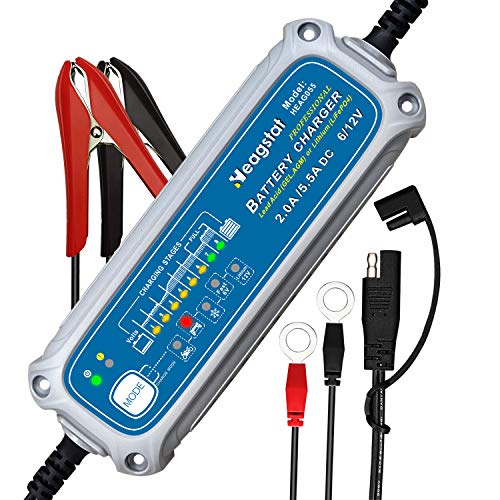
Heagstat 2/5.5A 6V/12V Smart Battery Charger

Schumacher Electric SC1446 10A Wheeled Charger
The Picks, Examined More Closely
Four units make this a practical choice for a household with several small vehicles or a property containing equipment that spends weeks without use. The chargers support 6V and 12V sealed lead-acid batteries, plus 12V LiFePO4 batteries with a battery management system, giving you more flexibility than a voltage-only charger.
Automatic float mode matters during long storage because it reduces charging after the battery reaches its prescribed stage. For one 6V vehicle, the extra units may be unnecessary, but for a motorcycle, mower, tractor, and classic car, the pack spreads across the garage instead of forcing cable sharing.
The Case For It
- Supports 6V and 12V sealed lead-acid applications.
- Handles 12V LiFePO4 charging when the battery includes BMS protection.
- Four chargers support separate storage locations and multiple vehicles.
- Automatic float operation suits seasonal storage and recurring top-ups.
Points To Note
- Compatibility depends on correct voltage, chemistry, and terminal polarity.
- Long-term storage still calls for periodic connection checks and clean, secure terminals.
Built With In Mind
This pack suits households maintaining several older cars, motorcycles, mowers, tractors, or other small 6V and 12V equipment.
Another Choice May Suit
Choose Heagstat 2/5.5A 6V/12V Smart Battery Charger for one mixed garage that needs selectable charging modes rather than four separate units.
The Dght pair combines a modest 3-amp output with automatic charging and maintenance. That pace suits passenger cars, SUVs, trucks, motorcycles, boats, and lawn equipment that need a measured top-up rather than the speed of a workshop charger.
Lead-acid and LiFePO4 support make chemistry selection more important than the 6V-versus-12V decision alone. Compared with the CARSHAM four-pack, this set carries fewer units but presents a straightforward 3-amp format for maintaining two separate batteries.
A Favorable Mix
- Rated at 3 amps for a measured charging pace.
- Transitions to float maintenance after charging.
- Supports lead-acid and LiFePO4 battery applications.
- Two units suit separate vehicles or storage areas.
Trade Offs
- The slower output favors recovery and upkeep over rapid replenishment.
- Owners commonly need to verify battery chemistry before selecting a mode.
- Two chargers may be excessive for a single-battery garage.
The Right Fit
You’ll appreciate this set for maintaining two mixed 6V or 12V batteries across cars, motorcycles, boats, or lawn equipment.
Look Elsewhere When
Schumacher Electric SC1446 10A Wheeled Charger makes more sense for larger equipment requiring manual control and a faster 10-amp output.
The A30 belongs beside the tire kit rather than on the charger shelf. A jump starter delivers a concentrated burst of power to restart a 12V vehicle, then sits in storage until needed; it is not a substitute for a 6V battery charger or a long-term maintenance connection.
Its listed engine coverage extends to 10L gasoline and 8L diesel vehicles, making it a road-trip companion for cars, trucks, motorcycles, and boats. Power-bank, dual-output, and LED functions give the portable unit more everyday utility once the clamps are stowed.
Everyday Advantages
- Starts compatible 12V gasoline and diesel vehicles.
- Portability supports use away from a home garage.
- Power-bank and dual-output functions add device-charging utility.
- LED lighting assists during roadside emergencies.
Where It May Fall Short
- It cannot charge the smaller 6V batteries represented in this roundup.
- Unit capacity can diminish over time without regular recharging.
- Engine-size claims do not replace correct battery sizing and clamp connection.
Made For
This model suits drivers of compatible 12V vehicles who want emergency starting capability away from a charger.
A Better Fit Elsewhere
Choose Heagstat 2/5.5A 6V/12V Smart Battery Charger for routine charging and float maintenance instead of roadside starting.
Combining jump-starting and a 150PSI inflator reduces the number of separate emergency tools in your vehicle. The listed 9L gasoline and 8L diesel coverage targets common passenger vehicles, while the LCD display gives the inflation function a more controlled interface than many basic inflators.
Like the Povasee A30, this is a 12V emergency device rather than a 6V maintainer. Its storage case helps protect the components during transport, and the integrated lighting and mobile-device charging make it more useful between emergencies, depending on how often you keep its internal battery charged.
Everyday Wins
- Jump-starting and tire inflation share one portable unit.
- The LCD supports more informative inflation control.
- A 150PSI maximum handles common vehicle tire tasks.
- The included case supports organized roadside storage.
- Lighting and device charging broaden emergency utility.
Small Caveats
- This unit does not address routine 6V battery charging.
- The storage case still requires sensible moisture control in a hot vehicle.
Who Will Love This
Roadside preparedness is your priority, and you want tire inflation beside emergency starting power in one kit.
Swap It Out When
Select Dght 2-Pack 3-Amp 6V 12V Battery Maintainer when batteries need routine maintenance rather than an emergency boost.
The A40 takes a different position within the portable group by pairing 5000A starting capacity with a 3-inch LCD and an 88.8Wh power source. Its listed gasoline-engine coverage and 10L diesel target make it a practical consideration for trucks, RVs, and larger 12V equipment, although starting capacity alone does not dictate compatibility.
Compared with the newer Povasee model, the A40 concentrates on starting, display, and device charging instead of tire inflation. That narrower feature set may suit you better when compact emergency starting matters more than maintaining a complete roadside toolkit.
Strengths Worth Knowing
- The 5000A rating targets demanding 12V starting situations.
- Coverage includes gasoline vehicles and diesel engines up to 10L.
- The 88.8Wh internal battery supports portable electronic use.
- Power-bank and dual-output functions add flexibility.
Practical Considerations
- It is not designed for 6V charging or battery storage maintenance.
- Owners commonly need to recharge the unit periodically between uses.
- There is no listed air compressor, unlike the 2026 Povasee model.
Built With In Mind
You’ll value the A40 as a portable booster for larger compatible 12V vehicles kept through winter or used far from a garage.
Where A Sibling Pick Shines
Povasee 5000A Jump Starter and 150PSI Inflator serves drivers who also need tire inflation during the same roadside emergency.
The Heagstat’s strongest feature is controlled choice. Selectable 2-amp and 5.5-amp operation changes the pace of maintenance, while the stated 6V mode gives older motorcycles, carts, and compact equipment a dedicated path instead of forcing one universal setting.
An eight-stage process moves through battery assessment, controlled startup, bulk charging, absorption, analysis, float, and pulse maintenance. For seasonal storage, that automatic sequencing is useful, but proper setup still requires checking polarity, battery chemistry, and the selected mode before connection.
Practical Advantages
- 2-amp and 5.5-amp settings suit different battery conditions.
- Dedicated 6V charging supports smaller legacy vehicles.
- Five stated modes cover lead-acid and LiFePO4 applications.
- Automatic stages reduce the need for constant supervision.
- Pulse maintenance supports recurring storage care.
Details To Watch
- Several selectable modes require accurate battery identification.
- Lead-acid, AGM, gel, and similar labels can be confusing on stored equipment.
- A single unit concentrates wear on one charger during long maintenance periods.
Who Should Grab It
This charger suits garage owners handling several battery sizes who value chemistry selection and adjustable charging speed.
Another Choice May Suit
CARSHAM 4-Pack 6V 12V Smart Float Charger makes more sense for maintaining several stored batteries in different locations simultaneously.
The SC1446 favors manual operation and a 10-amp output over automated menu-driven charging. That makes it relevant to older cars, tractors, and garage equipment where you want direct control over the process, especially after a battery has sat deeply discharged for an extended period.
Its wheeled format is practical in a workshop because the charger need not sit on a bench while cables stretch toward a vehicle. Compared with Heagstat’s staged electronic controls, the Schumacher is deliberately hands-on, which may feel less convenient but can be clearer for people comfortable managing a basic charging process.
The Good Stuff
- The 10-amp output suits routine workshop charging.
- Manual controls provide direct operating oversight.
- Wheels make movement around the garage easier.
- The format suits older vehicles and stationary equipment.
Less Ideal Details
- Manual operation requires more attention than automatic float charging.
- No 6V compatibility is established by the supplied information.
- Long cable runs and wheels make the unit less convenient for trunk storage.
Whose Shelf It Belongs On
This unit fits a home workshop maintaining older 12V vehicles, tractors, or equipment where direct charging control matters.
Not Your Match When
Choose Heagstat 2/5.5A 6V/12V Smart Battery Charger for automatic sequencing, 6V support, and unattended maintenance.
Choosing the Right Charger for Your Battery
Start with the label on the battery, not the vehicle’s age or shape. A charger matched to 12V cannot safely service a 6V installation, and lithium support remains chemistry-specific rather than universal.
Confirm Voltage and Chemistry
A 6V motorcycle battery and a 12V mower battery follow different voltage requirements, while LiFePO4 is a different chemistry from conventional lead-acid. AGM and gel are lead-acid constructions with their own charging expectations, so match the available mode to the battery designation before attaching the leads.
Decide Between Recovery and Maintenance
A low-current maintainer is suited to topping up a healthy stored battery, while a higher-current charger handles a more depleted vehicle. Charge time varies with capacity and the battery’s condition, so higher amperage does not automatically translate into better long-term maintenance.
Consider Connection Time and Access
Automatic float and pulse stages reduce supervision during seasonal storage. Manual controls suit workshop users who prefer direct oversight, while a wheeled format helps in a busy garage but takes more space than a compact wall-adjacent charger.
Separate Chargers From Jump Starters
A charger restores energy over time and can maintain voltage after reaching the proper stage. A jump starter provides concentrated starting power for an emergency, but the listed 12V portable models in this roundup do not replace a 6V charger.
Charger Details That Shape Daily Ownership
Common Shopping Slip Ups
The most consequential mistake is choosing from cable or case design before checking voltage and chemistry. The second is confusing jump-starting capacity with charging capability, which can leave a 6V maintenance need unmet.
What The Higher Tier Buys
More money may add selectable chemistry modes, stronger charging stages, displays, or carrying features. Those extras help when you manage several battery types, but a simple correct match can be enough for one healthy 6V battery in basic storage.
Frequently Asked Questions
Can a 12V charger service a 6V battery?
No. Voltage must match because the charger’s charging stages are designed for a specific battery system.
Is LiFePO4 the same as lead-acid?
No. LiFePO4 uses a different internal chemistry and requires a compatible charging mode.
Can a jump starter replace a battery charger?
No. A jump starter supplies a temporary starting boost, while a charger restores charge over time.
Which charger suits several stored vehicles?
A multi-unit pack keeps separate batteries connected to separate chargers, provided each battery has the correct voltage and chemistry.
Should I charge a battery through winter?
Periodic maintenance can help manage decline during storage, but terminals, connections, and selected charging mode still require attention.
Closing Verdict
For routine 6V care, choose the CARSHAM pack for multiple batteries or the Heagstat unit for selectable chemistry modes and automatic stages. Reserve portable Povasee models for 12V roadside emergencies, and consider the Schumacher SC1446 when direct workshop control takes priority over automation. Match the equipment to the battery label first, then choose the degree of control your garage actually needs.
