


A 626 watch battery looks simple, yet matching its chemistry, voltage, diameter, and model designation takes more care than most replacements require. A 1.5V alkaline cell may fit several watches, calculators, clocks, and small electronics, while a 1.55V silver oxide battery offers a different electrical profile and shelf-life expectation.
You’ll also need a clean installation process, correct polarity, and realistic handling around these tiny cells. These options cover practical situations ranging from replacing one watch battery to stocking batteries for several household devices.
A Side-By-Side Look

Renata 377 SR626SW Batteries, 20 Count

PKCELL SR626SW Watch Batteries, 10 Pack

15 Pack AG4 LR626 1.5V Batteries

DATB 377 AG4 LR626 Batteries, 20 Pack

LR626 AG4 Watch Batteries, 10 Pack
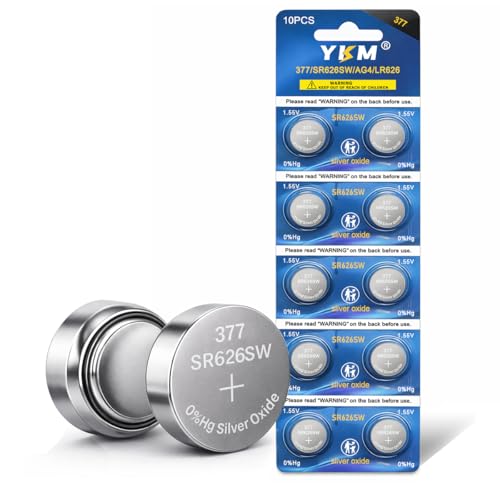
SR626SW 377 Batteries, 1.55V, 10 Pack

PKCELL SR626SW Watch Batteries, 20 Count
The Strengths Of Each Pick
Renata provides the clearest combination of stated capacity, voltage, chemistry, and storage behavior in this group. Silver oxide chemistry suits precision devices that specify SR626SW or 377 cells, and the 1.55V rating gives you a concrete basis for checking compatibility before opening a watch.
That makes this a sensible choice for a daily wearer who prefers documented specifications over a broad equivalence list. You may also appreciate the 20-count format for maintaining several watches, although actual service life depends on each device.
Noteworthy Benefits
- Published 24 mAh capacity helps frame expected service life.
- Low self-discharge supports storage between replacements.
- Twenty cells suit households with multiple compatible watches.
- Leakage resistance is a meaningful consideration near precision movements.
Honest Caveats
- Silver oxide chemistry costs more of your budget than a basic alkaline option.
- Correct polarity and the device’s required chemistry remain essential during installation.
Key Product Details
Made For
Watch owners who prioritize documented capacity, silver oxide chemistry, and long-term storage characteristics.
A Better Fit Elsewhere
The 15 Pack AG4 LR626 1.5V Batteries suit you better when a device accepts alkaline chemistry and broad household compatibility matters more than stated silver oxide capacity.
PKCELL takes a practical route with a 10-count pack and several familiar cross-reference names. That approach helps when a device compartment, manual, or old battery carries an SR626SW, LR626, AG4, 376, or 377 marking, though similar dimensions do not automatically guarantee equivalent chemistry.
Compared with Renata 377 SR626SW Batteries, the documentation here is lighter on nominal capacity and storage behavior. You’ll find this pack more convenient for routine household replacements than for selecting a watch cell strictly by documented silver oxide specifications.
Points In Its Favor
- Ten cells cover repeated watch and accessory replacements.
- Multiple model names simplify identification after opening a compartment.
- A sealed stainless steel appearance supports careful handling.
- The compact pack suits a drawer-based maintenance kit.
Small Limitations
- The supplied information provides less detail on capacity than Renata.
- Keep cells away from children and pets, and install them only where the device specifies a matching chemistry.
Right Fit For
Households replacing several compatible watches or small devices without needing a large reserve supply.
Consider Something Else
Renata 377 SR626SW Batteries fit your priorities better when you want explicit capacity and low self-discharge details before servicing a precision watch.
A 15-count alkaline pack is a broad answer for a busy household with more than one compatible gadget. The listed uses span watches, clocks, calculators, cameras, toys, instruments, recorders, and remote controls, giving you more ways to use one pack than a watch-only supply.
The distinction from YKM’s silver oxide cells matters. Alkaline chemistry and silver oxide chemistry share a similar form factor in many applications, but the device’s required type should take priority; a close visual match alone isn’t enough.
Useful Touches
- Fifteen cells support devices throughout the home.
- The 1.5V rating provides a simple compatibility check.
- Broad application guidance helps with mixed household inventories.
Worth Noting
- Alkaline cells may not match a device that explicitly requires silver oxide SR626SW chemistry.
- Store the pack dry and handle each coin cell by its edges to preserve the contact surfaces.
- Some listed equipment may require different battery sizes, so model markings remain more useful than application names alone.
Feature Snapshot
Who Will Love This
You’ll appreciate this option for maintaining several small household devices that accept 1.5V LR626 alkaline cells.
Another Choice May Suit
SR626SW 377 Batteries, 1.55V, 10 Pack suit you better when the device specifically requires silver oxide chemistry and you value stated dimensions.
DATB’s 20-count format combines a substantial household reserve with a long compatibility list. Named equivalents include SR626SW, 377, 626, SR626, LR66, LR626, AG4, 377A, and 626SW, which can make older printed markings easier to decode.
The catch is chemistry. This pack is described as alkaline, so it makes more sense for a device that accepts that chemistry or where the listed model relationship is supported by the device documentation. That’s a narrower decision than matching diameter alone.
The Practical Payoff
- Twenty batteries suit several watches and compact devices.
- A broad equivalent list reduces confusion around common model names.
- The 1.55V designation adds another compatibility checkpoint.
- One reserve pack simplifies household battery organization.
Possible Compromises
- Alkaline chemistry may not suit watches that specifically require silver oxide cells.
- Keep each replacement dry, and avoid leaving a partly used cell inside a device.
- The long model list can make the listing feel denser than the installation itself requires.
Built With In Mind
You’ll get the most value from this pack when several household devices accept the listed alkaline equivalents.
A Better Fit Elsewhere
PKCELL SR626SW Watch Batteries, 10 Pack suit you better for a smaller reserve with a compact set of common replacement names.
YIGOCELL leads with compatibility, listing an extensive set of AG4, LR626, 377, SR626, and related designators. That makes the pack useful while checking a compartment stamped with an unfamiliar number, especially in a home containing several devices bought at different times.
Its 1.5V alkaline format is the central trade-off. Compared with the 1.55V silver oxide choices here, this pack may suit more general-purpose equipment, but you should still follow the device’s chemistry instruction rather than relying on the long cross-reference list.
Where It Excels
- Extensive model references help identify older markings.
- Ten cells provide a manageable routine replacement supply.
- The 1.5V format suits many compatible alkaline devices.
- A compact case makes storage beside household tools practical.
Details To Watch
- An equivalence listing cannot replace the device manufacturer’s chemistry requirement.
- For a precision watch, you may prefer a cell with more explicit silver oxide specifications.
Technical Highlights
Who Should Grab It
You’ll find this pack useful for checking many model markings while maintaining a moderate supply for compatible devices.
Where A Sibling Pick Shines
Renata 377 SR626SW Batteries suit you better when stated 24 mAh capacity and low self-discharge are more important than an extensive equivalence list.
YKM supplies the most useful dimensional detail in this group, with each cell listed at approximately 6.8mm in diameter and 2.6mm thick. That measurement gives you a practical way to compare a replacement with a tight watch compartment before opening the case.
Silver oxide chemistry, 1.55V voltage, and 18mAh capacity make this a credible option for SR626SW and 377 devices. Its 18mAh figure sits below Renata’s stated 24 mAh, so your choice may come down to documented physical fit and pack size versus capacity.
Well-Handled Touches
- Published dimensions help prevent a tight-fit replacement.
- The 18mAh rating provides a clear service-life reference.
- Silver oxide chemistry suits compatible precision devices.
- Ten cells cover several watches without excessive reserve.
Areas To Watch
- The listed capacity is lower than the 24 mAh stated for Renata.
- Measurement tolerances can vary, so retain the original packaging for comparison during installation.
Feature Facts
Made For
You’ll appreciate the stated dimensions when replacing a cell in a compact watch compartment with little clearance.
Look Elsewhere
Renata 377 SR626SW Batteries suit you better when higher stated capacity and low self-discharge lead your selection criteria.
This 20-count PKCELL pack expands the earlier 10-cell option into a household maintenance supply. The stated 1.5V output, three-year shelf life, and compatibility names such as LR626, LR66, 377, SR626, SR626SW, and AG4 give you several ways to evaluate the pack before opening a device.
It appears to be an alkaline option despite carrying the SR626SW name, so treat the chemistry designation as carefully as the model number. Compared with the smaller PKCELL pack, the main practical gain is quantity rather than a different fit or electrical class.
Advantages To Know
- Twenty cells suit ongoing maintenance across several compatible devices.
- The stated shelf life helps you plan storage before opening the pack.
- Common model references make the listing approachable for mixed equipment.
- Sealed cells reduce exposed contact surfaces during storage and handling.
Trade-Offs To Consider
- The SR626SW name can encourage a chemistry assumption, so verify the device requirements.
- A 20-cell supply takes more drawer space than a smaller pack, and unused cells benefit from cool, dry storage.
- No nominal capacity is provided, so comparison with Renata or YKM is less direct.
Essential Details
The Right Fit
You’ll benefit most from this pack while maintaining several compatible devices and keeping a larger maintenance reserve.
Swap It Out
SR626SW 377 Batteries, 1.55V, 10 Pack suit you better for compact watch replacement because their dimensions are stated clearly.
Matching Chemistry, Size, and Model Designations
A 626 battery replacement begins with the device documentation, not the shape alone. Diameter and thickness determine mechanical fit, while model markings and chemistry indicate the expected electrical design. You should confirm all three before opening the compartment.
The 377 and 626 families can produce confusing listings because model numbers cross over between silver oxide and alkaline designs. A cell may look identical while carrying a different voltage or chemistry. Use the watch manual, device markings, or a manufacturer guide as your reference.
Start with the Printed Model Number
Read SR626SW, LR626, AG4, 377, or 376 before comparing packs. Model designations help narrow the field, although some listings combine several numbers without clearly emphasizing chemistry.
Treat dimensions as confirmation, not proof. A cell that appears to fit may still differ in voltage or discharge behavior. Close the compartment only after confirming that the replacement matches the device’s requirements.
Choose Chemistry for the Device
Silver oxide generally serves as the specification to look for in compatible precision watches and other equipment designed around SR626SW chemistry. Alkaline LR626 or AG4 cells suit devices explicitly designed for a 1.5V alkaline supply.
Don’t infer chemistry from a model name alone. The listing can contain several cross-references, so read the chemistry description and compare it with the device guide.
Think Beyond the Battery Count
Ten cells suit a modest routine, while a 15- or 20-count pack reduces repeated orders across several devices. A larger pack only adds value when you actually use the cells or keep them within a sensible storage period.
For a single watch, dimensional data and chemistry matter more than quantity. For a household with multiple watches, clocks, calculators, or small instruments, a reserve pack can be more convenient.
Handling Small Cells With Care
Coin cells are easy to lose and require careful handling during replacement. Keep each cell away from children and pets, and store the original packaging in a dry place. Never leave a loose battery inside a device after the replacement is complete.
Mistakes Worth Dodging
Don’t rely on appearance alone or assume every 626-sized cell has the same chemistry. Confirm the voltage, model designation, diameter, and thickness before installation. Handle cells by the edges, and avoid leaving tools or debris inside the battery compartment.
Silver oxide cells with documented capacity or dimensions can justify spending more than a basic alkaline option. The premium matters most when a precision watch, compact compartment, or long storage period makes those specifications important. A broad alkaline pack remains sensible for compatible general-purpose devices.
Frequently Asked Questions
Is a 626 watch battery the same as a 377 battery?
Many devices use related 626 and 377 designations, but model names can overlap across battery chemistries. Check the device documentation for voltage, chemistry, and dimensions before substituting.
Can I use a 1.5V battery instead of a 1.55V battery?
Only when the device manufacturer supports that substitution. Watch model markings, voltage, chemistry, and physical dimensions should all be compatible.
Are silver oxide batteries better than alkaline batteries?
Neither chemistry is universally better. Silver oxide fits many precision-device requirements, while alkaline can suit compatible clocks, calculators, and small electronics at a lower cost.
Are all AG4, LR626, and SR626SW batteries identical?
No. They can share a compact form while differing in chemistry, voltage, capacity, and discharge behavior. Treat equivalent numbers as clues rather than automatic proof.
How should I store unused 626 batteries?
Keep them in their original packaging, away from moisture, extreme heat, and children or pets. Store only the quantity you expect to use within the stated shelf-life period.
Final Verdict
Choose based on the exact device requirement, not merely the diameter or the similarity between 377 and 626 markings. Renata offers the strongest documented silver oxide capacity, YKM provides useful dimensions, and the larger alkaline packs suit households needing broader model matching or a bigger reserve. Match the chemistry first, confirm the physical fit, and choose the pack size that matches your actual maintenance routine.
