


Replacing a tired golf cart battery can mean more than matching case size and terminal layout. Voltage, capacity, charge rate, physical dimensions, and the cart’s controller all shape the result, especially across daily neighborhood courses, steep fairways, and utility carts carrying extra weight. This guide covers six-volt AGM options alongside complete lithium conversions, helping you choose the electrical format your installation can actually support.
The Main Contenders
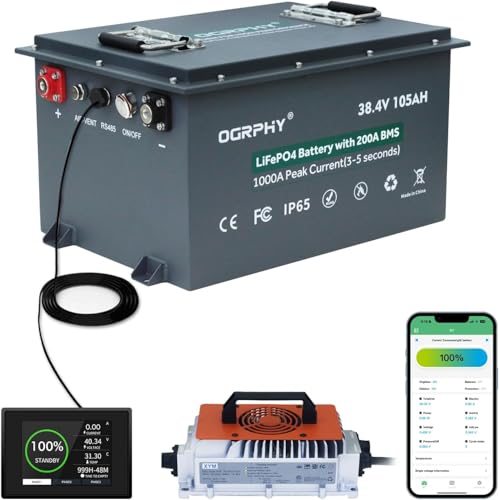
OGRPHY 36V Lithium Golf Cart Battery 105Ah with Touch Monitor and 25A Charger

Rocket L-105 225Ah 6V Golf Cart Battery Set of 6

TEMGO 48V 100Ah LiFePO4 Battery with Bluetooth and 18A Charger

OGRPHY 36V Lithium Golf Cart Conversion Kit 102Ah with 12V Interface

OGRPHY 36V 3.84KWh Lithium Battery 100Ah with 200A BMS and Charger

CROWN BATTERY 6CRV220 6V AGM Deep Cycle Battery 220Ah, 8 Pack

XS Power D6V-38 6V AGM Golf Cart Battery with M6 Hardware
A Breakdown Of The Leading Choices
This is a complete 36V lithium conversion, not a drop-in six-volt replacement. Its 105Ah rating, 200A battery management system, touch monitor, and mobile app suit a connected 36V cart used for commuting, errands, or extended days away from an outlet.
The 25A charger makes charging part of the package, reducing separate accessory shopping. Compared with the Rocket L-105’s six-unit flooded set, this option consolidates the installation and exposes more operating data, though compatibility work may be more involved.
The Helpful Details
- The mobile app and touch monitor give you a clearer view of charge status and battery conditions.
- A 200A BMS manages high-current discharge, which matters on hills and with utility carts.
- The included 25A charger supports a more complete lithium installation.
- Listed 4,000-plus cycle life targets long-term ownership rather than a short novelty upgrade.
Things To Consider
- The 36V lithium format will not replace six-volt batteries without matching the cart’s electrical system.
- Older controllers may need verification or modification before installation.
At A Glance
Who It Suits Best
You benefit most with a compatible 36V cart that gains useful monitoring and reduced maintenance complexity.
A Better Fit Elsewhere
Rocket L-105 225Ah 6V Golf Cart Battery Set of 6 suits you better when preserving a conventional 36V flooded series is the priority.
Six flooded batteries in series create a nominal 36V pack, a familiar arrangement for many golf carts. The 225Ah rating gives substantial stored energy, while listed replacements for Trojan T-105 and several comparable models make case-size verification especially important.
For a neighborhood course or utility cart, this straightforward lead-acid set can fit an established charging and controller setup. Unlike the monitored OGRPHY lithium system, it offers no app-based controls, and flooded batteries require periodic terminal and fluid attention.
Good Reasons To Consider
- Six matching units provide a balanced pack for a 36V series installation.
- The 225Ah capacity supports long runs and carts carrying passengers or equipment.
- Flooded lead-acid technology remains familiar to many repair technicians.
Minor Gripes
- Terminal upkeep, corrosion checks, and fluid monitoring add routine maintenance.
- Six heavy batteries require careful transport and level installation.
- Physical dimensions and terminal placement need confirmation before ordering six units.
The Right Fit
You benefit most with a conventional 36V cart and a preference for serviceable flooded batteries.
Consider Something Else
CROWN BATTERY 6CRV220 6V AGM Deep Cycle Battery 220Ah, 8 Pack better serves sealed installations needing more units.
This 48V lithium option is built around high output rather than a one-for-one battery swap. The listed 10.24kW output, 200A smart BMS, Bluetooth connection, LCD display, and included charger suit high-speed or heavily loaded carts designed around a 48V electrical platform.
Everything needed for a connected installation is grouped in one package. Compared with OGRPHY’s 36V conversion, it offers more output and display functionality, but your cart’s controller and motor system must be designed for 48V operation.
Positive Points
- Bluetooth monitoring helps you check operating information without relying only on dashboard indicators.
- The 2.8-inch touch display gives charging status and battery data a dedicated place.
- A 58.4V 18A charger and retention strap simplify the installation package.
- The 10.24kW listed output targets demanding hills, speed, and payload.
Practical Considerations
- A 48V conversion may require controller, motor wiring, and connector changes.
- App-dependent features add another setup element to an already substantial installation.
Technical Sheet
Made For
You benefit most with a 48V cart platform, elevated power needs, and a preference for connected controls.
Where A Sibling Pick Shines
OGRPHY 36V Lithium Golf Cart Battery 105Ah with Touch Monitor and 25A Charger is the more natural conversion for a 36V system.
Accessories often become the overlooked part of a golf cart conversion. This OGRPHY kit includes a 12V DC interface, allowing compatible lights, horns, and other 12V equipment to draw from the 36V lithium battery without a separate voltage converter.
That integration makes it appealing for a street-style cart with several powered accessories. Compared with OGRPHY’s 105Ah model, the 102Ah version trades a small amount of nominal capacity for a more useful accessory interface.
Key Advantages
- The built-in 12V interface reduces the need for a separate conversion device.
- It simplifies powering accessories on a lithium-equipped cart.
- The touch monitor supports direct battery status checks.
- The included charger supports a complete 36V conversion.
Details To Watch
- Connected 12V devices can continue drawing power until their discharge switch is turned off.
- Accessory current must remain within the interface’s supported limits.
Feature Card
Built With In Mind
You benefit most with a 36V conversion that needs multiple powered accessories and limited installation space.
Another Choice May Suit
TEMGO 48V 100Ah LiFePO4 Battery with Bluetooth and 18A Charger suits you better with a compatible 48V performance cart.
A 3.84kWh lithium pack gives this OGRPHY model a substantial energy reserve for long courses, solar charging, or a trolling motor. The 200A BMS and listed 1,000A peak current target sudden power demands, while the included 25A charger supports full-system charging.
Its broader intended uses separate it from the usual six-battery replacement. Compared with OGRPHY’s 105Ah touch-monitor model, this option emphasizes stored energy and high-current delivery rather than app-based monitoring, so your needs determine which conversion makes more sense.
Useful Highlights
- The 3.84kWh capacity supports longer operating periods away from a charger.
- High peak-current capability suits acceleration, hills, and demanding accessories.
- The included 25A charger simplifies ownership after installation.
- Solar and trolling motor use expand its value beyond the course.
Trade-Offs To Consider
- A full lithium conversion requires electrical knowledge and careful cable sizing.
- Physical clearance and weight distribution need checking in the battery bay.
- The missing monitoring interface may disappoint tech-focused owners.
Whose Shelf It Belongs On
You benefit most with a compatible 36V system used for extended off-course or stationary power needs.
Reach For A Different Pick
OGRPHY 36V Lithium Golf Cart Conversion Kit 102Ah with 12V Interface suits accessory-heavy carts better.
AGM means the electrolyte is held in glass-fiber mats, producing a sealed battery with lower spill risk than a conventional flooded unit. This eight-pack provides eight 6V batteries, allowing use across a 48V series or other compatible deep-cycle arrangements requiring that quantity.
The listed 220Ah at a 20-hour rate favors sustained runtime, including marine, RV, and stationary applications. For a conventional 36V golf cart, six batteries would form the pack, leaving two available separately, so system layout matters before installation.
Advantages To Know
- Sealed AGM construction reduces electrolyte spilling and routine watering needs.
- High 20-hour capacity favors long, steady discharge periods.
- The eight-unit quantity supports several compatible stationary configurations.
- Low self-discharge characteristics suit seasonal equipment storage.
Things That May Matter
- Eight units create substantial weight and may exceed a standard cart bay.
- Series voltage and charger settings must match your system.
- AGM charging requires compatible voltage and charge regulation.
Core Details
Best Suited To
You benefit most with a compatible 48V or stationary deep-cycle project that values sealed construction.
Look Elsewhere
XS Power D6V-38 6V AGM Golf Cart Battery with M6 Hardware better suits a shorter conventional golf cart pack.
The D6V-38 focuses on discharge strength, with a listed 2,000A maximum output for acceleration and steep terrain. Its 495A cold-cranking rating describes starter-type surge capability, while 55 minutes of reserve capacity targets sustained runtime after the load is applied.
Unlike the multi-pack sets, this listing covers one battery, so your cart’s quantity requirement determines total cost and weight. The sealed AGM design and included M6 hardware make it suitable for an existing installation with matching dimensions and terminals.
Points In Its Favor
- High discharge capability supports quick acceleration and hill climbing.
- Sealed AGM construction limits spill risk and removes watering tasks.
- Reserve capacity supports sustained operation after high initial demand.
- M6 terminal hardware simplifies connection preparation.
Worth Bearing In Mind
- Short burst ratings do not replace sustained-capacity matching.
- A complete 36V or 48V pack requires several matching batteries.
- Terminal compatibility and physical clearance should be confirmed.
Technical Highlights
Who Will Love This
You benefit most with a performance-focused cart operating on hills or carrying heavier loads.
Swap It Out When
CROWN BATTERY 6CRV220 6V AGM Deep Cycle Battery 220Ah, 8 Pack better serves multi-unit stationary builds.
What Matters Before You Replace The Pack
Start with voltage and configuration. A conventional 36V golf cart often uses six 6V batteries connected in series, which means each unit receives one-sixth of the pack voltage. A 48V cart typically uses eight, while lithium conversions replace several series batteries with one higher-voltage pack and may require controller changes.
AGM describes the internal electrolyte arrangement. Compared with flooded lead-acid batteries, AGM batteries are sealed and resist spilling, but your charger still needs the correct voltage and charging profile. Never match a battery by appearance alone; check group size, terminal location, cable clearance, and total pack voltage.
Capacity and discharge rate answer different questions. Ah measures stored energy, while ampere ratings describe current delivery during acceleration or other heavy loads. For steep courses, larger passengers, solar use, or accessories, both adequate capacity and strong discharge performance matter.
Installation demands deserve equal attention. Confirm controller compatibility, connector type, cable gauge, ventilation, and weight distribution before ordering a lithium conversion. Conventional flooded sets are more familiar to service shops, whereas lithium systems require exact electrical matching and disciplined terminal handling.
Common Fitment Traps Before Installation
Common Shopping Slip Ups
The biggest error is treating “golf cart battery” as a universal fitment. Six-volt models, 36V lithium packs, and 48V systems serve different electrical architectures, and one extra battery can change the entire pack voltage.
Measure the bay and inspect terminal orientation before ordering a multi-pack. A high-capacity battery that fits electrically may still crowd cables or concentrate too much weight in one location.
What The Higher Tier Buys
Higher-output batteries add current capability, monitoring, or a complete charger and conversion package. Those features matter most for hills, heavy payloads, solar charging, and accessory-heavy carts rather than routine solo transportation.
The format also changes ownership demands. Lithium can reduce watering and provide operating data, but a conventional AGM set may offer the simpler path when your charger, controller, and battery bay already match.
Frequently Asked Questions
Do all golf cart batteries use the same voltage?
No. Conventional carts commonly use series-connected 6V batteries, while complete lithium conversions operate at 36V or 48V. Your controller and charger must match the selected system.
How many batteries does a 36V golf cart need?
A standard flooded 36V arrangement uses six 6V batteries connected in series. A 48V arrangement commonly uses eight, although lithium conversions use a different configuration.
Can a lithium battery replace a six-volt pack?
Only within a properly engineered conversion. You will need compatible controller settings, wiring, connectors, charger, and sufficient physical clearance.
Are AGM golf cart batteries maintenance-free?
They require less routine maintenance because they are sealed and do not need watering. You should still keep terminals clean, connections secure, and the battery securely mounted.
How do I match a replacement battery?
Check voltage, physical dimensions, terminal orientation, cable clearance, capacity, and charger compatibility. Electrical matching is essential, while sufficient capacity and discharge performance determine practical fit.
Final Verdict
The XS Power D6V-38 stands out for high-discharge 6V AGM use, while the CROWN 6CRV220 favors large sealed installations. For connected lithium conversions, OGRPHY offers 36V choices with different capacities and accessory features, while TEMGO serves compatible 48V platforms. Match the voltage, controller, charger, and bay before focusing on capacity or peak output. A careful fitment check remains the surest route to a useful upgrade.
