


Battery terminal damage turns a simple electrical repair into a frustrating one, especially when a corroded cable end no longer sits securely against its post. These battery cable clamps suit vehicle repair, battery upgrades, RV wiring, and compact electrical projects, with fit determined mainly by vehicle, cable gauge, post style, and available space.
An Overview Of The Picks

Ford Edge MKX Negative Battery Terminal Clamp

Subaru 81608GA110 Positive Battery Terminal Connector

Vgate 12-Way Battery Distribution Block M10 Studs
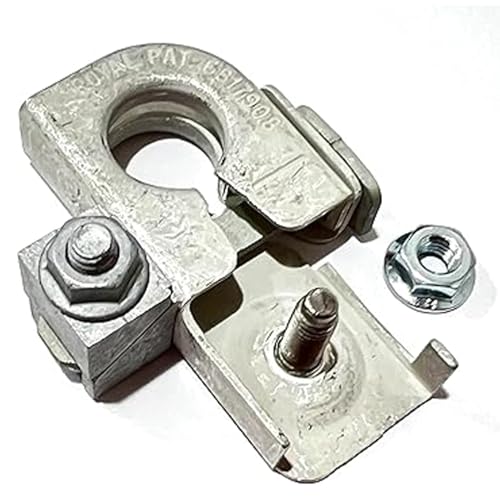
EDS 926-879 Negative Battery Terminal Connector

OURU 110-Piece Rubber-Coated Cable Clamp Kit

Vgate 12-Way Lead Acid Battery Clamp Block

Vgate 8-Way Lead Acid Battery Terminal Connector
Taking A Closer Look At The Options
A model-specific replacement solves the guesswork that can accompany a loose or corroded ground connection. The Ford Edge MKX Negative Battery Terminal Clamp is designed for the 2011–2014 Edge and MKX, making it a practical choice for restoring the negative cable end after the original connector becomes damaged.
You’ll appreciate the direct approach for a repair involving a familiar vehicle platform, though you should compare the connector shape and part number before removing the old assembly. The EDS 926-879 offers a broader Ford and Lincoln fit, but this Ford clamp is the more focused choice for the stated model years.
What It Does Well
- Model-specific pairing reduces compatibility guesswork during repair.
- Negative-terminal placement makes it useful for restoring a compromised ground connection.
- The matching vehicle years support a straightforward parts comparison.
Small Caveats
- Vehicle-specific fit limits its usefulness outside the listed applications.
- Corroded cable strands or damaged battery posts may require separate attention during installation.
Key Product Details
Right Fit For
You’re restoring the negative terminal on a 2011–2014 Ford Edge or MKX and can match the original connector carefully.
A Better Fit Elsewhere
Choose the EDS 926-879 Negative Battery Terminal Connector when your Ford or Lincoln application extends beyond the Edge and MKX years.
Vehicle-specific terminals matter because small differences in cable attachment and post clearance can undermine an otherwise convincing replacement. This Subaru connector is listed for positive-side applications across 1987–2009 models, giving you a defined part number and model range to compare before installation.
For routine electrical work, the genuine Subaru designation offers useful provenance without requiring a universal connector. You may find the original cable and post condition decisive, though, because replacing a terminal end does not restore a battery post that has become pitted or uneven.
Noteworthy Benefits
- The part number gives you a precise reference during vehicle repair.
- Model-year coverage spans many Subaru maintenance and restoration scenarios.
- A dedicated positive connector avoids adapting a general-purpose clamp.
Trade Offs To Consider
- The listed range narrows your options outside 1987–2009 Subaru applications.
- Post size, cable dimensions, and original connector geometry still require confirmation.
- You may need separate tools or cable preparation for a clean installation.
Made For
This connector suits you restoring a positive battery terminal on a supported Subaru after checking the original cable and post dimensions.
Another Choice May Suit
The Vgate 12-Way Battery Distribution Block M10 Studs serves you better when several cables need one compact distribution point.
Multiple auxiliary cables can turn an ordinary battery installation into a crowded maze of separate lugs. The Vgate 12-Way Battery Distribution Block M10 Studs gathers four hole-holder positions and eight threaded studs into a compact assembly, with bolt-down and stud attachment options for different cable arrangements.
You can use the included cable sizes as a starting point for lead-acid or lithium projects, but post type matters more than battery chemistry alone. An M10 or 3/8-16 post configuration must align with your battery, while the four hole holders accept the listed 2 AWG, 2/0 AWG, and 8 mm sizes.
A Few Strong Suits
- Twelve connection points reduce cable congestion around a busy battery.
- The compact layout suits RV, marine, trailer, and custom electrical projects where space is limited.
- Mixed holder and stud positions support several cable sizes and attachment methods.
- Compatibility with lead-acid and lithium batteries broadens project flexibility.
Practical Considerations
- The distribution block needs correct post compatibility and a secure mounting surface.
- Twelve positions may exceed the cable count in a simple replacement.
- Torque and surface preparation remain important for a dependable electrical joint.
Feature Breakdown
Who Should Grab It
You’re consolidating several cables into one distribution point for a compact custom battery installation.
Where Another Pick Shines
The Vgate 8-Way Lead Acid Battery Terminal Connector fits you better when eight points and tapered lead-acid posts better match your layout.
The EDS connector expands on the narrow model focus of the Ford Edge MKX clamp. Its wedge-lock design corresponds with the BT4Z-14450-BA negative-terminal format, giving you a familiar ground-side replacement for a broader selection of supported Ford and Lincoln vehicles.
That broader range makes it useful for a mixed household fleet, provided you verify the terminal style and vehicle application. The list includes Edge models from 2011–2024 and Explorer models from 2011–2019, so the stated years alone don’t settle fit for every vehicle.
Notable Upsides
- Crosses several Ford and Lincoln applications instead of one model pairing.
- The wedge-lock clamp provides a defined mechanism for securing the ground cable.
- Matching the BT4Z-14450-BA reference helps you compare the connector with the original.
Things That May Matter
- Vehicle-year compatibility still requires confirmation, especially outside the listed Edge and Explorer ranges.
- A replacement connector won’t clean severe corrosion from the cable or battery post.
Built With In Mind
You’ll find this connector practical for maintaining a negative connection across several supported Ford and Lincoln vehicles.
Swap It Out When
The Ford Edge MKX Negative Battery Terminal Clamp is more focused when you want a direct model-specific match for a 2011–2014 Edge or MKX.
Not every cable clamp serves as a battery terminal, but the OURU kit addresses the adjacent workshop problem of routing and securing lines. It contains 110 clamps across ten sizes, from 1/4 inch to 1-3/4 inches, so you can cover small wiring runs and larger hose or cable diameters without sizing each clamp one at a time.
The rubber coating helps reduce chafing and gives the clamp band a softer surface against nearby material. You may find the assortment most useful for organizing equipment, securing loose lines, or building tidy cable runs in a garage, van, workshop, or home utility area.
Bright Spots
- Ten diameter choices make it easy to match several cable or hose sizes in one project.
- Rubber-coated surfaces help protect the line from direct metal contact.
- The 110-piece count supports repeated repairs, maintenance, and workshop storage.
- Stainless steel construction suits organizing work around vehicles, tools, and outdoor equipment.
Where It May Fall Short
- This assortment is for routing and retaining cables, not making a battery electrical connection.
- Some combinations may leave you with more clamps than your immediate project requires.
Quick Facts
The Right Fit
This kit suits you when a workshop, garage, van, or utility area needs varied cable and hose sizes for routing and retention.
Look Elsewhere When
The Vgate 12-Way Battery Distribution Block M10 Studs is the better fit for distributing electrical cables directly from a battery post.
The Vgate 12-Way Lead Acid Battery Clamp Block offers a more substantial multi-cable platform than a simple replacement terminal. Its 12 positions divide between six 2/0 AWG hole holders and six 8 mm threaded studs, while the stated conductor range runs from 8 AWG to 4/0 XL AWG.
You’ll find the machined 6061 aluminum construction useful in a vehicle, RV, motorhome, truck, bus, or houseboat where several supply lines need organized access to a lead-acid post. The 6V through 48V range is broad, but battery voltage doesn’t establish post or cable compatibility by itself.
Positive Points
- Twelve connection points simplify crowded multi-cable battery layouts.
- Six cable holders and six studs support a broad range of conductor sizes.
- The compact block suits mobile electrical systems with limited battery-box space.
Where It Is Less Suited
- Its capacity exceeds the needs of a basic two-cable replacement.
- Aluminum interfaces require careful surface preparation to support dependable electrical contact.
- Lead-acid construction makes it less directly suitable for a lithium setup than the Vgate 12-Way block.
Technical Highlights
Who It Suits Best
You’re building a multi-cable lead-acid system in a car, RV, motorhome, truck, bus, or houseboat.
Reach For A Different Pick When
The Vgate 12-Way Battery Distribution Block M10 Studs fits you better for mixed lead-acid or lithium installations using M10 or 3/8-16 posts.
Eight connection points offer a practical middle ground for a crowded but not sprawling battery installation. The Vgate 8-Way Lead Acid Battery Terminal Connector combines four hole holders with four threaded studs and supports wire gauges from 8 AWG through 4/0 XL AWG.
Compatibility spans SAE, DIN, and EN tapered top posts, including AGM, gel, wet, maintenance-free, and calcium-based lead-acid batteries. Lithium setups need a separate stud-to-post adapter, and JIS pencil posts fall outside the listed scope, so post shape deserves a close check before purchase.
What Earns Its Place
- Eight positions provide useful capacity without expanding to a 12-way block.
- Four holders and four studs accommodate different conductor sizes and connection methods.
- SAE, DIN, and EN post support broadens compatibility across common tapered lead-acid posts.
- The stated 8 AWG to 4/0 XL AWG range fits numerous cable sizes.
Possible Compromises
- JIS pencil posts are not covered by the stated compatibility.
- Lithium battery use requires an additional stud-to-post adapter.
- Four or more major cables may still call for the 12-way option.
Important Details
Best Suited To
You need a compact eight-point connector for a compatible lead-acid battery and several cables.
Consider Something Else
The Vgate 12-Way Lead Acid Battery Clamp Block gives you more connection points for crowded vehicle or marine electrical layouts.
What Matters Before You Choose a Battery Cable Clamp
Start with the terminal’s job. A vehicle-specific negative connector restores one original-style connection, while a distribution block combines several cables at one battery post. The Subaru 81608GA110 and Ford Edge MKX clamp suit replacement work; the Vgate blocks suit larger wiring systems.
Cable gauge is the next checkpoint. A clamp rated for 8 AWG through 4/0 XL AWG can handle a broader range than a simple terminal sized for one original cable. You’ll also need to confirm the cable lug, post diameter, and attachment method, because a close-looking post can still present a mismatched clamp.
Post style determines compatibility just as clearly. Threaded studs, wedge locks, tapered tops, and battery-post adapters are not interchangeable terms. Measure the post and examine the original connector before removal, especially across mixed JIS, SAE, DIN, and EN battery layouts.
Finally, consider service access. A twelve-point block reduces cable congestion but needs suitable mounting space and multiple prepared contact surfaces. A smaller eight-way connector may suit a compact project, while a cable-management assortment like the OURU kit secures loose lines without serving as the actual battery connection.
Common Mistakes Worth Avoiding
Mistakes Worth Dodging
Choosing by cable diameter alone can lead to a poor match because battery post shape and attachment style also control fit. Match the vehicle or battery configuration, record the original part number, and measure the post before ordering a vehicle-specific replacement.
The Case For Spending Up
A multi-way machined connector costs more because it combines several attachment points, wider conductor support, and a compact distribution format. The upgrade is worthwhile for crowded RV, marine, or vehicle wiring, while a single original-style terminal remains more sensible for a basic repair.
Frequently Asked Questions for Battery Cable Clamps
How do I identify the correct battery cable clamp?
Match the vehicle, battery type, post diameter, cable gauge, and original connector shape. Part numbers provide the strongest starting point for a direct replacement.
Are universal battery terminals suitable for vehicles?
Universal terminals can suit some custom installations, but fit depends on post size and attachment design. A vehicle-specific connector is generally easier to compare with the original part.
What does AWG mean in a cable clamp?
AWG identifies American wire gauge, a conductor-size standard where lower numbers indicate heavier wire. Choose a clamp whose listed range contains your cable gauge.
Can one battery block connect several cables?
Yes, a multi-way block provides separate connection points for distribution wiring. Each attachment must match its cable size and the block must fit the battery post securely.
Do battery cable clamps work with lithium batteries?
Some multi-purpose blocks support lithium systems, while others require an adapter. Confirm battery chemistry, post type, and the manufacturer’s stated compatibility before installation.
