


Weak Android reception can make navigation, calls, and streaming frustrating across a home, office, or vehicle. A cellular booster addresses reception by strengthening an available signal, while a high-capacity power bank extends runtime when charging access is limited. These are distinct tools, so matching the right one to your location and travel habits matters.
The Main Contenders

BrstsWhel Home & Multi-Room Cell Phone Signal Booster, 7,000 Sq. Ft.

F FREEQUEEN LOVE LIFE AT&T and T-Mobile Signal Booster

Liahomco 80,000mAh Portable Charger, 30W USB-C Power Bank

weBoost Drive Reach Overland Signal Booster for Off-Road Vehicles

weBoost Home Studio Omni Signal Booster, Model 471166
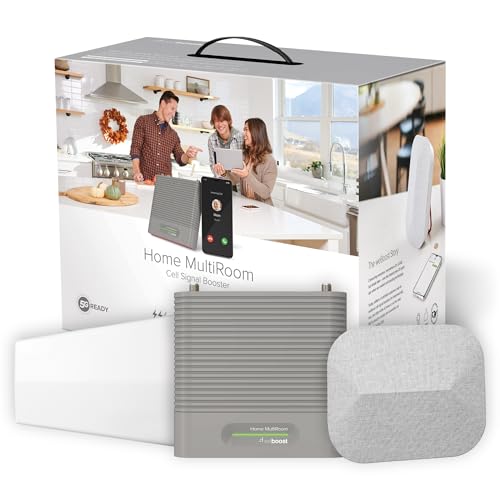
weBoost Home MultiRoom Signal Booster, Model 470144

weBoost Drive X RV Base Signal Booster Kit, Model 476021
The Details Behind The Selections
Large homes with marginal outdoor reception are the clearest fit for this BrstsWhel system. Its stated coverage scales with the signal captured by the exterior antenna, reaching about 3,000 square feet from a moderate signal and up to 7,000 square feet from a strong one, so your building’s layout and local tower coverage will shape the result.
The installation uses an exterior log-periodic antenna, an indoor unit, and roughly 32 feet of separation between antennas. That arrangement is more involved than a single-room extender, but it suits Android users who need calls and data across several floors or work areas.
What Pays Off
- Up to 7,000 square feet of stated coverage supports large homes and offices.
- Compatibility with 5G, 4G LTE, and 3G traffic covers common Android usage.
- Support for Bands 5, 12, 13, and 17 covers several cellular frequencies.
- The external antenna can capture stronger reception than indoor placement.
Trade Offs
- No usable signal at the exterior antenna means there is nothing to amplify.
- 5G performance depends on locally deployed 4G-band service because dynamic spectrum sharing uses existing frequencies.
- Installation requires antenna placement and careful separation, so outdoor wiring and weather exposure deserve attention.
Key Specs
Made For
This system fits households across U.S. carriers that receive a measurable cellular signal outside but struggle to carry it indoors.
A Better Fit Elsewhere
Choose weBoost Home MultiRoom instead for a carrier-neutral home setup where a more structured multi-antenna system better matches your space.
This narrower booster makes sense for Android households concentrated on AT&T or T-Mobile service, particularly in areas using low-band 700 MHz frequencies. The product context names Bands 12 and 17, which can help signal travel farther and penetrate buildings better than some higher-frequency bands.
Compared with the broad multi-carrier framing of BrstsWhel, the case here is more focused. You gain a clear low-band target, but households carrying phones from several services may prefer a wider-frequency system.
Notable Gains
- Band 12 and 17 support targets AT&T and T-Mobile low-frequency coverage.
- Android phones, tablets, and hotspots can use the amplified cellular network.
- The specified 698–716 MHz uplink and 728–746 MHz downlink ranges provide a clear compatibility target.
- Set-and-support availability makes troubleshooting more approachable for first-time owners.
Worth Noting
- Compatibility remains carrier- and band-specific, so service outside the named networks may not deliver comparable results.
- The product context also mentions other carriers and brands, yet the Band 12/17 focus makes the core use clearest for AT&T and T-Mobile.
- Antenna placement can determine indoor results, and long extension cables introduce avoidable signal loss.
Right Fit For
This option suits AT&T or T-Mobile subscribers in low-band coverage areas who mainly need improved indoor reception for an Android phone or tablet.
Another Choice May Suit
weBoost Home Studio Omni is the stronger fit for a mixed-carrier household or a Canadian location.
Think of the Liahomco as an energy reserve rather than a reception booster. It keeps an Android phone charged during camping, road trips, outages, and other situations where cellular service may exist but an outlet does not, which makes it a useful companion to a vehicle signal system.
The stated 80,000mAh capacity is substantial, yet the large battery and multiport layout will add weight to a pack. For a desk or travel bag, that is a fair exchange; for a lightweight day hike, the Liahomco Home Studio Omni offers no comparable battery function at all.
Positive Takeaways
- Up to 30W USB-C PD charging can replenish compatible Android devices more quickly than a low-output pack.
- Five outputs and two inputs reduce cable juggling when several devices need power.
- The stated capacity supports repeated smartphone charges during an extended trip.
- An LED display and non-slip exterior help with remaining power checks and handling.
Small Caveats
- Its size and weight make it less convenient than a compact power bank for everyday carry.
- 30W charging depends on the phone, cable, and protocol supporting the same power level.
- Charging capacity does not improve reception, so navigation and calls still depend on an available cellular signal.
Quick Facts
Built With In Mind
Campers, long-distance travelers, and households preparing for outages benefit most from its high reserve and multi-device layout.
Consider Something Else When
Choose weBoost Drive Reach Overland instead when your main problem is weak mobile reception rather than limited battery life.
Remote travel is the defining use case for weBoost Drive Reach Overland. Designed for off-road vehicles, it targets the moments when navigation, trail communications, and roadside assistance need more dependable reception than a handset can provide alone.
The stated support for major U.S. carriers makes it more broadly relevant than the AT&T and T-Mobile focus of F FREEQUEEN LOVE LIFE. In a truck or SUV, however, secure antenna placement and cable routing matter, especially around metal body panels and roof-mounted accessories.
What Stands Out
- Vehicle-focused construction suits off-road trips where homes and fixed towers are far away.
- Support for 5G and 4G LTE across major U.S. carriers accommodates changing network conditions.
- An Android phone can use improved reception without relying solely on satellite communication.
- Setup support is available for installation and connectivity questions.
Points To Consider
- It cannot create service where no carrier signal reaches the receiving antenna.
- Roof or hood placement may need reinforcement to resist vibration on rough roads.
- Vehicle cable runs should avoid sharp metal edges, pinch points, and excess slack.
Made For
Off-road drivers, overlanders, and remote campers gain the most from its vehicle-specific approach.
Reach For A Different Pick When
weBoost Drive X RV Base is the more natural choice for an installed setup inside a larger RV or trailer.
Home Studio Omni is built around an omni antenna, which receives and distributes cellular signals across a broad direction rather than depending on a single narrow alignment. That design makes it practical for a home office where a desk, conference area, and adjoining room may all need coverage.
The stated capacity reaches up to 2,000 square feet, placing it below the larger BrstsWhel claim but within a more defined home-office range. Its listed network support spans U.S. and Canadian carriers, a useful distinction from U.S.-only products.
A Strong Showing
- Omnidirectional coverage simplifies placement compared with a tightly aimed antenna.
- The stated 2,000-square-foot range suits home offices and medium residential work areas.
- 4G LTE and 5G support accommodates modern Android voice, navigation, and data use.
- U.S. and Canadian carrier compatibility broadens its geographic fit.
Honest Caveats
- Actual coverage depends heavily on the cellular signal reaching the system’s receiving point.
- Large homes with several exterior walls may exceed its stated indoor range.
- Setup support can help with placement, though the system still needs usable carrier service nearby.
Feature Snapshot
Who It Suits Best
Remote workers and mixed-carrier households in the U.S. or Canada benefit from its broad indoor orientation and office-sized coverage.
Look Elsewhere When
BrstsWhel Home & Multi-Room better fits a very large property with a strong outdoor signal and a need for greater stated area.
Home MultiRoom targets a common household problem: a signal that works near one exterior wall but disappears in bedrooms, upstairs offices, or the kitchen. Its multi-room architecture distributes cellular service across as many as four rooms, while the stated maximum area reaches 5,000 square feet.
That puts it between Home Studio Omni and the broader BrstsWhel claim. For a multi-carrier home, the tradeoff is more involved placement, yet it remains a more natural choice than a vehicle kit or a battery-only solution.
Useful Strengths
- Coverage for up to four rooms serves common whole-home weak-signal zones.
- The 5,000-square-foot stated range fits many large homes and multipurpose properties.
- Major U.S. carrier support suits households with mixed Android plans.
- 4G LTE and 5G coverage serves calls, text, navigation, and streaming.
Trade-Offs To Consider
- Room count is a useful shorthand, though walls, floors, and antenna placement still matter.
- The system cannot improve reception where the receiving antenna captures no usable signal.
- Multiple indoor components add installation and cable-management work compared with a compact one-room system.
Best Suited To
Families and remote workers spread across several rooms benefit from its combination of multi-carrier support and stated large-home coverage.
Where A Sibling Pick Shines
weBoost Home Studio Omni fits a smaller home office better, particularly when broad directional reception and Canadian network support matter.
The Drive X RV Base is purpose-built for people who need cellular service inside an RV, camper, or trailer. An exterior receiving antenna can capture a stronger signal than a device inside the living space, then distribute it to phones, tablets, and other cellular equipment throughout the vehicle.
Compared with Drive Reach Overland’s off-road focus, this kit speaks more directly to RV habitation and extended stays. The trade-off is installation complexity, since exterior placement, cable entry, and interior distribution must be planned around the vehicle’s construction.
Real Benefits
- An exterior receiving position improves the chance of capturing a stronger tower signal.
- Indoor distribution supports Android devices used throughout an RV or trailer.
- 5G and 4G LTE support covers common voice and data connections on major U.S. networks.
- A base-station approach can serve several devices rather than one handset.
Details To Watch
- Owners need to seal cable entry points carefully to prevent moisture from reaching the vehicle interior.
- Roof-mounted antenna hardware should be checked periodically for looseness and cable wear.
- Performance still falls sharply when distant towers provide no usable signal at the antenna.
The Right Fit
RV travelers, campers, and trailer owners needing broad in-vehicle cellular coverage gain the most from this model.
A Better Fit Elsewhere
weBoost Drive Reach Overland is the more natural choice for off-road vehicles that need a mobile signal system rather than an RV-centered installation.
Choosing Between Signal and Battery Support
Start by identifying the failure you actually face. A dropped call, stalled map download, or weak video stream points toward reception, while a phone that repeatedly dies away from an outlet calls for stored power. Treating both as the same “booster” problem can leave you carrying the wrong tool.
Confirm the Cellular Source
Check the signal where the receiving antenna will sit, not only beside your Android phone indoors. Outdoor bar readings, carrier compatibility, and the frequencies used in your area provide a practical baseline. A system cannot amplify a signal that reaches its antenna without usable strength.
Match the Coverage System
A single indoor unit may suit one office, while several rooms require a multi-room layout. Large homes may need an exterior receiving antenna and longer cable runs, and vehicles demand secure, weather-resistant placement. The stated square-foot figures are useful guides, though construction materials often determine real indoor reach.
Treat a Power Bank as a Companion
A large power bank supports an Android device after reception has been improved, but it does not strengthen the network. Its rated capacity and wattage describe stored energy and charging speed, not coverage. Packing one alongside a vehicle booster makes sense for long trips where both usable reception and dependable charging may be intermittent.
Avoid Confusing the Two Jobs
Common Shopping Slip Ups
A large battery-capacity number does not translate directly into a guaranteed number of phone charges because screen size, battery condition, cable quality, and conversion losses affect the result. Likewise, coverage area is only one part of a cellular system, so check carrier bands and receiving-antenna conditions before choosing.
What The Higher Tier Buys
A higher-tier home system may provide more transmitting and receiving components, broader frequency support, or capacity for additional rooms. The extra hardware helps only when placement and local service support it, so a simpler matched system can serve a small space more efficiently than an oversized one.
Frequently Asked Questions
Can a power bank strengthen Android reception?
No. A power bank stores electrical energy for charging, while a cellular booster strengthens an available radio signal.
Which booster suits a large home?
Look for a multi-room system with sufficient receiving capacity and an exterior antenna position that captures usable service. Stated square footage offers only a starting estimate.
Do cellular boosters work without carrier service?
No. The system needs a detectable signal at its receiving antenna before it can distribute stronger service indoors or inside a vehicle.
Is a power bank useful with an off-road booster?
Yes, particularly during long trips where your Android phone needs repeated charging and an outlet is unavailable. The two products solve separate problems.
Can one booster support several Android phones?
Multi-room and vehicle base-station systems can support several cellular devices. Band compatibility and the available receiving signal still determine the result.
Wrap Up
The best choice depends on the problem behind your dead zones: reception calls for a correctly placed cellular system, while battery runtime calls for the Liahomco power bank. Match the equipment to your carrier, available signal, room count, and vehicle, then account for cable routing and weather exposure before installing.
