


A dead iPhone can disrupt a commute, delay a road trip, or leave you without directions during a long day away from home. Battery banks for iPhone range from compact models for routine top-ups to high-output units that can also power tablets and laptops. The right balance depends on capacity, charging speed, connector setup, and how much equipment you need to carry.
The Picks In Brief

LHUOED Portable Charger 50000mAh with Built-In Cables

LILIO Portable Charger Power Bank 60000mAh 22.5W

VEGER 10000mAh Power Bank with Wall Plug and Cables
TALIX 100W 10000mAh Power Bank with USB-C Cable

MaiVoz 56800mAh 22.5W PD Power Bank

TALIX 20000mAh Laptop Power Bank with 190W Output
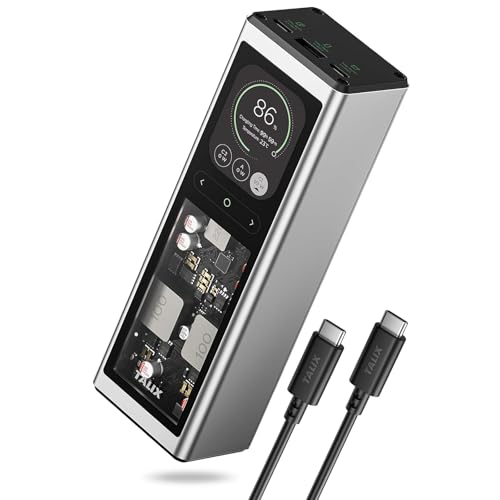
TALIX 140W USB-C Power Bank 20000mAh 3-Port
The Strengths Of Each Pick
LHUOED combines a 50,000mAh reserve with a foldable wall plug, built-in USB-C and iOS cables, plus USB-A and USB-C ports. That arrangement suits road trips, airport layovers, and busy homes where leaving a separate cable behind is likely.
The wall plug reduces the need for a second adapter, while the integrated cables remove much of the cable clutter that turns your phone bag into a small electrical drawer. Compared with the smaller VEGER, LHUOED offers substantially more reserve, although the larger body may take up more room.
Useful Highlights
- 50,000mAh provides useful backup for several phones over a multi-day trip.
- Built-in USB-C and iOS leads support your iPhone without a loose cable.
- USB-A and USB-C ports expand compatibility with other travel devices.
- The attached plug handles wall charging without a separate adapter.
Practical Considerations
- The high capacity makes this heavier and bulkier than a daily commuter model.
- Built-in cables cannot be replaced independently, so damaged leads reduce usability.
Quick Facts
Built With In Mind
You benefit most from this model through long drives, camping trips, or homes where several phones need dependable reserve power.
A Better Fit Elsewhere
The VEGER 10000mAh Power Bank with Wall Plug and Cables is easier to carry for routine commuting and short flights.
Capacity is the defining feature here: 60,000mAh provides a large reserve for family trips, outdoor work, or an extended period away from reliable outlets. You can keep several devices running without reaching for a wall socket after every battery check.
The 22.5W PD output uses Power Delivery, a charging standard that negotiates a suitable power level with compatible devices. Unlike LHUOED’s cable-first approach, LILIO focuses on higher reserve and faster charging, so you may still need to carry your preferred cable.
A Few Highlights
- The 60,000mAh capacity suits long family trips and shared device charging.
- 22.5W PD output supports compatible iPhone fast charging.
- Large power reserve reduces dependence on airports and campsite outlets.
- It can serve as a central charging supply for several travel devices.
Honest Caveats
- Its considerable size and weight may be excessive for pocket charging.
- Fast charging depends on device and cable compatibility.
- Large batteries need regular charging and sensible partial-use habits between trips.
Feature Snapshot
Made For
Families, campers, and frequent travelers benefit most from carrying one high-reserve supply for multiple phones.
Another Choice May Suit
The MaiVoz 56800mAh 22.5W PD Power Bank may suit you better when camping and travel compatibility matter alongside substantial capacity.
VEGER puts everyday phone backup into a relatively compact form. The 10,000mAh capacity is smaller than the travel-focused models above, but the built-in AC plug, USB-C cable, micro USB cable, and iOS cable keep the package self-contained.
Pass-through charging lets the power bank charge from a wall outlet while it also powers a connected device, which can be handy overnight before a flight. For daily commuters, that convenience may outweigh the lower reserve, particularly since you can restore the battery at your desk before leaving home.
Why It Works Well
- The built-in wall plug removes the need to carry a separate adapter.
- Integrated cables cover common phone and accessory connections.
- Pass-through charging supports an overnight charging routine.
- Its lower capacity is easier to manage during daily commutes.
Smaller Caveats
- 10,000mAh offers less phone charging than the 50,000mAh and 60,000mAh models.
- Owners of older cable-based devices may benefit from carrying an adapter.
- The fixed cable set may age faster than replaceable accessories.
Key Specs
Right Fit For
Daily commuters and short-flight travelers benefit from the compact size, integrated wiring, and straightforward wall recharging.
Look Elsewhere When
LHUOED’s 50,000mAh model fits you better when your trip needs several days of reserve rather than one or two routine top-ups.
TALIX takes a different approach by targeting compatible USB-C laptops rather than maximizing phone capacity. Its 100W output, a measure of electrical power delivery, can serve tablets, smartphones, laptops, and handheld gaming devices that accept USB-C charging.
The built-in cable avoids one loose accessory, while 10,000mAh keeps the pack relatively compact. That combination may prove useful during a flight or work session, though a laptop draws considerably more power than a phone and 10,000mAh is primarily an emergency reserve.
Where It Delivers
- Up to 100W output supports compatible USB-C laptops and tablets.
- The attached USB-C cable simplifies laptop and phone charging.
- Automatic power adjustment matches supported device requirements.
- Compact capacity reduces bulk compared with high-reserve travel packs.
Worth Bearing In Mind
- Laptop charging is limited by the 10,000mAh capacity.
- The unit only reaches its strongest output after meaningful recharging.
- Older laptops with different ports will need appropriate adapters.
Built For
Mobile creative professionals benefit most as a lightweight emergency supply for a compatible laptop and phone.
Swap It Out When
TALIX’s 20000mAh Laptop Power Bank with 190W Output suits you better for longer laptop sessions and several connected devices.
MaiVoz balances a 56,800mAh reserve with 22.5W PD charging for compatible iPhone, Android, and USB-C devices. That makes it a practical fit for camping, roadside work, and road trips where charging locations can be distant or inconsistent.
Unlike the TALIX 100W model, MaiVoz concentrates on phones and smaller USB-C devices rather than laptop power. Its capacity sits just below LILIO’s 60,000mAh unit, so the practical distinction rests more on intended use and supported device mix than on a dramatic capacity gap.
What Helps Most
- The large battery reserve supports phone charging across a multi-day outing.
- 22.5W PD output can shorten charging time on compatible devices.
- USB-C charging broadens support beyond a single iPhone model.
- Capacity suits outdoor work and travel away from dependable outlets.
- The Light Black finish gives the large enclosure a restrained appearance.
Things To Weigh
- Its size may be burdensome for daily pocket use.
- 22.5W output is well below the 100W and 140W laptop-focused models.
- You should periodically inspect the contacts and recharge the unit before storage.
The Main Details
Who Will Love This
Campers, road travelers, and outdoor workers benefit most from the large reserve and broadly compatible phone charging.
A Sibling Pick Shines
The LILIO 60000mAh model offers more capacity for families sharing one supply across several phones.
Three charging connections and up to 190W of combined output make this TALIX model useful beyond an iPhone. It can handle a compatible laptop, tablet, phone, watch, or earbuds through one built-in USB-C cable, one USB-C port, and one USB-A port.
Single-port output reaches 140W, while total output across connected devices reaches 190W. That distinction matters for mobile workstations because device demand changes, and the power bank must support more than just one phone-sized charging load.
Real-World Strengths
- Three connection options support phones, laptops, tablets, and accessories.
- The 140W single-port output suits compatible USB-C laptops.
- Up to 190W total output supports a broader connected device mix.
- The built-in cable reduces dependence on a loose USB-C lead.
- 20,000mAh offers more laptop reserve than the 100W TALIX.
Practical Considerations
- Connected laptops must support the required USB-C power profile.
- Running several devices drains the 20,000mAh reserve faster.
- The higher-output electronics are bulkier than basic phone packs.
Technical Reference
Who Should Grab It
Mobile professionals benefit most from one supply that can cover a laptop, phone, and smaller accessories.
Reach For A Different Pick When
The TALIX 140W USB-C Power Bank 20000mAh 3-Port better concentrates output on a single demanding laptop connection.
This TALIX model concentrates on demanding USB-C laptops through 140W peak output using PD 3.1 EPR, an extended power-delivery profile for high-wattage devices. Its three-port layout keeps smaller-device charging available, but the primary strength is clearly workstation-class output.
The listed charging examples depend on a compatible device and PD 3.1 EPR cable, so you should check your laptop before relying on those rates. Compared with TALIX’s 190W total-output model, this one favors one strong connection over several moderate loads.
Strengths Worth Knowing
- The 140W USB-C output supports demanding compatible laptops.
- Three ports retain charging options beyond a single laptop.
- 20,000mAh balances useful capacity with greater portability than high-reserve phone packs.
- PD 3.1 EPR supports devices requiring an extended power profile.
Details To Watch
- The stated laptop charging rates require matching device and cable support.
- A high output rating does not replace adequate battery capacity for extended work.
- You may need separate adapters for older non-USB-C devices.
- Store the unit partially charged and inspect its cable connections periodically.
The Right Fit
You benefit most from this model through travel days spent working on a PD 3.1 EPR-compatible USB-C laptop away from outlets.
Not Your Match When
The VEGER 10000mAh model suits you better for simple phone top-ups that prioritize portability over laptop power.
What To Prioritize In A Portable Power Supply
Start with capacity based on your longest period away from an outlet. A 10,000mAh bank is more practical for routine commuting, while 50,000mAh or greater offers broader support for family travel, camping, and several phone top-ups. Higher capacity generally means more weight and bulk, so carrying extra reserve may not suit a minimalist phone case.
Charging speed matters after capacity. Power Delivery, commonly shortened to PD, is a standard that negotiates suitable charging rates with compatible devices. Your iPhone also benefits from a suitable USB-C connection, while laptops may require higher wattage and compatible cables. A high rating alone does not guarantee the same result across every device.
Matching The Charger To Your Routine
Capacity For Day Trips For daily commuting, a compact 10,000mAh model can provide the useful balance of backup capacity and easy carrying. Long weekends, outdoor work, and group travel justify larger reserves more readily, particularly when several devices need access to the same power supply.
Ports And Built-In Cables Built-in leads reduce the number of loose accessories, while open ports add flexibility. Check your actual device mix first: iPhone-only travel may need little beyond USB-C, whereas laptop users benefit from additional ports and clearly specified output.
Output For Larger Devices USB-C charging standards such as PD, PD 3.0, and PD 3.1 EPR describe different supported power ranges. Compatibility depends on the connected device, cable, and required charging profile. You should confirm those requirements before traveling rather than relying on the wattage printed on the battery bank.
Mistakes Worth Dodging
Where Shoppers Go Wrong
A large capacity rating can distract you from portability. High-capacity batteries add weight, and a bank that is inconvenient to carry may remain unused. Choose enough reserve for realistic outages rather than an extreme number that rarely fits your normal routine.
Checking only watts creates another common error. Charging speed also depends on device support, port selection, cable capability, and battery level. Confirm that your phone or laptop supports the advertised charging standard.
What Separates Premium From Basic
Higher-output models earn their place through stronger laptop charging, multiple ports, or larger usable capacity. Those upgrades matter during workdays, flights, and outdoor trips where your phone is not the only device needing power. For simple daily top-ups, a smaller all-in-one model may deliver better convenience for less bulk.
Frequently Asked Questions
How much capacity do you need for an iPhone?
A 10,000mAh bank suits routine commuting and short outings. Choose 50,000mAh or more for extended trips, several devices, or limited access to outlets.
Can you charge an iPhone and laptop from one power bank?
Compatible models can charge both, although laptops consume much more energy. Check USB-C power requirements, supported charging profiles, ports, and battery capacity before your trip.
Does higher wattage mean faster charging?
Higher wattage can support faster charging on compatible devices. Your iPhone or laptop must also support the same standard, and the cable and port must permit the required output.
Is a built-in cable convenient?
Built-in cables reduce loose accessories and simplify packing. They cannot be replaced independently, so you should consider whether your devices rely on the included connection.
Should you carry a high-capacity model on every flight?
Large banks help during long trips but may be excessive for short outings. A compact 10,000mAh model is often easier to manage for routine commuting and brief travel.
Final Verdict
Choose your battery bank around the weakest point in your day. Commuters benefit from the compact VEGER, long-distance travelers gain useful reserve from LHUOED, LILIO, or MaiVoz, and mobile professionals have better laptop options within the TALIX range. Match capacity and output to your devices, then keep the unit charged before leaving home.
