


Battery-backed scheduling solves a familiar problem: lights, pumps, ventilation fans, and low-voltage circuits need dependable control without manual switching. It matters most in RVs, solar setups, workshops, outdoor areas, and commercial panels where schedules must survive short outages or battery changes. The right device depends less on the timer interface than on voltage, contact arrangement, load type, and how its memory behaves.
A Quick View Of The Lineup

Zunate 12V DC Timer Switch 30A

Zunate Digital Timer Switch 85-265V 30A

Zunate Weekly Timer Switch 100-130V 30A

OFF! Outdoor Citronella Candle 8 oz

Intermatic T104M 24-Hour Timer
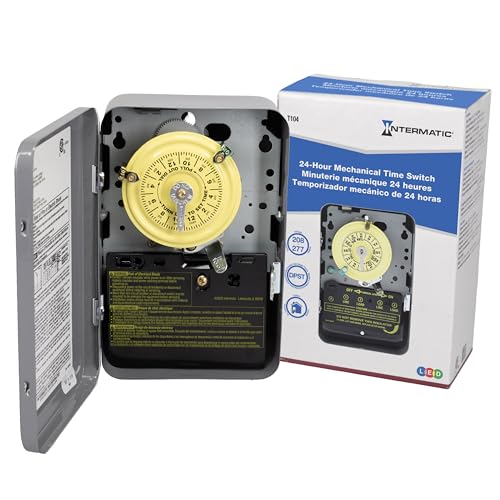
Intermatic T104 208-277V DPST Timer

Intermatic T101 120V SPST 40A Timer
A Deeper Look At The Lineup
A 12-volt DC system changes the design brief completely, and this Zunate switch is built around that requirement rather than adapting a household AC timer. It suits RV interior circuits, solar-powered equipment, marine systems, and other direct-current loads, where a standard wall timer would have the wrong supply requirements.
You get more control than a simple countdown can offer, although the panel programming deserves a careful setup. Compared with the Intermatic mechanical models later in the lineup, it relies on electronics and an internal button battery to preserve its clock and schedules.
A Favorable Mix
- Sixteen daily switching programs support detailed routines for lighting and equipment cycles.
- Fifteen weekly grouping choices help repeat the same schedule across selected days.
- The 24-hour countdown complements fixed schedules for short-duration tasks.
- Program memory survives a complete power disconnect or battery swap.
Points To Note
- The 30A rating describes switching capacity, not permission to exceed a connected circuit’s limits.
- Owners should plan secure panel placement and clear access to the programming controls.
At A Glance
Built With In Mind
This model fits RV, solar, and marine owners who need programmable 12V control with schedule retention.
A Better Fit Elsewhere
Installers working with standard 120V AC equipment should consider the Intermatic T101 instead.
Wide AC input compatibility makes this digital timer more accommodating than the 100-to-130-volt Zunate model. Its 85-to-265-volt range covers common grid-powered equipment, while the DIN-rail format suits organized control panels rather than a standard wall box.
Eighteen daily switching events offer finer scheduling than most of the mechanical options here, making the setup attractive for signage, pumps, or water-heating equipment. In practice, a panel-mounted DIN timer still needs compatible wiring, enclosure space, and correct load selection.
What Pays Off
- The broad 85V-to-265V AC range simplifies installations spanning common supply voltages.
- Eighteen daily events support equipment that runs several distinct cycles.
- Fifteen weekly combinations reduce repetitive day-by-day programming.
- Internal battery memory preserves timing settings through outages and grid fluctuations.
- The countdown mode provides a useful option outside fixed schedules.
Trade Offs
- Its DIN-rail format requires compatible panel space rather than a simple wall opening.
- The electronics require a reliable incoming supply, even though memory survives an interruption.
- Complex programming takes more attention than a mechanical dial.
Who It Suits Best
Electricians and experienced panel installers benefit from the flexible schedule and broad voltage range.
Where A Sibling Pick Shines
The Zunate 12V DC Timer Switch 30A is the more natural fit for a solar RV or other low-voltage system.
The middle ground in Zunate’s digital range is this 100-to-130-volt AC weekly timer. Its supply range suits the usual residential split-phase voltage, while the DIN-rail enclosure makes sense inside a control panel controlling ventilation fans, heating equipment, or signage.
You can program up to 16 daily events and combine schedules across the week. Compared with the broader Zunate Digital Timer Switch 85-265V 30A, it offers less voltage flexibility but a more focused fit for standard North American panel systems.
Useful Touches
- Sixteen daily on/off events provide detailed control for recurring equipment.
- Fifteen weekly groupings make weekday and weekend routines practical to establish.
- The 24-hour countdown gives you a separate short-cycle option.
- Internal lithium-cell memory retains the clock and schedule after an outage.
Small Caveats
- You need a DIN-rail panel and compatible wiring arrangement.
- Its AC input range does not cover low-voltage DC circuits.
- Program changes take planning, especially across several repeat cycles.
The Right Fit
Workshop owners and panel installers needing detailed weekly control on 120V equipment will find this format practical.
Reach For A Different Pick When
Choose Zunate Digital Timer Switch 85-265V 30A for installations spanning a wider AC input range.
This candle belongs on the list only as an outdoor atmosphere option, not as an electrical timing device. A pair of 8-ounce citronella-scented candles can add a familiar scent and gentle light to a backyard gathering, patio dinner, or quiet evening near a campfire.
Each candle offers up to 25 hours of burn time, so the two-pack spreads that use across multiple gatherings. The honest read is simple: it creates ambiance, but it does not schedule or switch equipment.
The Upside
- The two-pack supports separate tables, rooms, or successive gatherings.
- Each 8-ounce candle burns for up to 25 hours.
- The citronella scent reinforces a familiar outdoor setting.
Where It May Fall Short
- It provides no electrical control, scheduling, or battery-backed memory.
- Burn time varies with candle conditions and use.
- You must extinguish the candles before leaving them unattended.
Made For
Backyard hosts and campers seeking scented candlelight benefit from this two-candle set.
Skip It When
Choose the Intermatic T104 instead for automatic control of a 208-to-277V circuit.
Moving from electronic timers to a mechanical mechanism changes what you retain: the dial program remains physical rather than stored in a battery-backed clock. The Intermatic T104M is a 24-hour DPST mechanism, with DPST meaning a double-pole, single-throw contact arrangement.
This is a component for a compatible Intermatic timer housing, not a complete wall timer. It suits repair work or replacement in selected timer systems, so matching the housing and motor is essential before ordering.
Real Benefits
- The mechanical dial avoids dependence on a clock battery for schedule retention.
- A full 24-hour cycle supports equipment that repeats once per day.
- The 208-to-277V DPST design fits high-voltage control applications.
- Replacing a compatible mechanism can preserve an existing enclosure.
Worth Bearing In Mind
- The motor is sold separately.
- Compatibility depends on the specified Intermatic timer numbers and housing.
- Mechanical timing offers fewer scheduling choices than the Zunate digital models.
Who Will Love This
Houses with a compatible Intermatic enclosure benefit from this mechanism as a targeted replacement part.
Another Choice May Suit
The Intermatic T104 24-Hour Mechanical Timer is easier to consider when you need a complete indoor unit.
The Intermatic T104 brings a mechanical schedule to 208-to-277V equipment that needs substantial switching capacity. Its DPST contact system controls both conductors of the circuit, while the 24-hour dial gives the load a predictable daily operating window.
Unlike the battery-memory Zunate models, its schedule does not depend on an internal electronic clock. That simplicity benefits workshops and commercial settings, although the 208-to-277V supply makes it unsuitable for ordinary 120V residential equipment.
Benefits That Matter
- Supports loads up to 40A within the specified electrical system.
- Handles motor loads up to 5HP at 240V under the stated conditions.
- The two-pole contact arrangement switches both legs of the circuit.
- Mechanical timing avoids clock reprogramming after an outage.
Details To Watch
- The 208-to-277V range excludes 120V circuits.
- Daily mechanical scheduling cannot match multi-event digital programs.
- Installation and load selection require care around high-voltage equipment.
Essential Details
Professional Pick
Commercial operators and experienced installers benefit from the T104’s high-load, two-pole arrangement.
Look Elsewhere When
The Intermatic T101 is the more suitable choice for indoor equipment connected to a 120V circuit.
For a straightforward indoor schedule, the Intermatic T101 reduces the decision to familiar mechanics. It uses a 24-hour dial and can provide as many as 12 on/off operations per day, with a minimum interval of one hour.
SPST means single-pole, single-throw, so this model controls one conductor rather than both legs of a circuit like the T104. That makes it appropriate for compatible 120V equipment where a double-pole arrangement is unnecessary.
Strong Points
- A 24-hour mechanical dial makes daily scheduling visible and direct.
- Up to 12 daily operations cover several equipment routines.
- The 40A rating supports substantial loads on compatible circuits.
- No electronic clock means no battery-dependent schedule storage.
- The 120V format fits common residential equipment.
Some Limits To Know
- The one-hour minimum interval excludes subhourly countdown operation.
- SPST switching does not provide the same two-pole isolation as a DPST model.
- Mechanical settings require physical adjustment rather than remote control.
Best Suited To
Homeowners and workshop operators needing dependable 120V daily scheduling will appreciate this straightforward design.
Swap It Out When
Choose the Zunate Digital Timer Switch 85-265V 30A for minute-level, multi-event scheduling across a wider AC range.
Choosing a Timer Around Your Electrical System
Voltage comes before scheduling
Start with the exact supply feeding the device. The Zunate 12V DC Timer Switch 30A handles low-voltage DC, the Intermatic T101 handles 120V AC, and the 208-to-277V models serve higher-voltage equipment. A timer with a high current rating still cannot control a circuit outside its voltage range.
SPST and DPST change the installation
SPST describes one switched conductor, while DPST switches both conductors of a two-wire circuit. Double-pole control can suit equipment requiring both sides disconnected, but it must match the circuit configuration. Confirm enclosure style, wiring space, and equipment requirements before installation.
Daily programs serve different routines
Mechanical timers are efficient for repeatable daily windows. The Zunate digital models support one-minute intervals, multiple daily events, weekly grouping, and countdowns, which helps with equipment cycling throughout the day. More scheduling freedom also means more programming and a clearer need for accurate clock settings.
Memory is not universal
The Zunate models use internal batteries to retain programmed times, while mechanical dials remain physically set. Memory behavior matters for battery banks, temporary outages, and installations where clock resets would interrupt operations. Check the cell type and replacement process before deploying a digital timer in a remote location.
Practical Checks Before Installation
Mistakes Worth Dodging
Do not treat a 30A or 40A label as permission for any equipment in that range. Motor starting current, continuous loads, conductor size, and local electrical requirements still apply, and a low-voltage timer never belongs on an AC circuit.
Where The Extra Money Goes
Higher-end control usually adds broader voltage support, more programs, smaller timing increments, or retained clock data. Those gains matter in RV systems, panels, and complex routines; a simple mechanical timer remains easier to maintain for one daily operating window.
Frequently Asked Questions
What type of timer keeps its schedule during an outage?
Digital timers with internal memory can retain their programmed clock settings. Mechanical timers remain physically programmed, although the driven mechanism may continue advancing only while powered.
Which timer suits an RV’s 12V lighting?
A 12V DC timer designed for vehicle or battery-bank circuits is the relevant choice. Confirm wire size, circuit limits, and whether the load requires a constant-on connection rather than scheduled switching.
Can a 120V timer control a 240V load?
No. Voltage compatibility is essential, and a 120V timer should not be used to control a 240V circuit. High-voltage equipment requires a timer rated for that supply and a correctly configured circuit.
Are mechanical timers more dependable?
They have fewer electronic parts and no battery-dependent clock. Mechanical construction suits simple daily schedules, while digital systems provide finer intervals and more events.
What does DPST mean?
DPST stands for double-pole, single-throw and describes a switch capable of controlling both conductors of a two-wire AC circuit. It is not interchangeable with every single-pole timer.
Final Verdict
Match the timer to your circuit before considering extra programs. Zunate models serve low-voltage, digitally scheduled, and panel-based systems, while the Intermatic options cover mechanical daily control from 120V through 208-to-277V. The OFF! candle adds outdoor atmosphere but performs no electrical timing, so keep that distinction clear. Choose the simplest model that satisfies your voltage, load, contact, and scheduling requirements.
