


A wind generator’s battery does more than start a motor. It stores irregular energy, carries the inverter’s load, and determines how long your system can operate when the wind falls quiet. These picks cover everything from compact power stations to high-capacity deep-cycle units and portable-generator replacement batteries.
Choose by voltage, capacity, terminal arrangement, and electrical role. A 12V battery with enough usable capacity handles routine loads, while a complete high-output system suits household backup and larger electronics. The honest catch is that several generator-specific batteries listed here fit conventional portable engines, not wind turbines, so their real-world relevance depends on your equipment.
The Main Contenders

OSCAL PowerMax 6000 Solar Generator 120/240V

Interstate DCM0100 12V 110Ah SLA/AGM Deep Cycle Battery

Casil 12V 18Ah SLA Battery for 7500 EXL Generator

YTX7L-BS 12V 6Ah Predator 3500 Battery
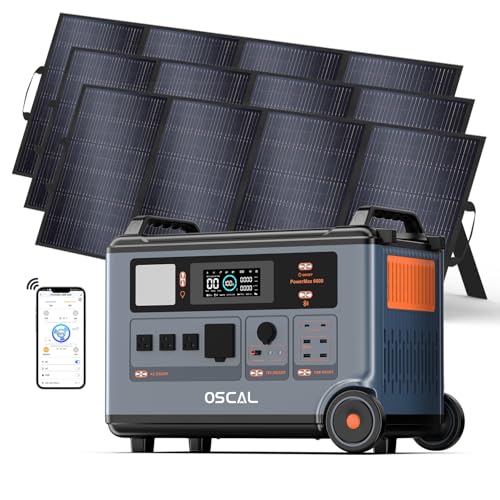
OSCAL PowerMax 6000 with Three 400W Solar Panels

GRECELL 500W Portable Power Station 519.48Wh
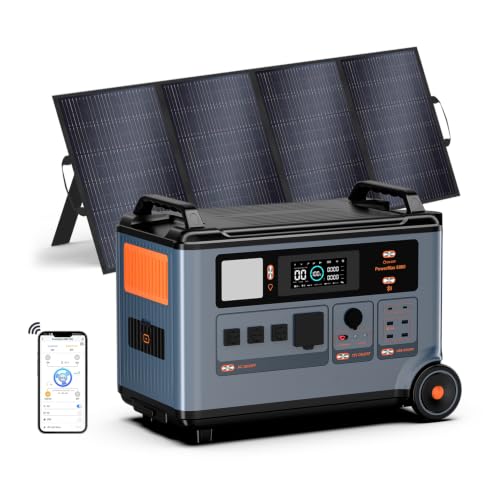
OSCAL PowerMax 6000 with 400W Solar Panel
A Closer Look At Each Pick
The PowerMax 6000 turns a 3,600Wh battery bank into a much broader power center for a home, cabin, or renewable-energy project. Its 6,000W continuous output and 9,000W surge capacity make it more useful for substantial appliances than a typical camping station, particularly across long outages where weather can interrupt charging.
Split-phase 120V and 240V output is the feature that matters most here. That arrangement allows compatible equipment to draw from the voltage it was designed for, although each circuit and appliance must remain within its own rating. Compared with the Interstate DCM0100, this is a complete power system rather than a single battery.
Real Benefits
- The 3,600Wh capacity gives household electronics more room to operate between charging periods.
- Dual-voltage output supports both common North American household circuits.
- Bi-directional DC and AC conversion suits renewable charging and battery management.
- Four AC outputs let you organize several loads without adding a separate distribution box.
Things To Consider
- This larger stationary-style system is harder to move than the GRECELL 519.48Wh option.
- Placement, ventilation, wiring, and load selection require careful attention during installation.
Quick Facts
Built With In Mind
You benefit most from this model as a household backup or renewable-energy hub with several compatible electrical loads.
A Better Fit Elsewhere
The GRECELL 519.48Wh suits campers who need lighter equipment with more varied USB outputs.
For a permanently installed renewable-energy bank, the DCM0100 is the most directly relevant battery in this roundup. Deep-cycle describes a battery designed to discharge repeatedly and recover from regular cycling, which fits a wind turbine’s irregular charging pattern better than a short-duration engine-starting battery.
Its 12V, 110Ah AGM construction gives a system substantial storage capacity without requiring a complete portable power station. That makes it sensible for a shed, workshop, or off-grid residence, provided your charge controller and inverter are configured for deep cycling.
Well-Handled Touches
- The sealed AGM format reduces loose-acid handling during routine operation.
- Deep-cycle construction suits repeated wind, solar, and RV discharge cycles.
- Insert terminals provide a secure connection for stationary battery banks.
- Maintenance-free operation simplifies ownership after installation.
Practical Considerations
- Its size and weight make installation a two-person task in many setups.
- Terminal position, case dimensions, and charge requirements need confirmation against your battery box.
- Owners commonly report a meaningful performance loss in very cold conditions, so storage temperature matters.
Technical Reference
The Right Fit
Home-system owners and renewable-energy hobbyists benefit most when their inverter and controller can work with a 12V AGM deep-cycle bank.
Consider Something Else When
The OSCAL PowerMax 6000 120/240V is a better fit for people seeking an integrated inverter and outlet package.
This Casil unit serves a different purpose from the renewable-energy systems around it. It is a 12V SLA replacement battery developed for compatible 7,500 EXL portable generators, so it may suit a small wind project only when the generator acts as the system’s starting or backup source.
The 18Ah capacity favors short engine-starting duties rather than extended storage. Its 7.13-by-2.99-by-6.57-inch case also matters greatly because battery compartments leave little room for improvised fits, and the drop-in terminals simplify installation only after dimensions and polarity have been checked.
Positive Takeaways
- The defined generator fit reduces uncertainty compared with an unlisted universal battery.
- Nut-and-bolt terminal hardware supports a familiar connection format.
- The compact 18Ah case fits naturally into compatible generator compartments.
Less Ideal Details
- This is not a deep-cycle wind-energy bank and shouldn’t be judged by that role.
- Owners of other generator models may find no useful case or terminal compatibility.
Core Details
Who It Suits Best
You benefit most as the owner of a compatible 7,500 EXL generator seeking a direct replacement starting battery.
Look Elsewhere When
The Interstate DCM0100 is the stronger match for a continuously cycling wind, solar, or RV battery bank.
The YTX7L-BS targets Predator 3500 generator systems, giving it a clear role as a compact starting battery. You may find it useful in a remote setup where a small portable engine supports a wind turbine controller, but its 6Ah capacity does not resemble the large storage volume of the Interstate DCM0100.
The sealed AGM design removes the liquid-acid handling associated with conventional flooded batteries. It also arrives with terminal hardware, which makes installation straightforward after you confirm cable clearance and electrical compatibility.
Everyday Advantages
- The sealed construction limits spill exposure during transport and installation.
- Vibration resistance suits mobile generators used at campsites or jobsites.
- The ready-to-connect format reduces setup time after arrival.
Worth Bearing In Mind
- The 6Ah rating is limited for sustained energy storage or frequent deep discharge.
- Long storage periods call for suitable charging maintenance rather than complete neglect.
- The narrow Predator 3500 fit may exclude your equipment entirely.
Made For
Portable-generator users needing a light, sealed replacement for a compatible Predator 3500 system benefit most.
Another Choice May Suit
The Casil 12V 18Ah SLA Battery offers more starting capacity for owners of a compatible 7,500 EXL generator.
Where the stand-alone PowerMax 6000 leaves charging hardware to the setup, this bundle adds three 400W solar panels. That makes it the more complete renewable package in the group, especially for a cabin or home that needs dependable daytime recharging alongside stored wind power.
The power station still carries the same core 3,600Wh capacity, 6,000W continuous output, and 9,000W surge capability as the smaller OSCAL bundle. The tradeoff is obvious: more equipment, more installation planning, and a larger site requirement, but also a broader replenishment option when wind conditions are poor.
The Practical Payoff
- Three panels provide a substantial solar charging path for a home backup installation.
- The 2,400W solar input supports faster replenishment than a single-panel arrangement.
- Split-phase output serves compatible 120V and 240V household loads.
- The 2,200W AC charging capability adds another route for restoring stored energy.
Details To Watch
- Sun exposure, panel placement, and cable routing require more planning than a battery-only purchase.
- Three panels demand meaningful roof or ground space, and portable use becomes less convenient.
Feature Breakdown
Who Will Love This
Homeowners with suitable solar exposure benefit most from this bundled charging and storage approach.
Reach For A Different Pick When
The OSCAL PowerMax 6000 with One 400W Solar Panel better serves you with less space and a simpler array.
The GRECELL 519.48Wh station fills the gap between a small engine-starting battery and a full home-power system. Its 500W continuous AC capacity is modest beside the OSCAL models, but the mix of USB, 12V, car, and wireless charging outputs makes it much more useful for phones, computers, lights, and portable tools.
Two pure sine wave AC outputs provide cleaner-shaped power for compatible electronics. That distinction matters because pure sine wave output more closely resembles standard household electricity than a modified waveform, which can be preferable for sensitive equipment.
A Few Strong Suits
- Ten output positions let you organize several low- and moderate-power devices.
- The 60W USB-C output supports compatible modern charging protocols.
- Wireless charging adds convenience for supported phones at a campsite.
- Its smaller capacity makes transport easier than the 3,600Wh OSCAL systems.
Some Limits To Know
- The 500W limit may be restrictive for heating, power tools, and large appliances.
- Owners commonly report that fan noise becomes noticeable during heavier continuous loads.
- Capacity is better suited to occasional portable use than extended household backup.
Best Suited To
Campers, travelers, and tradespeople benefit most when they need several device-charging options in one movable unit.
Where A Sibling Pick Shines
The OSCAL PowerMax 6000 120/240V is the better match for households needing substantially greater output and storage.
This one-panel bundle offers a practical middle ground between the stand-alone OSCAL PowerMax 6000 and its three-panel package. You get a 400W charging source, 3,600Wh battery capacity, and high-output 120V/240V conversion without committing to the site space required by three panels.
For a wind-plus-solar cabin, the included panel can replenish energy during calm weather while the turbine handles its own collection cycles. You still need suitable sunlight, correctly configured connections, and load management, since nominal panel output does not guarantee the same input at every hour or season.
The Upside
- The panel and power station arrive as a coordinated renewable-energy package.
- The 6,000W output comfortably exceeds the panel’s charging capacity for faster energy replenishment.
- Split-phase output accommodates both major North American household voltages.
- Four AC outlets simplify connection of multiple compatible loads.
Potential Compromises
- One panel may recover 3,600Wh slowly during limited or intermittent sunlight.
- The system remains bulkier and heavier than the GRECELL travel station.
- Proper ventilation and placement remain important during sustained high output.
The Main Details
Whose Shelf It Belongs On
Cabin owners and renewable-energy hobbyists with moderate roof or ground space benefit most from this matched setup.
Not Your Match When
The Interstate DCM0100 suits you better when you need a modular deep-cycle bank instead of an integrated power station.
Matching Storage To Wind Output
Start with voltage and system architecture. Most residential wind projects operate through a charge controller and inverter, so the battery voltage must match that equipment. A nominal 12V label alone does not prove compatibility with a 24V or 48V battery bus.
Capacity comes next. Amp-hours measure charge, while watt-hours measure stored energy, and actual runtime depends on inverter losses, temperature, cable losses, and discharge depth. Deep-cycle batteries tolerate repeated cycling better than small engine-starting units, but charge settings still determine how effectively they recover.
Physical fit deserves equal attention. Measure the battery compartment, cable reach, terminal orientation, ventilation route, and clearance around flammable materials. The Casil and Upstart batteries are model-specific starting components, while the DCM0100 and complete power stations serve distinctly different roles.
Common Wind Battery Mistakes
Mistakes Worth Dodging
Ignoring polarity and charge-controller voltage can damage a new battery before the turbine ever feeds it useful energy. Confirm every connection against your system documentation and avoid treating a portable-generator starter as renewable-energy storage. Dimension cable thickness for the intended current and long cable runs, since thin conductors lose meaningful energy as voltage drops.
What Separates Premium From Basic
Higher spending may buy greater usable capacity, stronger inverter components, more output connections, and bundled charging hardware. The OSCAL systems illustrate that step clearly: one panel supports a simpler setup, while three panels shorten replenishment time during suitable weather. The extra capability matters most for frequent outages, larger loads, or sites that cannot rely on one renewable source alone.
Frequently Asked Questions
Can a car battery power a wind generator?
A car battery can operate some small controllers, but its short starting design makes prolonged deep discharge undesirable. A deep-cycle battery is generally more appropriate for repeated wind-energy storage.
Are all 12V wind generator batteries compatible?
No. Voltage is only the first requirement. You also need compatible charging voltage, terminal layout, case dimensions, capacity, and the correct battery type for your controller.
Is more battery capacity always better?
Higher capacity can extend available runtime, but it also requires compatible wiring, charge control, space, and greater weight. Balance stored energy against your turbine’s realistic generation and load profile.
Can solar panels charge a wind generator battery bank?
A compatible solar charge controller can manage solar input into the same battery bank, often through an integrated power station or a properly designed parallel system. Avoid connecting separate charge sources without correct regulation.
What maintenance does an AGM battery need?
Keep terminals clean, maintain the proper charge state, and keep the battery within its intended temperature range. Periodic inspection helps reveal corrosion, swelling, loose connections, or unexpected heat.
Final Verdict
For renewable-energy storage, the Interstate DCM0100 is the clearest dedicated battery choice, while the OSCAL bundles suit people who also want an inverter and household outputs. The GRECELL station serves portable electronics, and the Casil and Upstart units fit specific portable-generator starting roles. Match the battery to the turbine controller first, then size capacity and connections around your real loads.
