


Solar storage has to fit two demanding roles: absorbing energy during daylight hours and supplying dependable power through outages or off-grid periods. The right battery depends on your inverter voltage, usable capacity, temperature range, physical space, and monitoring needs. This roundup covers home-scale storage, cold-climate charging, portable Starlink power, and connection cables.
The Choices Worth Comparing

ECO-Worthy Cubix100 48V 600Ah Six-Pack Battery System

BigBlue Starlink Mini Battery Pack

VATRER POWER 12V 300Ah Self-Heating LiFePO4 Battery
ECO-Worthy Cubix100 48V 200Ah Two-Pack Bluetooth Battery

XRDS-RF 12AWG 20FT Solar XT60 Cable

ELFCULB SB50 to XT90 10AWG Cable
ECO-Worthy Cubix100 48V 100Ah Server Rack Battery
Why These Options Stand Out
The ECO-Worthy Cubix100 48V 600Ah Six-Pack Battery System is built for installations that need substantial storage rather than a lightweight weekend setup. Its 48-volt architecture and stated 30.72-kWh capacity suit a dedicated equipment room, where six server-rack modules create a cleaner path to whole-home backup than scattered small enclosures.
You benefit most from higher household demand and a system designed by a qualified installer. Compared with the single 100Ah Cubix100 later in this roundup, the six-pack offers much greater storage capacity, but it also demands more floor space, electrical coordination, and attention to ventilation.
What Earns Its Place
- The 30.72-kWh stated capacity reduces the number of batteries needed for a high-demand storage design.
- Six matching 48V modules simplify capacity planning for a dedicated rack installation.
- LiFePO4 chemistry suits repeated deep-cycle storage applications.
Installation Logistics
- The rack needs adequate floor space, cooling, and cable routing.
- Hazardous-material shipping rules can complicate delivery planning.
- The system is non-returnable according to the listing.
Key Product Details
Built For Large Homes
This system fits households with substantial daily storage needs, a dedicated rack space, and an installer comfortable with high-voltage battery integration.
Consider A Smaller Arrangement
The ECO-Worthy Cubix100 48V 100Ah Server Rack Battery offers a more manageable starting point for smaller homes or incremental expansion.
The BigBlue Starlink Mini Battery Pack serves a different purpose from the rack systems here. Its stated 99Wh capacity and 27,500mAh rating target portable satellite-internet use, with the listing claiming up to five hours of runtime. That makes it relevant to remote work, field visits, and travel where maintaining a connection matters more than powering household appliances.
Its compatibility with the Starlink Mini and integrated stand or clip arrangement may reduce setup friction. You still need to keep the supplied connector arrangement and device fit in view, since this is a specialized portable pack rather than a general solar-storage battery.
Key Advantages
- The 99Wh capacity provides portable power without the bulk of a home battery bank.
- Stated five-hour runtime targets extended Starlink Mini use away from household outlets.
- Its dedicated form reduces the need for unrelated portable power stations.
Things To Consider
- Runtime varies with usage, signal demand, and remaining capacity.
- The pack needs periodic recharging during travel.
- Its specialized fit may not suit other satellite systems.
Made For Remote Connectivity
This pack suits Starlink Mini users who need portable power for travel, fieldwork, or outages around a temporary workspace.
A Better Fit Elsewhere
The VATRER POWER 12V 300Ah Self-Heating LiFePO4 Battery serves stationary off-grid storage rather than compact communications power.
Cold charging is the defining issue addressed by the VATRER POWER 12V 300Ah Self-Heating LiFePO4 Battery. Its internal management system activates heating below 32°F during qualifying charging conditions, then stops heating after the battery reaches 41°F. That behavior is particularly relevant to garages, sheds, and off-grid systems exposed to seasonal cold.
The 12V, 300Ah deep-cycle configuration gives you 3.6kWh of nominal energy, while app monitoring offers a clearer view of operating data than many basic banks. In a permanently cold climate, the added heating hardware is useful, but installation still demands a charger and enclosure suited to the location.
The Value In It
- Self-heating supports charging in below-freezing conditions, a common seasonal problem.
- The 3.6kWh nominal capacity provides useful storage for essential circuits.
- App monitoring helps you check battery status without relying only on enclosure indicators.
- LiFePO4 chemistry fits renewable-storage use with frequent charge cycles.
Area To Watch
- Heating consumes some incoming charging power during cold operation.
- The listed 12V format may need series or parallel configuration for common 48V systems.
- A cold garage should still be protected from excessive moisture and condensation.
Quick Facts
Made For Cold Locations
This battery fits off-grid households, cabin owners, and solar users whose battery enclosure regularly experiences subfreezing temperatures.
Try Another Arrangement
The ECO-Worthy Cubix100 48V 100Ah Server Rack Battery better fits modular 48-vault installations designed around rack-mounted storage.
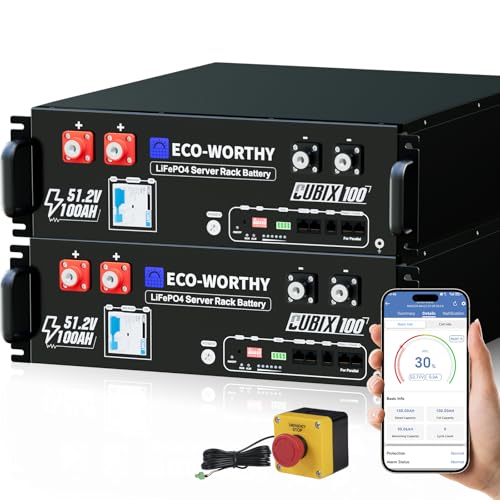
The ECO-Worthy Cubix100 48V 200Ah Two-Pack Bluetooth Battery occupies the practical middle ground between one 100Ah module and the much larger six-battery system. Each unit provides 100Ah, producing a stated combined capacity of 10.24kWh. That gives a home backup system useful overnight storage without committing to the full footprint of the 600Ah configuration.
Bluetooth monitoring distinguishes it from the single Cubix100 reviewed at the end, making it more convenient for checking battery information during routine maintenance. You still need compatible 48-volt equipment and enough rack space for two modules, so a clean installation matters here.
Everyday Advantages
- The two-pack provides 10.24kWh of stated storage for moderate household backup loads.
- Bluetooth monitoring simplifies access to operating information near the rack.
- Matching 48V modules preserve a consistent system architecture.
Practical Considerations
- Two batteries occupy more space than one Cubix100 module.
- Compatibility with your inverter and communication equipment must be confirmed.
- Cable management and rack ventilation remain installation responsibilities.
Right Fit For Medium Homes
This configuration suits households seeking useful overnight storage, remote monitoring, and room to expand without installing six modules immediately.
Reach For More Storage
The ECO-Worthy Cubix100 48V 600Ah Six-Pack Battery System better serves high-demand homes that need substantially more energy reserve.
The XRDS-RF 12AWG 20FT Solar XT60 Cable is a connection component, not a storage battery, so its purpose differs from the five banks in this roundup. It links a solar panel or related component with an XT60 connection over 20 feet. That reach helps place panel wiring closer to a battery or power station without stretching a short lead across a rack.
Tinned copper is designed to resist corrosion better than untreated copper in damp installations, while 12-gauge construction suits moderate-current solar wiring. Confirm connector polarity and cable current limits before installation; the physical length offers routing flexibility, not permission to exceed equipment requirements.
Why It Works Well
- The 20-foot length simplifies routing between separated solar components.
- Tinned copper supports conductivity and corrosion resistance.
- XT60 connections provide a defined interface for compatible equipment.
- Heat-resistant insulation suits protected outdoor cable routes.
Minor Gripes
- The XT60 connector will not fit equipment using another connector format.
- Exposed connectors need weather protection during outdoor use.
- Polarity must be checked before energizing the circuit.
Technical Highlights
Built With Installers In Mind
This cable suits homeowners and solar installers routing XT60-compatible equipment across a garage, shed, or outdoor installation.
Choose A Specialized Cable
The ELFCULB SB50 to XT90 10AWG Cable serves forklift battery connections rather than residential panel routing.
Warehouse power comes before household solar in the ELFCULB SB50 to XT90 10AWG Cable. Its SB50 and XT90 connectors suit compatible forklift battery equipment, giving technicians a short cable for mobile industrial applications. You should treat it as a specialized power lead rather than a general solar cable, despite the shared emphasis on battery connections.
Tinned copper provides electrical conductivity and corrosion resistance, while the nylon-reinforced housing is designed for demanding workshop conditions. The two-foot length keeps the connection compact, although that same measurement offers little flexibility when the battery and equipment sit farther apart.
The Good Stuff
- The 10AWG tinned copper conductor supports efficient power transfer.
- SB50-to-XT90 fittings serve compatible forklift equipment without a custom lead.
- The compact two-foot length suits closely mounted components.
Things That May Matter
- The short lead may not reach separated forklift components.
- Connector compatibility must be checked against your equipment.
- Workshop cables should be inspected for damaged insulation before use.
Feature Snapshot
Made For Forklift Work
This cable suits warehouse technicians and fleet-maintenance teams using compatible SB50 and XT90 power connections.
Look Elsewhere For Solar
The XRDS-RF 12AWG 20FT Solar XT60 Cable offers a longer run and residential solar connector arrangement.
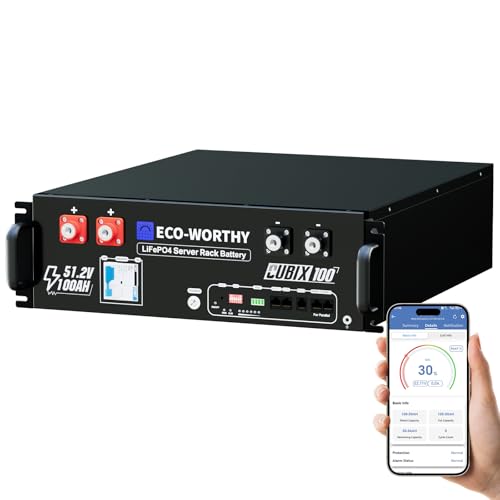
The ECO-Worthy Cubix100 48V 100Ah Server Rack Battery provides a manageable starting unit for a modular solar-storage project. At 4.8kWh nominal energy, it holds more capacity than the 12V VATRER bank but requires fewer physical modules than the ECO-Worthy two-pack. That balance works well for essential circuits, staged installations, and systems planned for later expansion.
The rack format supports a neat equipment-room layout, while closed-loop communication lets compatible equipment exchange operating information with the battery. Depending on your inverter, you may need supported communication hardware or a configuration that omits Bluetooth, so compatibility deserves an early check.
What Makes Sense
- The 4.8kWh nominal capacity suits essential-home backup and off-grid use.
- A single module simplifies the initial rack layout.
- LiFePO4 chemistry fits renewable energy storage.
- Closed-loop communication supports connected system monitoring.
Small Caveats
- Its 48V architecture requires compatible high-voltage equipment.
- One module may not cover a whole home with substantial overnight demand.
- Rack clearance and cable routing affect installation neatness.
Core Details
The Right Fit For Modular Builds
This module suits homeowners and solar installers creating essential-power storage in manageable expansion stages.
Choose Prebuilt Bluetooth Monitoring
The ECO-Worthy Cubix100 48V 200Ah Two-Pack Bluetooth Battery better fits users wanting more storage and direct Bluetooth monitoring.
Matching Storage to Your Energy Plan
Start With System Voltage
Battery voltage is non-negotiable because an inverter must operate at a compatible voltage range. The 48V ECO-Worthy systems suit high-voltage residential equipment, while the VATRER bank uses a 12V format that may need additional units arranged in series. Never connect unfamiliar battery banks without checking the inverter manual and configuration requirements.
Calculate Usable Energy
Nominal capacity is not the same amount available to your household. Inverter limits, conversion losses, state-of-charge settings, and temperature can reduce usable output. Multiply the system’s nominal watt-hours by your inverter’s usable percentage, then compare that figure with the energy consumed during an outage.
Match the Environment
A garage in a mild climate may prioritize compactness and monitoring, while a shed in a cold region benefits from self-heating. Ventilation, moisture control, and accessible cable routing still matter in both locations. For solar panel wiring, connector compatibility and conductor gauge need equal attention.
Plan Servicing and Expansion
Choose a layout that leaves room to inspect terminals, remove a module, and reach cooling or ventilation equipment. Modular server-rack systems make staged expansion easier, but each additional battery adds wiring and communication requirements. Portable packs suit travel, but they do not replace stationary home storage.
Avoidable Storage and Wiring Errors
Mistakes Worth Dodging
Capacity alone does not determine compatibility. Confirm voltage, connector type, communication protocols, and inverter support before ordering. Do not route unprotected outdoor connectors casually or assume a nominal watt-hour figure will equal usable backup energy.
What Separates Premium From Basic
Higher-capacity systems add usable energy, while monitored or self-heating models simplify troubleshooting or cold charging. Those additions matter for frequent outages, cold installations, and larger households. A smaller compatible system remains more practical than an oversized bank the rest of your equipment cannot support.
Frequently Asked Questions
How Many Batteries Does Solar Storage Need?
The required count depends on inverter voltage, target energy reserve, and each battery’s nominal capacity. Divide your required usable watt-hours by the expected usable output of each matched unit, then account for conversion losses.
Is a 48V Battery Better Than 12V?
A 48V battery can reduce current for the same power level, but compatibility matters more than voltage alone. Choose the architecture supported by your inverter, charge controller, and existing wiring rather than treating one voltage as universally better.
Can Solar Batteries Work in Cold Weather?
Charging performance depends on temperature and the battery’s internal controls. The VATRER POWER model includes self-heating, while other lithium batteries may require warmer storage or more conservative charging settings.
Do Solar Battery Systems Need Monitoring?
Monitoring is useful for checking state of charge, temperature, and operating history. It can simplify fault detection, although connectivity does not replace suitable ventilation, wiring protection, or periodic inspection.
Are XT60 and XT90 Connections Interchangeable?
No. XT60 and XT90 describe different connector formats, so each cable must match both the source and destination hardware. Check connector type, polarity, length, and current requirements before installation.
Final Verdict
Choose the ECO-Worthy six-pack for substantial home storage, the Bluetooth two-pack for a balanced connected setup, or the 100Ah module for staged expansion. VATRER serves colder locations, while BigBlue handles portable Starlink Mini power and the two cables cover specialized connection needs. Match the system to your equipment and operating environment before adding capacity.
