


Battery choice decides how an RC car accelerates, how long a plane stays airborne, and whether a multirotor can carry its intended payload. The right power pack also depends on chemistry, cell count, capacity, discharge rating, connector type, physical clearance, and charging setup. This guide covers batteries for cars, trucks, planes, helicopters, and multirotors, plus two useful power-distribution accessories for compatible XT60 and Deans systems.
The Choices Worth Comparing
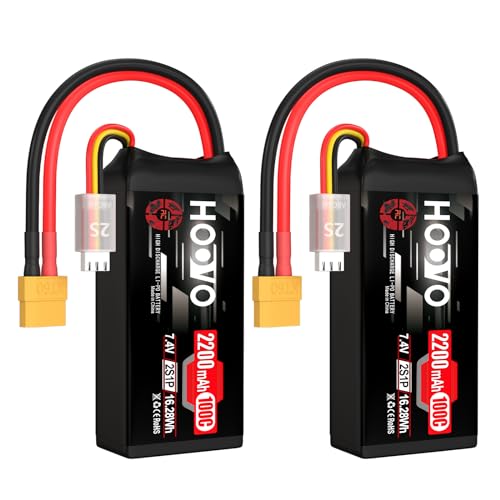
HOOVO 2S 2200mAh 100C Lipo Battery XT60

URGENEX 7.4V 2200mAh 50C Lipo Battery Deans

Nuofany 2-Pack XT60 Parallel Y Splitter 12AWG

Hobbypark Male Deans T to 4mm Banana Adapter 2-Pack
GEILIENERGY 7.2V 3800mAh NiMH Battery Charger Set

GEILIENERGY 7.2V 3800mAh NiMH Battery 2-Pack

Zeee 7.4V 5200mAh 50C Hard Case 2-Pack
The Strengths Of Each Pick
The HOOVO pack targets compact RC builds that need substantial discharge capability without carrying the bulk of a 5200mAh battery. Its 100C rating describes the maximum discharge class, useful for high-current motors, while the 2S1P configuration supplies 7.4V nominal voltage. Compared with URGENEX, HOOVO has the higher stated discharge rating and an XT60 connection rather than a Deans plug.
Its 75 by 33.8 by 18.5mm dimensions may suit a battery tray designed around a shorty pack, and the listed weight includes the attached wiring and connector. For performance-minded hobbyists, that balance of capacity and rated output makes more sense than carrying excess capacity. You still need to confirm the voltage, connector, polarity, and physical clearance before installation.
Key Advantages
- The 100C rating serves high-current RC applications where stronger bursts matter.
- The compact 2200mAh format reduces weight compared with larger 2S packs.
- A 7.4V 2S configuration matches many common two-cell RC platforms.
- The XT60 plug offers a secure, widely used connection where clearance permits.
Practical Considerations
- LiPo charging requires a compatible balance charger and careful supervision.
- The XT60 connector may not fit a vehicle designed around Deans connectors.
At A Glance
Built With In Mind
This pack suits experienced RC hobbyists running compact, high-current vehicles with an XT60-equipped battery bay.
A Better Fit Elsewhere
URGENEX 7.4V 2200mAh 50C Lipo Battery Deans is the better fit for a Deans-equipped model with less demanding burst output.
URGENEX fills the middle ground between compact LiPo capacity and extreme discharge specification. Its 50C continuous rating and stated 80C burst capability give RC car, truck, airplane, drone, and helicopter hobbyists a flexible 2S option. The Deans plug differentiates it from HOOVO’s XT60 pack and may fit older vehicles or established battery collections.
For daily use at an RC club or in a home workshop, 2200mAh helps limit pack weight while preserving useful runtime. The 7.4V voltage remains important, but connector compatibility and current demands still govern the outcome. Depending on your model, you may need a higher-capacity pack rather than a stronger discharge rating.
Benefits That Matter
- The listed 80C burst rating adds short-duration output for responsive models.
- Deans connectivity can simplify use with older RC vehicles.
- The 2S1P format provides a common voltage across many hobby classes.
- Capacity is sufficient for lighter cars and smaller aircraft where excess weight matters.
- The included USB charging lead adds setup convenience, subject to charger compatibility.
Worth Noting
- A burst rating does not make a low-capacity pack suitable for every high-current model.
- Charging depends on a proper LiPo balance charger and matching connector arrangement.
Made For
You’ll find this battery most practical in Deans-equipped cars, planes, and multirotors sized for a 7.4V 2S pack.
Another Choice May Suit
Zeee 7.4V 5200mAh 50C Hard Case 2-Pack offers more stored energy for larger models with sufficient battery-bay space.
The Nuofany splitter is a power-distribution accessory rather than a rechargeable battery. It converts one male XT60 connection into two female XT60 connections, allowing two compatible packs to be joined in parallel. Parallel wiring increases available capacity while retaining the same nominal voltage, provided both packs match in chemistry, cell count, voltage, and condition.
That arrangement can extend runtime in a large multirotor or RC vehicle with two dedicated battery positions. The 12cm, 12 AWG lead provides a short path between the batteries and connector, reducing cable clutter. In your workshop, the included pair gives you a spare, but the key requirement is a wiring plan that keeps the load within each pack’s specifications.
Where It Excels
- Two leads support repeated XT60 parallel setups or one kept as a backup.
- The 12 AWG conductor is suited to relatively low-resistance power routing.
- The Y layout simplifies connection between matched battery packs.
Trade Offs
- The splitter cannot safely combine mismatched battery packs.
- Poor soldering, loose connectors, or exposed wiring can create heat and reliability problems.
- XT60 compatibility excludes Deans-equipped systems without another connection path.
Right Fit For
RC multirotor hobbyists using matched XT60 batteries and a properly engineered parallel circuit benefit most.
Consider Something Else
HOOVO 2S 2200mAh 100C Lipo Battery XT60 is the better fit for a single-pack, high-output RC vehicle.
Hobbypark solves a small but persistent charging problem: your charger uses 4mm banana outputs while the RC battery uses a male Deans connector. These adapter leads bridge that mismatch without requiring fresh soldered connections each session. They suit RC cars, aircraft, boats, and multirotors that use the specified Deans arrangement.
The silicone wire is described as 14 AWG with tin-plated copper conductors, which supports manageable resistance and repeated cable flexing. Two leads and two battery straps make it practical to keep separate charging setups for different vehicles. The honest limitation is that the adapter only changes the physical connection; your charger still needs the correct battery chemistry and charge profile.
Bright Spots
- Preconnected leads remove repetitive soldering from your charging routine.
- Silicone insulation tolerates the flexing expected in mobile RC use.
- The two-pack format supports more than one vehicle or provides a replacement.
- Included straps help keep adapter cables from shifting during charging.
Small Caveats
- The Deans side and banana polarity must match the battery and charger.
- Connector adapters cannot compensate for an incompatible charger chemistry.
Who Should Grab It
Bench hobbyists charging male-Deans RC packs from a 4mm banana-output charger find this especially useful.
Where Another Pick Shines
GEILIENERGY 7.2V 3800mAh NiMH Battery Charger Set is the better fit for a Tamiya-equipped vehicle that needs a complete NiMH charging setup.
GEILIENERGY combines a flat 7.2V NiMH pack with a matching charger, reducing the parts you need to assemble a Tamiya-equipped RC setup. Six Sub-C cells provide the stated nominal voltage, while 3800mAh offers substantially more capacity than either 2200mAh LiPo pick. That endurance comes with a larger and heavier pack, a trade-off that matters in space-constrained aircraft.
For club racing or frequent driving sessions, NiMH chemistry offers a practical alternative to LiPo packs. The 10C discharge figure supports common RC demands, though LiPo packs can offer a higher power-to-weight ratio. You still need to confirm the charger’s connector orientation and follow the battery’s charge requirements during setup.
Features That Help
- The included charger reduces setup complexity for a first NiMH pack.
- 3800mAh capacity favors longer driving and racing sessions.
- The Tamiya connector supports many established RC cars and trucks.
- NiMH chemistry avoids the balancing routine required by two-cell LiPo packs.
- The stated 10C discharge rate covers conventional recreational RC demands.
Factors To Consider
- NiMH packs generally weigh more than similarly compact LiPo options.
- The included charger may not support LiPo chemistry.
- Large flat packs need more clearance than a shorty LiPo.
Who Will Love This
New RC hobbyists operating a 7.2V Tamiya-equipped car or truck benefit from the included charging equipment.
Swap It Out When
URGENEX 7.4V 2200mAh 50C Lipo Battery Deans is the better fit for a lightweight model with a Deans-equipped battery bay.
Two matched GEILIENERGY packs let you rotate between charging and driving without immediately returning to the charger. Each battery contains six Sub-C NiMH cells at a stated 3800mAh capacity and 10C discharge rate. Compared with the single-pack GEILIENERGY set, this option excludes the charger but supports a steadier weekend rotation for Tamiya-equipped vehicles.
That continuity is useful at an RC track or during multi-vehicle sessions. It also exposes an ownership detail: both batteries and the charger must match in chemistry, connector orientation, and cell count. Depending on your vehicle’s weight budget, the added battery mass can still matter, particularly in a touring car or small aircraft.
What Helps Most
- The matched pair supports rotating use at the track or hobby bench.
- High capacity supports extended sessions between charges.
- Tamiya connectors align with common legacy RC platforms.
- The stated discharge rate suits conventional RC driving demands.
Possible Compromises
- No charger is included with this two-pack.
- NiMH’s weight is substantial compared with compact LiPo alternatives.
- Matched packs need equal treatment and compatible charger connections.
- Large dimensions may restrict use in small battery compartments.
The Right Fit
Track-based hobbyists who already own a compatible 7.2V NiMH charger benefit from continuous battery rotation.
Reach For A Different Pick
GEILIENERGY 7.2V 3800mAh NiMH Battery Charger Set is the better fit for someone starting with only one Tamiya-equipped vehicle.
The Zeee pair favors longer sessions and larger RC platforms that can accommodate substantial battery packs. Each 5200mAh battery stores more energy than the HOOVO and URGENEX 2200mAh options, while its stated 50C rating provides a lower headline discharge figure than HOOVO’s 100C class. Capacity and peak output solve different problems, so the larger Zeee pack isn’t automatically right for every performance build.
At 138 by 47 by 25mm and approximately 250g per pack, these hard-case batteries demand generous mounting space. The T connector can simplify common RC connections, and two packs give you a rotation for racing or extended flying. Measure the bay and check connector clearance before committing, especially in a model designed around a shorty pack.
Useful Highlights
- 5200mAh capacity supports longer use between charges.
- The two-pack format keeps a matched second battery ready.
- Hard-case construction suits models that carry packs as structural components.
- The 50C rating supports substantial sustained current.
- T connectors serve many established RC vehicle platforms.
Details To Watch
- Weight and dimensions can exceed a compact model’s capacity.
- LiPo charging requires a compatible balance charger and close supervision.
- The 50C class provides less peak output than HOOVO’s stated 100C rating.
Essential Details
Whose Shelf It Belongs On
Large RC cars, trucks, and aircraft with ample battery space benefit from the extended capacity and matched rotation.
Look Elsewhere
HOOVO 2S 2200mAh 100C Lipo Battery XT60 fits lightweight, high-output models where weight matters more than capacity.
Matching Batteries to Your RC Model
Start with voltage and cell count. A 2S lithium polymer battery has a nominal voltage of 7.4V, while the six-cell NiMH packs here provide 7.2V. Your ESC, battery compartment, and vehicle wiring must accept that configuration, and mixing chemistries or cell counts can damage electronics or create unsafe operating conditions.
Capacity measures stored energy in milliampere-hours, so a larger number can extend runtime at a given draw. It also adds size and weight. Measure your battery tray, account for the connector, and prioritize low mass for planes and drones, while larger cars and trucks may accommodate greater capacity more easily.
The C rating describes a battery’s discharge class, not its capacity. A higher number can support greater current, but real-world suitability also depends on motor, ESC, wiring, and cell quality. Compare the HOOVO’s 100C rating with the URGENEX and Zeee 50C options rather than choosing solely by the printed number.
Connector shape matters just as much as electrical specifications. XT60, Deans, and T connectors differ physically, and adapters can help, but every joint adds another connection that must be secure. You’ll also need a charger that supports the battery chemistry and cell count. LiPo balancing chargers maintain individual cell voltage, while NiMH charging follows a different process.
Battery Details That Prevent Frustration
Common Shopping Slip Ups
Connector mismatch is an easy mistake to make because XT60, Deans, and T leads appear similar in small product photos. Measure the battery bay and trace the full connection path before ordering. Cell count and chemistry are equally important, since a charger or connector alone does not make an incompatible battery usable.
Where The Extra Money Goes
Higher discharge ratings, larger capacity, hard cases, and matched packs serve different ownership needs. The upgrade matters for larger vehicles or sustained output, while a compact pack is often more rational for weight-sensitive aircraft. Your model’s voltage, weight budget, connector, and runtime determine whether extra spending creates real value.
Frequently Asked Questions
What voltage do I need for my RC model?
Most models specify their required battery voltage, but the connector alone cannot identify it. Match the cell count to your ESC, wiring, and manufacturer instructions before installation.
Is higher battery capacity always better?
No. Greater capacity can extend runtime, although the added size and weight may not suit a small aircraft or drone. Choose the smallest capacity that comfortably meets your operating needs.
Can I use a different RC battery connector?
Adapters can bridge some connector formats, but polarity, voltage, current capacity, and connector security still matter. Verify every joint and avoid improvised connections under high load.
Does a higher C rating increase runtime?
The C rating indicates discharge capability rather than stored capacity. Runtime depends mainly on capacity, vehicle demand, efficiency, and operating conditions.
Can I charge NiMH and LiPo batteries with the same charger?
Only a charger explicitly designed for both chemistries, with the correct cell configuration, is suitable. Select the proper charge program and follow the battery manufacturer’s instructions.
Final Verdict
The right RC battery is a precise match for your model’s voltage, current demand, connector, and available space. HOOVO favors compact high-output builds, URGENEX serves common Deans platforms, and Zeee prioritizes capacity for larger models. The GEILIENERGY sets suit Tamiya-equipped NiMH systems, while Nuofany and Hobbypark solve specific XT60 and charging-connection needs. Match the hardware before ordering, and both installation and charging become much simpler.
