


Batteries For Off Grid Solar need to handle more than stored energy. They must also work with your charge controller, inverter, expected load, and local weather, so a small cabinet backup has different requirements than a year-round home system. You’ll find portable power stations, fixed LiFePO4 banks, marine batteries, and compact lead-acid options within this lineup. The right fit depends on capacity, voltage, physical space, and how much installation work you’re prepared to handle.
A Quick View Of The Lineup

Jackery Explorer 1000 v2 Power Station, Dune White

ECO-WORTHY Powermega 48V 314Ah System with Liber 10KP

ECO-WORTHY Powermega 48V 314Ah LiFePO4 Battery
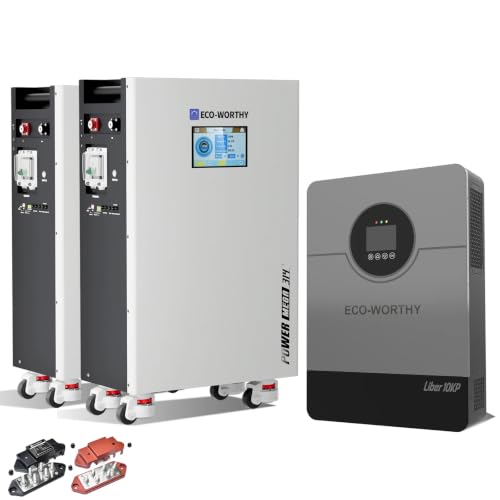
ECO-WORTHY Powermega Two-Battery System with Liber 10KP

SPRUEDER 12V 9Ah Rechargeable SLA Battery with F2 Terminal

LiTime 24V 100Ah Bluetooth LiFePO4 Marine Battery

SOK 2-P 12V 314Ah Self-Heating LiFePO4 Battery
A Closer Look At Each Pick
The Explorer 1000 v2 serves two roles: a portable power station and a battery-backed source for small solar setups. Its 1,070Wh capacity stores enough energy for several smaller devices or select higher-draw appliances, depending on runtime and conversion losses. For weekend campers or households needing portable outage support, the 23.8-pound format is easier to move than a fixed cabinet bank.
Unlike the larger ECO-WORTHY systems later in the lineup, this unit doesn’t require a permanently installed inverter and battery room. Its 1,500W AC output handles many common camping and household loads, but an over-limit appliance can still trip or prevent startup. That makes it more convincing for a practical weekend setup than for running an entire occupied home.
A Few Strong Suits
- The 1,070Wh capacity gives you useful overnight energy without a floor-mounted installation.
- AC output supports ordinary outlets, avoiding the need for a separate power-conversion unit during travel.
- The foldable handle and 23.8-pound weight suit vehicle trunks, campsites, and home backup use.
- A 3,000W surge level gives supported appliances room for brief startup demands.
Points To Note
- Continuous output stays at 1,500W, so high-power appliances require careful load planning.
- For a permanent residence, fixed wiring and expandable storage usually offer a cleaner long-term arrangement.
Feature Snapshot
Made For
Weekend campers, road travelers, and homeowners seeking a movable short-duration backup source benefit most.
Another Choice May Suit
Homeowners needing continuous whole-house capacity should compare the ECO-WORTHY Powermega Two-Battery System with Liber 10KP instead.
A fixed off-grid home usually needs more than a battery alone, and this package joins a 48V 314Ah LiFePO4 bank with a 10kW hybrid inverter. An inverter changes stored direct-current energy into household AC, while the battery determines how long connected loads can operate. That makes the combined system more practical for a cabin, essential circuits, or a residence designed around solar storage.
The battery’s RS485, CAN, and RS232 communication options give an installer several paths to coordinate with compatible equipment. Its built-in LCD and wireless connection also support monitoring without opening the enclosure. The honest catch is installation complexity, especially for anyone accustomed to plugging a portable station into a wall.
Positive Points
- The matched battery and inverter reduce the need to assemble a storage architecture from separate components.
- A 10kW inverter offers meaningful headroom for appliances beyond lighting and communications.
- Wireless monitoring helps you check operating information from a more convenient location.
Trade Offs
- Fixed equipment needs a suitable location, ventilation, wiring, and an appropriately sized solar system.
- Compatibility should be confirmed with your solar controller and planned loads before installation.
- Transport and service procedures for a large battery may be less convenient than handling a portable unit.
Core Details
Right Fit For
Cabin owners and technically capable homeowners needing a permanent battery-and-inverter package benefit most.
Look Elsewhere When
Travelers needing a carryable power source should choose the Jackery Explorer 1000 v2 Power Station instead.
For a solar installation that already has compatible power-conversion equipment, this standalone 48V battery supplies substantial expandable storage without bundling another inverter. Its 314Ah rating corresponds to approximately 16.1kWh under the stated nominal architecture. That makes it relevant to an owner of an off-grid cabin, workshop, or larger residence who needs more storage than a compact portable station can hold.
Active cell balancing helps keep the cells within a similar state during charging and discharge, while the updated design adds integrated aerosol fire protection. Compatibility with earlier V1 units also matters for staged expansion. You still need to verify charge controllers, inverter communication, physical clearance, and your planned parallel configuration before ordering.
The Value In It
- The approximately 16.1kWh capacity provides a substantial reserve for extended periods away from the grid.
- Active cell balancing supports more consistent cell behavior within the battery pack.
- Parallel compatibility allows a staged approach rather than requiring one oversized battery from the start.
- Aerosol fire protection adds a defined layer to the fixed-storage package.
Worth Noting
- This is battery-only equipment, so you still need a compatible inverter and solar controls.
- The listing identifies the item as non-returnable, so configuration errors deserve extra care.
- Hazardous-material shipping rules can affect delivery arrangements and receiving.
Technical Highlights
Built With In Mind
Experienced off-grid installers and homeowners already equipped with compatible conversion hardware benefit most.
Reach For A Different Pick
Those needing batteries and inverter hardware together should examine the ECO-WORTHY Powermega 48V 314Ah System with Liber 10KP.
Doubling the Powermega batteries moves this package into a different ownership tier. Two 48V 314Ah units provide more than 30kWh of stated usable storage when paired with the 10kW Liber hybrid inverter. That scale makes sense for a home with substantial daytime solar production, repeated outages, or residents who expect to run ordinary household loads through a sustained power interruption.
Compared with the single-battery Powermega system, the added storage doesn’t raise the inverter’s continuous rating, but it can extend how long that output remains available. It also demands more floor space, wiring capacity, and careful thermal planning. For a small weekend cabin, that extra capability may be unnecessary; for a semi-independent residence, it changes the calculation.
Real Benefits
- More than 30kWh of usable storage gives connected household loads a longer operating window.
- The 10kW hybrid inverter provides useful conversion capacity for high-load appliances.
- Two integrated batteries reduce the complexity of sourcing a matched storage expansion later.
- Built-in Bluetooth and Wi-Fi support make system monitoring more accessible.
Practical Considerations
- You’ll need a protected installation area with enough clearance, service access, and cable routing capacity.
- Adding a second battery extends runtime, but actual output remains constrained by the inverter and connected loads.
- Solar array sizing, battery temperature, and local electrical requirements deserve professional planning.
Who Will Love This
Solar-equipped homeowners preparing for extended outages benefit most from this two-battery configuration.
Swap It Out When
Smaller cabins and essential-load systems can get more manageable scale from the ECO-WORTHY Powermega 48V 314Ah System with Liber 10KP.
The SPRUEDER battery occupies the other end of the capacity range. A sealed lead-acid, or SLA, battery contains electrolyte sealed inside the case, making it suitable for installations where spill containment matters. At 12V and 9Ah, this unit fits a gate opener, emergency light, router support circuit, or other small device better than a 48V lithium cabinet.
Its 5.94-by-2.56-by-3.91-inch shape is straightforward to place in a tight utility area, and the F2 terminal gives you a defined connection point to verify before wiring. Lead-acid typically demands more attention to charge control and ventilation than the LiFePO4 options here, while lithium batteries generally support deeper discharge with less routine upkeep.
Key Advantages
- The compact dimensions suit small control boxes and equipment rooms with limited shelf space.
- The sealed case simplifies placement around backup equipment without an open liquid electrolyte design.
Minor Gripes
- The 108Wh nominal energy capacity is modest beside the lithium options, so more units may be needed for longer runtimes.
- Proper charging, ventilation, and terminal maintenance remain important ownership responsibilities.
- Its 12V rating does not directly replace a 24V or 48V solar storage bank.
Who Should Grab It
Homeowners needing inexpensive, compact backup storage for a small 12V device benefit most.
Not Your Match When
Cabin owners needing multi-day storage should compare the LiTime 24V 100Ah Bluetooth LiFePO4 Marine Battery instead.
Marine, RV, and off-grid use converge neatly in the LiTime 24V 100Ah battery. Its 2.4kWh nominal capacity sits between the small SPRUEDER unit and the fixed ECO-WORTHY banks, offering meaningful runtime without the footprint of a whole-home cabinet. Support for 4P2S, meaning four batteries in parallel and two series-connected strings, can expand the installation to 10.24kWh.
Bluetooth 5.0 provides a practical way to check state of charge and manage discharge settings, which is useful on a boat or in an RV where physically reaching the battery may be inconvenient. At 45.85 pounds, the unit is still substantial, and its 8.2-by-21-by-8.5-inch size deserves a compartment check before installation.
Strong Points
- Bluetooth monitoring reduces the need to access a battery hidden beneath seating or equipment.
- The 24V format bridges common marine and RV DC power systems.
- Four-parallel, two-series support provides a path toward 10.24kWh of combined capacity.
- The 45.85-pound weight remains manageable for a permanently installed mobile system.
Softer Spots
- The long housing may not fit a small boat compartment despite the lower relative weight.
- A 24V battery still requires a compatible inverter or DC power conversion arrangement.
- Wireless monitoring depends on a suitable connection location and correctly configured discharge limits.
Feature Card
Who It Suits Best
Boat owners, RV travelers, and remote-site users with a 24V architecture benefit most.
A Better Fit Elsewhere
Owners of a 48V residence needing much more storage should consider the ECO-WORTHY Powermega 48V 314Ah LiFePO4 Battery.
The SOK 2-P targets installations where the battery rack may see bumps, vibration, moisture, or cold before your next maintenance visit. Its PC+ABS housing combines rigid polycarbonate with flame-retardant ABS, creating a protective shell around the lithium iron phosphate cells. That ruggedized enclosure is a different emphasis from the ECO-WORTHY systems, which prioritize high-capacity residential integration.
Self-heating is especially relevant for off-grid sites exposed to cold conditions, since temperature management can become part of charging control. An IP67 rating means the enclosure resists dust and temporary immersion under its defined test conditions, though cable connections still need suitable environmental protection. The 12V 314Ah format gives you another way to construct a 24V or 48V bank, depending on your series and parallel arrangement.
Features That Help
- The IP67 enclosure suits dusty, damp, or exposed rack locations better than an open-frame battery.
- Self-heating helps manage cold-environment charging requirements.
- Flame-retardant PC+ABS provides a durable shell for travel and off-grid use.
- The 12V 314Ah capacity offers useful flexibility for larger DC banks.
Details To Watch
- You’ll still need compatible interconnects, a charge controller, and a power-conversion device.
- IP67 applies to the battery enclosure rather than every attached cable or open connector.
- Series and parallel installation requires matched settings and correctly rated interconnect hardware.
Technical Reference
Built With In Mind
Rough outdoor racks, RV projects, and exposed off-grid installations benefit from this ruggedized format.
A Better Fit Elsewhere
Weekend travelers prioritizing carryable power should choose the Jackery Explorer 1000 v2 Power Station, Dune White.
What Matters Before Building Your Solar Storage Bank
Match the electrical architecture
Start with your inverter’s input voltage and the solar controller’s battery settings. A 12V battery isn’t inherently interchangeable with a 24V or 48V system, even though multiple units can sometimes be connected in series or parallel. Write down the required configuration before selecting capacity.
Estimate runtime from actual loads
Battery capacity alone doesn’t reveal how long equipment will run. Multiply your required watts by the number of hours you expect to operate without solar input, then allow for conversion losses and realistic battery limits. Essential lighting, a communications router, and a refrigerator create very different demands.
Measure the installation area
Measure width, depth, height, ventilation access, cable bend space, and the route required to reach the battery. The LiTime 24V 100Ah Bluetooth LiFePO4 Marine Battery, for example, measures 8.2 by 21 by 8.5 inches, so a small marine compartment may need careful checking before purchase.
Consider who will maintain it
Fixed lithium systems need compatible charge controls, ventilation, firmware settings, and occasional inspection. Lead-acid remains relevant for small applications, although charge management and terminal care deserve attention. Portable units trade capacity for convenience, making them easier to inspect but less suitable for sustained whole-home use.
Avoidable Errors in Off-Grid Storage
Mistakes Worth Dodging
Choosing by watt-hours alone can leave out inverter limits, voltage mismatches, and daily load patterns. Measure the intended battery compartment before ordering, then confirm the charge controller supports the battery chemistry and communication method. For mobile systems, reserve capacity for winter conditions and the operating demands of heaters, refrigeration, and navigation equipment.
What The Higher Tier Buys
Higher-capacity lithium systems add usable energy, longer runtime, remote monitoring, and conversion hardware in some packages. Those additions can suit a home expecting repeated outages or extended cloudy periods. Smaller systems remain sensible for tool charging, communications, lighting, or portable weekend use, where extra storage would simply consume space without adding practical value.
