


An AC outlet battery pack turns stored battery energy into familiar 110V or 120V power for vehicles, campsites, and backup setups. The right capacity depends on the devices you run, how long you need them powered, and whether you prefer remote operation, USB charging, or a hardwired installation. These EFFORTWAY inverters cover several power classes, from portable 2,000W models to higher-output 5,000W options for demanding appliances.
The Essentials At A Glance

EFFORTWAY 5000W Power Inverter 12V AC 120V 4 AC Outlets

EFFORTWAY 3000W Power Inverter 12V AC 120V 4 AC Outlets

EFFORTWAY 2000W Power Inverter 12V AC 120V 2 USB 2 AC Outlets

EFFORTWAY 3000W Power Inverter 12V AC 120V 4 USB 4 AC Outlets

EFFORTWAY 4000W Power Inverter 12V AC 120V Hardwire Terminal

EFFORTWAY 4000W Power Inverter 12V AC 120V 4 AC Outlets
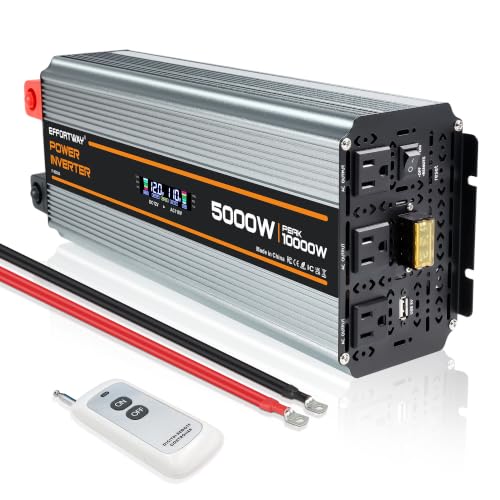
EFFORTWAY 5000W Power Inverter 12V AC 120V Hardwire Terminal
The Picks, Examined More Closely
For RV travel and larger off-grid equipment, this 5,000W inverter brings substantial output without the bulk of a dedicated stationary system. It converts 12V DC battery power into 110V or 120V AC, while the wireless controller keeps status checks accessible from inside a cab or living area. In a busy campground, that separation between the inverter and your seating space is a practical advantage.
Four AC outlets provide more connection options than the smaller models, so several low-to-moderate draw devices can share one setup. The LCD gives you a clearer view of input voltage, output conditions, battery status, and load information. Depending on your battery bank and wiring, you may need to account for substantial startup demands from household appliances.
The Value In It
- 5,000W continuous output supports higher-draw camping equipment.
- 10,000W peak capacity gives compatible loads room for startup surges.
- Four AC outlets reduce the need for multiple adapters.
- Wireless control helps monitor a mounted installation.
- Conversion efficiency above 90% limits unnecessary power loss.
Things To Consider
- The 5,000W rating still depends on a properly sized battery bank and cable system.
- Heavy loads can drain vehicle batteries quickly during idle use.
Who It Suits Best
You benefit most with an RV, truck, or fixed solar setup that runs several powered devices beyond basic phone charging.
Where Another Pick Suits Better
EFFORTWAY 3000W Power Inverter 12V AC 120V 4 AC Outlets is the lighter fit for travelers carrying only smaller electronics.
The 3,000W class sits between the portable 2,000W inverter and the heavier 4,000W models. It suits weekend campers who need more than a phone charger but do not want to carry a large battery system. Remote operation is especially helpful when the inverter sits near the vehicle battery or inside a separate storage compartment.
Four AC outlets make it easier to organize a camp setup, with one connection reserved for a laptop, another for lights, and the remaining outlets for smaller appliances. The LCD provides a useful reference for voltage and load conditions. For long road trips, keeping the inverter secured and ventilated matters because heat and loose connections can undermine otherwise straightforward use.
Everyday Advantages
- 3,000W continuous output handles more devices than the compact model.
- 4 AC outlets support shared household-style connections.
- Wireless controller improves monitoring from a distance.
- Over 90% conversion efficiency helps preserve battery capacity.
Worth Noting
- The 3,000W figure is not appropriate for every high-startup appliance.
- Vehicle use calls for careful cable connection and ventilation.
- A separate battery pack may be needed for extended camping.
Made For
This inverter fits weekend campers, road-trip families, and mobile workers who need a moderate AC output with remote status checks.
Where A Sibling Pick Shines
EFFORTWAY 2000W Power Inverter 12V AC 120V 2 USB 2 AC Outlets is easier to carry for travel-focused users with smaller loads.
This is the portable option for travel days, tailgating, and emergency power for smaller devices. Its 2,000W continuous rating converts 12V battery power into 110V or 120V AC, while the 4,000W peak figure provides temporary headroom for compatible equipment. The LCD adds useful visibility without turning operation into a guessing exercise.
Two AC outlets and two USB ports make the connection layout more practical than a single-outlet inverter. You can charge a phone directly while powering a small fan or laptop, provided the total load stays within the inverter’s limits. The trade-off is capacity, as this model is less suitable for power tools, kitchen appliances, or other high-draw equipment.
The Helpful Details
- 2,000W continuous output suits portable camping electronics.
- 4,000W peak rating handles brief startup demands.
- Two USB ports support convenient device charging.
- LCD reports input, output, battery, and load information.
- Conversion efficiency above 90% reduces conversion losses.
Small Caveats
- Two AC outlets may be limiting for a shared campsite setup.
- Continuous high-draw appliances can still overload the unit.
- Remote control is not included in the listed feature set.
Right Fit For
You benefit most as a traveler carrying a modest battery setup for lights, phones, laptops, and other low-to-moderate electronics.
Another Choice May Suit
EFFORTWAY 5000W Power Inverter 12V AC 120V 4 AC Outlets is the better fit for an RV carrying larger appliances and several powered devices.
The extra USB capacity gives this 3,000W inverter a more flexible connection mix than the other 3,000W option in the roundup. It works well for mobile offices, family camp vehicles, and roadside setups where several people need to charge devices while other equipment runs from AC outlets. A wireless controller also makes it easier to manage a system mounted away from your work area.
Four AC outlets reduce adapter clutter, while the listed four USB ports give you more low-draw charging options. The LCD and remote system provide visibility into operating conditions, but your battery bank must still deliver enough current. Owners commonly report that cable length and ventilation deserve attention during extended use, especially in a warm vehicle or enclosed storage area.
Practical Advantages
- 3,000W output supports moderate RV and camping loads.
- Four USB ports serve multiple phones and small electronics.
- Four AC outlets broaden connection options.
- Remote monitoring helps with mounted systems.
- 6,000W peak rating covers brief startup loads.
Areas To Watch
- USB charging shares the inverter’s overall power budget.
- Heat buildup can reduce usable runtime in a closed compartment.
- The extra ports may not justify its size for very light use.
Who Will Love This
This model suits families, mobile workers, and campers who want AC outlets and USB charging in one moderate-capacity unit.
A Better Fit Elsewhere
EFFORTWAY 4000W Power Inverter 12V AC 120V 4 AC Outlets is a stronger choice for tools and larger household equipment.
The hardwire terminal makes this model more relevant to semi-permanent RV or off-grid installations than the lighter travel designs. Its listed 4,000W continuous output can support more demanding equipment, while the stated 80,000W peak figure should be checked carefully against your equipment requirements before you plan around it. The remote controller and LCD are useful for managing a fixed setup from a distance.
Three AC outlets and a USB connection cover common camping and service needs without requiring several separate power devices. The hardwire connection can reduce dependence on loose plug connections during travel, but installation requires attention to polarity, fusing, cable sizing, and ventilation. For a compact van or occasional campsite use, the added installation commitment may be more than necessary.
Real Benefits
- 4,000W continuous output suits higher-demand equipment.
- Hardwire terminal supports a more permanent connection.
- Three AC outlets serve common RV appliances.
- Wireless control improves system monitoring.
Possible Compromises
- Installation requires careful electrical preparation.
- The listed peak figure appears unusually high and deserves verification.
- Only three AC outlets are provided for a higher-output unit.
The Right Fit
You benefit most with an RV owner building a fixed battery-powered system for tools, appliances, or sustained AC use.
Reach For A Different Pick When
EFFORTWAY 3000W Power Inverter 12V AC 120V 4 AC Outlets is easier to deploy for travel where a hardwired installation is unnecessary.
Compared with the 3,000W models, this inverter gives you more headroom for tools, small appliances, and equipment with uneven startup demands. Four AC outlets make it a practical middle point for a workshop vehicle or RV that needs flexibility without moving to the largest battery systems. The wireless controller is helpful when the inverter is installed near a battery bank or in a storage bay.
Its stated 4,000W continuous and 8,000W peak output provides a clear operating target, but the inverter still cannot create extra energy on its own. Battery age, cable resistance, and ambient temperature affect usable runtime. You may find the LCD most useful during setup, since checking input voltage and load status can help reveal undersized wiring before a larger device is connected.
What Makes Sense
- 4,000W continuous output fits demanding portable loads.
- Four AC outlets support a varied equipment mix.
- 8,000W peak rating adds startup flexibility.
- Remote control reduces unnecessary physical checks.
- Over 90% conversion efficiency limits losses.
Points To Keep In Mind
- It is larger and more power-hungry than the 2,000W model.
- USB charging is not as extensive as the 3,000W model’s.
- Long high-load sessions demand careful ventilation and battery planning.
Built With In Mind
This model fits RV owners, tradespeople, and campers who regularly operate equipment beyond the range of a compact inverter.
Swap It Out When
EFFORTWAY 2000W Power Inverter 12V AC 120V 2 USB 2 AC Outlets is the lighter choice for travel and electronics-only use.
This is the higher-output option for an RV, truck, or off-grid system that needs more AC headroom than the compact models provide. The listed 5,000W continuous output is aimed at larger loads, while the 10,000W peak rating offers brief surge capacity. A hardwire terminal makes the unit more appropriate for a planned installation than for occasional plug-in use.
Three AC outlets and a USB port cover essential connections, and the wireless controller lets you monitor an installation from another part of the vehicle or cabin. You still need to size the battery bank and wiring for the load, and the inverter needs airflow during sustained operation. For occasional phone charging, this capacity is unnecessary, but for power-heavy camping equipment it offers a sensible upgrade path.
Strong Points
- 5,000W continuous output supports higher-load equipment.
- 10,000W peak rating handles brief startup demand.
- Hardwire terminal suits planned vehicle installations.
- Wireless control improves monitoring from a distance.
- Conversion efficiency is listed above 90%.
Trade-Offs To Consider
- It requires a suitably substantial battery and wiring system.
- Three AC outlets are fewer than several lower-capacity models.
- Portable users may find the installation-oriented design cumbersome.
Who It Suits Best
You benefit most with a power-heavy RV or solar system that runs multiple AC devices and benefits from a fixed connection.
Not Your Match When
EFFORTWAY 3000W Power Inverter 12V AC 120V 4 AC Outlets is the more portable option for lighter weekend-camping loads.
Choosing The Right Inverter For Your Power Setup
Start With Load Requirements
Continuous output matters more than the peak number for most devices. Add up the running wattage of laptops, lights, chargers, tools, and appliances, then leave room for conversion losses and startup surges. A 2,000W inverter suits smaller electronics, while 3,000W to 5,000W models make more sense for RV equipment and household-style loads.
Decide Between Portability And Installation
Portable models are easier to move between vehicles and campsites. Hardwire terminals suit a fixed installation where you want a steadier connection and remote monitoring, but they require more careful electrical setup. In either case, protect connections from moisture and keep airflow around the inverter.
Check Battery And Cable Capacity
An inverter does not create additional energy, so its output depends on a capable battery bank and appropriately sized cables. For deep cycling, lead-acid battery age and depth of discharge affect runtime, while lithium systems can offer lighter alternatives with different voltage requirements. Confirm your battery voltage, connection method, and expected load before choosing.
Use The Display And Remote
The LCD and wireless controller are more than convenience features. They help you monitor input voltage, output status, battery condition, load capacity, and error codes in a setup you cannot easily reach. Review those readings periodically, especially before starting high-draw equipment or relying on the system during travel.
Power Planning Notes For Portable Setups
Mistakes Worth Dodging
The most common mistake is choosing an inverter by its peak rating instead of its continuous capacity. Another is powering several high-draw appliances together without checking the total load. Ignore the USB port count when deciding suitability for larger tools, and remember that a long cable or undersized battery can reduce practical runtime.
What Separates Premium From Basic
Higher-output models add power for demanding equipment, more AC outlets, remote controls, or hardwire connections. Those features matter when you run appliances for long periods or install the inverter permanently. A compact 2,000W model remains the more sensible choice for occasional phone, laptop, and light charging.
Frequently Asked Questions
What size inverter do I need for camping?
Choose based on the combined running wattage of your devices, not just the number of outlets. A 2,000W inverter fits smaller electronics, while 3,000W to 5,000W models handle more demanding camping equipment.
Can these inverters run a refrigerator?
A refrigerator may work with a sufficiently sized inverter and battery, but its startup surge and constant draw determine runtime. Check the appliance’s wattage and keep the total load below the inverter’s continuous rating.
Do I need a separate battery for an inverter?
The inverter needs a compatible 12V DC source, such as a vehicle battery or dedicated battery bank. A separate bank helps prevent vehicle-battery depletion during extended use.
Is a wireless controller useful at a campsite?
It helps when the inverter is mounted near the battery or inside a storage compartment. You can check operating status without leaving your seating area or opening a connection cabinet.
What is the difference between continuous and peak power?
Continuous power is the level the inverter can sustain during normal operation. Peak power is a short-duration allowance for startup surges, so you should base regular load planning on the continuous figure.
Final Thoughts
Choose the lowest output that comfortably covers your normal load, then confirm battery capacity, cable sizing, ventilation, and connection safety. The EFFORTWAY 2000W model favors travel and smaller electronics, while the 3,000W, 4,000W, and 5,000W options serve increasingly demanding RV and off-grid setups. Match the inverter to the equipment instead of relying on a larger headline number.
