


Heating and cooling controls often fail at the worst time, such as during a sudden temperature swing, a busy morning, or an overnight freeze. Ac Heater Thermostats give you more precise scheduling, clearer displays, and compatibility tailored to conventional systems, heat pumps, PTAC equipment, or an RV. The right model depends mainly on your HVAC configuration, daily routine, and installation requirements.
The Shortlist At A Glance

PRO1 T725 Programmable Heat Pump and Conventional Thermostat

PRO1 T731 Non-Programmable Heat Pump PTAC Thermostat
PRO1 T771 Single Stage Conventional Thermostat
PRO1 T701 Single Stage Conventional Thermostat
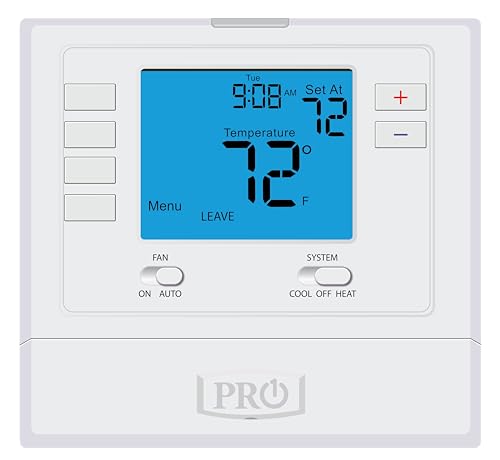
PRO1 T715 Multi-Stage Programmable Gas Thermostat
PRO1 T805 Single Stage Programmable Thermostat

FHRHRY 9430-338 12V RV Thermostat
The Strengths Of Each Pick
Programmable control makes the PRO1 T725 useful for households that rise, leave, and return on different schedules. Its support for 7-day or 5/1/1 programming gives you separate weekday and weekend control without forcing one routine on every day.
The T725 handles two-stage heat-pump heating or single-stage conventional heating and cooling, making it broader than the conventional-only PRO1 T805. You’ll need to match the wiring and equipment configuration carefully before installation.
Where It Helps
- Seven-day and 5/1/1 scheduling support different household routines.
- The 4-square-inch blue backlit screen improves visibility in dim rooms.
- Two-stage heat-pump support accommodates higher-efficiency systems.
- Conventional and heat-pump versatility broadens replacement options.
Things To Consider
- Programming takes more setup attention than a non-programmable model.
- System compatibility must be confirmed before the old thermostat is removed.
Feature Snapshot
Built With In Mind
You benefit most from the T725 with a compatible heat-pump or conventional system and a schedule that changes throughout the week.
Where A Sibling Pick Shines
The PRO1 T805 is the simpler fit for a single-stage conventional system where scheduling matters but multi-stage heat-pump support does not.
A packaged terminal air conditioner, or PTAC, needs a controller designed around its wiring and operating demands. The PRO1 T731 fills that role with compatibility for two-stage heat-pump systems or conventional one-heat, one-cool equipment, giving hotels, apartments, and guest rooms a focused control option.
Unlike the programmable PRO1 T725, this model keeps operation manual and uncomplicated. Depending on the space, that simplicity may be an advantage because guests encounter fewer settings and fewer accidental schedule changes.
Practical Advantages
- Compressor-delay selection helps protect compatible equipment from rapid cycling.
- Separate heating and cooling cycle-rate settings provide operational control.
- The blue backlight and glow-in-the-dark button ease nighttime adjustments.
- A non-programmable layout suits short-term rooms and variable occupancy.
Practical Considerations
- No scheduling means room temperatures remain fixed until manually changed.
- Compatibility is limited to the specified heat-pump and conventional configurations.
Key Product Details
Made For
You’ll find the T731 most useful in a PTAC room where simple manual operation and equipment protection settings matter more than daily scheduling.
Another Choice May Suit
The PRO1 T725 is a better fit for a residence that needs scheduled heating and cooling for a compatible heat-pump system.
The PRO1 T771 brings the same non-programmable approach as the PRO1 T701, but its broad 25°F to 90°F setpoint range makes it more relevant to utility spaces. A garage, shed, or workshop may need lower settings than a typical living area, and that wider range gives you more control.
The 4-square-inch blue backlit display keeps settings readable in a dim basement or unfinished room. You’ll still need compatible one-heat, one-cool conventional equipment and the proper wiring arrangement.
Positive Points
- The 25°F to 90°F range suits low-temperature control in utility spaces.
- A backlit 4-square-inch screen improves readability in unfinished rooms.
- Manual operation avoids programming complexity.
Worth Noting
- The non-programmable format offers no automatic daily schedule.
- It is designed for conventional single-stage systems rather than multi-stage heat pumps.
- Installation remains sensitive to equipment type and terminal assignments.
Quick Facts
The Right Fit
You’ll appreciate the T771 in a garage, shed, or workshop with a compatible conventional system and a need for low-temperature settings.
Reach For A Different Pick When
The PRO1 T805 suits you better when weekday and weekend programming would meaningfully reduce daily thermostat adjustments.
Manual temperature control remains practical for many conventional systems. The PRO1 T701 handles one heating stage and one cooling stage, so it fits standard gas or electric arrangements without introducing schedule programming.
Its 4-square-inch blue backlit display makes the basic controls easier to read at night, and the glow-in-the-dark light button helps locate the keys in a darkened hallway. Compared with the PRO1 T805, the trade-off is less automation in exchange for a simpler interface.
Where It Excels
- Straightforward manual controls suit people who prefer not to manage schedules.
- The blue backlight improves visibility during evening temperature adjustments.
- A glow-in-the-dark button helps in dim hallways or bedrooms.
- The roomy display reduces the effort of reading settings.
Small Caveats
- Manual setpoint changes require more attention throughout the day.
- Compatibility is limited to conventional one-heat, one-cool systems.
Who Will Love This
You’ll likely prefer the T701 with a conventional system, a steady daily routine, and a preference for uncomplicated manual control.
Swap It Out When
The PRO1 T805 is the stronger option for a home that needs separate schedules for weekdays, weekends, or sleeping periods.
The PRO1 T715 targets two-stage gas equipment with two heating stages and two cooling stages. Multi-stage operation lets a compatible furnace or air-conditioning system move through capacity levels rather than treating every demand as the same, which can suit homes with larger or more variable loads.
Seven-day, 5/1/1, and non-programmable modes give you flexibility, though a programmable model offers little benefit without a routine worth automating. The 4-square-inch blue backlight and glow-in-the-dark button keep operating information accessible in dim spaces.
Advantages To Know
- Two-stage heating and cooling support fits compatible multi-stage gas systems.
- Multiple scheduling modes serve varied family and work routines.
- The large backlit display makes setup easier to follow.
- A glow-in-the-dark button helps locate controls at night.
Trade Offs
- It requires compatible two-stage gas equipment and correct wiring.
- The advanced configuration may be unnecessary for a single-stage system.
- Programming needs an initial setup before it provides useful automation.
Technical Highlights
Who Should Grab It
You benefit most from the T715 with a compatible two-stage gas system and a schedule that justifies automated temperature changes.
A Better Fit Elsewhere
The PRO1 T701 is the simpler option for a conventional single-stage system controlled by the same temperature settings every day.
A large, readable interface matters once a thermostat contains a weekly schedule. The PRO1 T805 combines a 7-square-inch blue backlit display with 7-day, 5/1/1, and non-programmable options, making settings easier to review during installation and daily adjustments.
Unlike the PRO1 T715, it supports a conventional one-heat, one-cool arrangement rather than two-stage gas equipment. That narrower scope makes it a sensible daily option for many homes, especially where your schedule changes but multi-stage capacity is unnecessary.
Notable Upsides
- The extra-large display simplifies reading schedules and setpoints.
- Three operating modes accommodate recurring, mixed, or fixed routines.
- Blue backlighting keeps settings visible during evening use.
- A glow-in-the-dark light button helps in dim rooms.
Points To Note
- It supports only one conventional heating stage and one cooling stage.
- Weekly programming adds setup work compared with the PRO1 T701.
Built With In Mind
You’ll appreciate the T805 in a conventional home where a clear display and different weekday or weekend settings improve daily comfort.
Look Elsewhere When
The PRO1 T725 suits you better with a two-stage heat pump, while the FHRHRY 9430-338 fits compatible RV systems.
RV climate control operates from a 12-volt system and must match the equipment architecture on the camper. The FHRHRY 9430-338 is designed for a single-zone Airxcel Coleman-mach air conditioner or furnace, giving you a specific replacement path for compatible models in the 9430 series.
Compared with the residential PRO1 choices, this unit changes the compatibility equation completely. Confirm your coach model, existing control layout, wiring, and system type before ordering, because a similar-looking RV thermostat may not connect to the same equipment.
Useful Highlights
- Designed specifically for compatible 12V RV climate systems.
- Single-zone control suits one air conditioner or furnace system.
- The digital wall format offers a modern alternative for older RV controls.
Things That May Matter
- Compatibility is limited to the specified Airxcel Coleman-mach equipment.
- Incorrect wiring assumptions can complicate installation.
- The RV application differs completely from the PRO1 residential models.
Feature Breakdown
Made For
You’ll find this thermostat suitable for an RV with a compatible 12V Airxcel Coleman-mach single-zone air-conditioning or furnace system.
Another Choice May Suit
The PRO1 T701 is the better fit for a conventional residential system with simple one-stage heating and cooling.
Match The Thermostat To Your HVAC System
System type sets the first boundary. A conventional system uses separate heating and cooling equipment, while a heat pump reverses the same core components to provide both functions. PTAC systems use their own wiring conventions, and RV thermostats operate on a distinct 12V network, so a visually similar control face does not guarantee compatibility.
Stage count also matters. Single-stage systems operate at one heating and cooling capacity, while multi-stage equipment can engage capacities progressively as demand changes. Record the equipment model, stage configuration, existing wire labels, and transformer arrangement before selecting a replacement.
Scheduling Matches Your Routine
Programmable models help when temperature needs change throughout the day. Seven-day scheduling offers the most control, 5/1/1 consolidates one weekday schedule with a separate weekend plan, and manual operation suits a space that stays at nearly the same setpoint. You’ll get more practical value from scheduling when your schedule is consistent enough to repeat.
Displays And Controls Shape Daily Use
A backlit screen improves visibility in dim rooms, and a larger display can make schedule editing less tiring. Consider button layout as well as readability, especially in a bedroom, rental unit, or workshop. Non-programmable controls reduce setup steps but require you to change temperatures manually whenever comfort needs shift.
Essential Choices Before Installation
Wrong Turns To Avoid
Do not choose by display size or desired features alone; equipment compatibility comes first. Check the existing terminal labels and required connections, since replacing the wrong thermostat can leave the HVAC system unable to operate as designed. A professional installer is prudent whenever wiring, transformer wiring, or equipment configuration is uncertain.
What Separates Premium From Basic
Higher-tier controls add scheduling, larger displays, multi-stage operation, or equipment-specific delay settings. Those additions help households with changing routines, more complex HVAC equipment, or accessibility preferences. Manual models remain sensible when your space maintains one temperature for long stretches.
Frequently Asked Questions
Are programmable thermostats more energy-efficient?
Programmable models can reduce unnecessary heating or cooling by matching setpoints to your routine. Savings depend on schedule quality, equipment condition, occupancy, and climate.
Can I install any thermostat on a heat pump?
You need a thermostat rated for the system’s voltage, wiring method, and stage configuration. Multi-stage heat pumps require matching controls and correct terminal assignments.
What is the difference between conventional and heat-pump thermostats?
Conventional thermostats control separate heating and cooling equipment. Heat-pump thermostats control equipment that provides heating and cooling through a reversing process.
Is a non-programmable thermostat suitable for a garage?
It can be suitable when your conventional equipment is compatible and you want simple manual control. A broad setpoint range helps in garages, sheds, and other utility spaces.
How do I verify RV thermostat compatibility?
Confirm the camper’s manufacturer, model, power supply, HVAC equipment, wiring layout, and existing control numbers. A close visual match alone is not enough.
Final Verdict
Start with your HVAC type, stage count, and wiring, then choose scheduling only after the equipment requirements are clear. The PRO1 range covers conventional, heat-pump, PTAC, and programmable needs, while the FHRHRY 9430-338 serves compatible RV systems. Matching the controller to the equipment is the decisive first step.
