

Introduction
A dependable charger makes a surprising difference in a busy household, especially when flashlights, remotes, toys, cameras, and small appliances rely on AA or AAA batteries. The right model reduces scattered charging clutter, supports the battery type you already own, and gives you a clearer picture of charging progress. These options range from compact Eneloop power packs to multi-bay chargers for larger collections.
NiMH, or nickel-metal hydride, is a rechargeable battery chemistry used in many common household devices. NiCd, or nickel-cadmium, is an older rechargeable chemistry that appears in some legacy equipment. You’ll want to match the charger to the batteries rather than assume every rechargeable model fits every charger.
The Picks In Brief

Eneloop Panasonic Super Power Pack Charger

Eneloop Panasonic K-KJ55MC84CZ Power Pack

Mspalocell 24-Slot LCD Smart Charger

Mspalocell 16-Bay AA AAA Battery Charger

Mspalocell 12-Bay LCD Fast Charger

Mspalocell 12-Bay USB Battery Charger
Mspalocell 16-Bay Smart LED Charger
A Closer Look At Each Pick
The Eneloop Panasonic K-KJ17MC124A is built for households that want batteries, charger, and storage in one coordinated kit. Its 12 AA and 4 AAA configuration gives you a useful starting inventory for remote controls, clocks, flashlights, and small toys, while the C and D adapters broaden the compatibility range for larger household cells.
For daily use, the plastic storage case makes the power pack easier to keep together instead of losing loose batteries in a drawer. The included batteries are designed for repeated charging, and the charger supports an individual charging approach. You’ll get the most benefit from this set if your household uses mixed AA and AAA rechargeable cells regularly.
The Upside
- Includes 12 AA and 4 AAA rechargeable batteries for immediate household use.
- Supports AA, AAA, C, and D batteries through the included adapters.
- Storage case keeps batteries and charging equipment together.
- Individual charging helps you manage a mixed battery collection.
Things To Consider
- The larger battery count takes up more space than a compact two-bay charger.
- Adapters need careful handling during setup, especially around larger C and D cells.
- This kit is more substantial than a charger-only option for a single device.
Key Specs
Who It Suits Best
Households building a shared rechargeable battery system will appreciate the broad mix of cells and organized storage.
Where Another Pick Suits Better
Travelers with a small battery routine may prefer the more compact Eneloop Panasonic K-KJ55MC84CZ Power Pack.
Compared with the larger Eneloop Panasonic Super Power Pack, the K-KJ55MC84CZ is the more compact option for a desk, travel bag, or small apartment. It includes 8 AA and 4 AAA rechargeable batteries, giving you enough cells for a practical rotation without taking up the space of a larger kit.
You’ll find this model most useful for a handful of frequently used devices such as remotes, flashlights, and small electronics. The specified 3-hour quick charging design makes it more convenient than planning around a long unattended cycle. The trade-off is less capacity, so larger C and D battery users should look at the Super Power Pack instead.
What Pays Off
- Eight AA batteries cover several common devices at once.
- Four AAA batteries add flexibility for smaller electronics.
- Three-hour charging suits overnight or scheduled routines.
- Smaller footprint helps in apartments and travel setups.
Worth Noting
- Fewer batteries make it less convenient for larger collections.
- The kit is focused on AA and AAA cells rather than broad C and D support.
- A three-hour cycle requires planning around regular use.
Technical Sheet
Made For
People managing a small number of AA and AAA devices in a compact living space will find this kit easy to incorporate.
A Better Fit Elsewhere
Households needing C and D compatibility should choose the Eneloop Panasonic K-KJ17MC124A Super Power Pack Charger.
The 24-slot design puts this Mspalocell charger in a different class from the two compact Eneloop power packs. It is aimed at households, hobby spaces, or offices that accumulate a substantial number of AA and AAA rechargeable batteries and would rather charge them together than swap cells between several small chargers.
NiMH and NiCd batteries are both supported, which helps with mixed collections of modern and older rechargeable cells. The LCD display is useful for seeing charge progress, while the stated charging rates differ by battery size. The tradeoff is a larger footprint and more equipment to manage, especially in a small apartment or on a crowded desk.
Everyday Wins
- 24 slots reduce the need for several separate chargers.
- Supports both NiMH and NiCd rechargeable batteries.
- LCD display gives you a central view of charging activity.
- AA and AAA support covers many common household devices.
Potential Drawbacks
- The 24-bay footprint needs more shelf or tabletop space.
- Charging many high-capacity AA batteries may take longer than a smaller setup.
- A shared LCD becomes less convenient when batteries are spread across different rooms.
Right Fit For
Large households, classrooms, and hobby areas with many AA or AAA rechargeable cells will get the most use from the 24-slot format.
Look Elsewhere When
People with only a few batteries will likely find the Mspalocell 12-Bay LCD Fast Charger easier to place and manage.
The Mspalocell 16-Bay AA AAA Battery Charger is the flexible middle ground in this list. It supports AA, AAA, C, and D NiMH rechargeable batteries, and any quantity can occupy the available slots, so you can charge a partial collection instead of filling every bay.
That flexibility suits a garage, workshop, or mixed-device household where battery sizes change from one task to the next. The LCD display marks charging and error states, which gives you more information than a simple indicator. You should confirm that your C and D cells are NiMH, because alkaline batteries and other rechargeable chemistries do not belong in this charger.
Positive Points
- Sixteen bays balance capacity with a more manageable footprint than 24 slots.
- Supports AA, AAA, C, and D NiMH batteries.
- Partial charging works, so you don’t need to fill every bay.
- LCD status labels make charging problems easier to identify.
Practical Considerations
- Do not place alkaline or other unsupported battery types in the bays.
- Mixed-size charging requires attention to the stated compatibility limits.
- The LCD helps with status, but it does not replace correct battery matching.
Feature Snapshot
Best Suited To
Mixed-battery households and workshop users benefit from the broader size coverage and partial-bay flexibility.
Another Choice May Suit
A smaller desk setup may be better served by the Mspalocell 12-Bay AA AAA Battery Charger with USB charging.
With 12 independent bays, the Mspalocell 12-Bay LCD Fast Charger handles AA and AAA rechargeable batteries without forcing you into a fixed arrangement. The LCD provides visible charging information, and the refresh function adds a maintenance-oriented feature for households with batteries that sit unused for stretches of time.
Unlike the 16-bay and 24-bay Mspalocell models, this one keeps the footprint more moderate while still supporting a useful number of cells. The stated 100-240V adapter range also suits travel between different regions, though you still need the appropriate plug connection. The refresh function is worth considering, not assuming, for batteries that are stored frequently.
Reasons It Performs
- Twelve bays support regular household battery rotations.
- LCD display provides clear charging progress information.
- Refresh function supports maintenance of stored rechargeable cells.
- AA and AAA NiMH and NiCd batteries can be mixed.
- The adapter accepts 100-240V input for flexible regional use.
Possible Compromises
- Twelve bays are less spacious than the 16- and 24-bay alternatives.
- Refresh cycles may add time compared with a basic charger.
- LCD-based controls are more involved than simple status lights.
Quick Facts
Who Will Love This
People who want a middle-capacity charger, readable status feedback, and a refresh function will find this setup practical.
Swap It Out When
Large collections are better served by the Mspalocell 24-Slot LCD Smart Charger and its greater number of bays.
The Mspalocell 12-Bay USB Battery Charger keeps the focus narrow and useful: AA and AAA NiMH or NiCd rechargeable batteries across independent slots. Compared with the LCD-equipped model, it offers a more streamlined setup for people who mainly need a dependable multi-bay charger rather than a detailed display or refresh routine.
Independent slots mean you can leave unused positions empty, which is helpful for a small collection that grows over time. USB power can also simplify setup around a compatible power source, though the charger’s actual charging behavior still depends on the battery type and capacity. You’ll benefit most from a desk, home office, or travel organization where one central station is more convenient than several wall adapters.
The Value In It
- Twelve independent slots support partial charging and mixed AA/AAA placement.
- USB power suits setups that already rely on USB connections.
- NiMH and NiCd support covers common rechargeable household batteries.
- The simpler feature set reduces visual and operational complexity.
Soft Spots
- USB charging may depend on a suitable power source and connection.
- It does not list C or D battery support in the supplied features.
- Users wanting detailed charging readouts may prefer the LCD model.
Built With In Mind
Home-office users and commuters with a modest AA and AAA battery routine will appreciate the independent, USB-based layout.
Where A Sibling Pick Shines
People who want visible charging progress should consider the Mspalocell 12-Bay LCD Fast Charger instead.
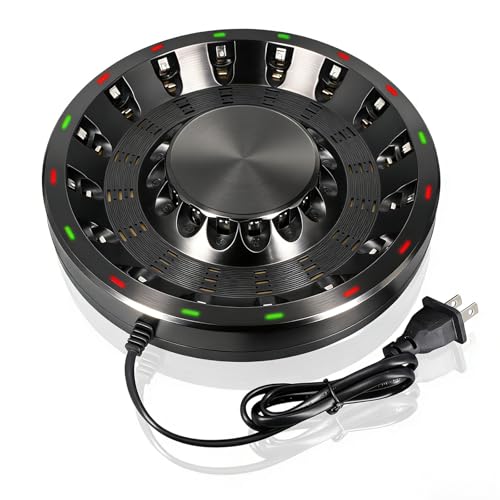
The Mspalocell 16-Bay Smart LED Charger offers a middle-sized alternative to the 12-bay options, with enough capacity for a busy household that keeps several rechargeable cells moving between devices. It accepts AA and AAA NiMH or NiCd batteries, and the 16 independent channels allow you to charge a mixed group rather than separating every size.
The LED indicators use a simple visual language: red shows charging, green shows a completed charge, and flashing indicates a battery that cannot be charged. That makes the system easy to scan in a busy kitchen or workshop, where an LCD may be more detail than you need. You’ll need to keep unsupported battery chemistries out of the bays and treat flashing status as a signal to check the cell.
Features That Help
- Sixteen independent channels support mixed AA and AAA charging.
- LED colors separate charging, completed, and problem states.
- NiMH and NiCd rechargeable batteries are supported.
- The round-bay layout is designed for straightforward placement.
Small Caveats
- It does not list C or D battery support in the supplied details.
- Flashing indicators require you to remove and inspect questionable cells.
- The 16-bay footprint remains larger than a compact two-bay charger.
Core Details
Whose Shelf It Belongs On
Households and workshop users who want a larger mixed-battery station with easy status lights will find it suitable.
Reach For A Different Pick When
A smaller collection with a need for a refresh function may be better served by the Mspalocell 12-Bay LCD Fast Charger.
Choosing a Charger for Your Battery Routine
Start with battery chemistry. Most modern household rechargeable batteries use NiMH, while NiCd remains relevant for older equipment. A charger designed for one chemistry should not be used with alkaline batteries or unsupported rechargeable cells. The bay count comes next, since a larger charger is useful for a shared collection but wasteful for a handful of AA cells.
Display features also depend on your routine. An LCD provides more detailed progress information, while LEDs are easier to scan at a glance. A refresh function may be useful for batteries stored for long periods, though it adds another maintenance feature to understand. USB power can be convenient in a home office, while a wall adapter may suit a fixed charging location better.
Common Charging Mistakes to Avoid
Pitfalls Shoppers Hit
Do not assume that all AA and AAA batteries use the same chemistry. Alkaline cells are disposable and do not belong in a rechargeable charger. Also check whether C or D support is included, since one bay count and battery format may not cover every cell in your drawer.
What Separates Premium From Basic
A higher-tier charger may add independent channels, LCD monitoring, mixed-size support, or a refresh function. Those extras matter most for frequent users and larger collections; a small set of everyday devices may not need them.
Frequently Asked Questions
Can I charge AA and AAA batteries together?
You can use a charger that specifically supports mixed AA and AAA rechargeable batteries. Confirm that every cell is a compatible rechargeable chemistry before placing it in the charger.
Are NiMH and NiCd batteries interchangeable?
They share common rechargeable formats, but you should confirm that the charger supports both chemistries. Compatibility depends on the charger’s stated battery types.
Does a larger charger charge faster?
Not necessarily. Charging time depends on the charger’s output, battery size, capacity, and the number of cells placed in the bays. A larger charger mainly helps you charge more batteries at once.
Can I use C or D batteries in an AA charger?
No. A charger must explicitly support the larger battery format. Do not adapt an unsupported cell into a charger without the manufacturer’s stated compatibility.
Is a display necessary for a household charger?
It is useful for monitoring progress, but LED indicators can be enough for a simpler setup. Choose an LCD for more detailed visibility or LEDs for a more streamlined station.
Final Verdict
Choose the Eneloop power packs for a compact, organized start with AA and AAA batteries. The 16- and 24-bay Mspalocell models suit larger household collections, while the 12-bay options offer a middle ground between capacity, display detail, and charging simplicity. Match the charger to your battery chemistry, sizes, and available space before making your choice.
