


Rechargeable batteries only help when you can manage them efficiently. A capable charger keeps remotes, flashlights, toys, cameras, and everyday tools ready without juggling battery replacements, while independent slots help mixed collections charge without awkward pairing. The right fit depends on battery chemistry, slot count, portability, and the controls you actually need.
A Side-By-Side Look

Energizer Recharge Pro AAA and AA Battery Charger with Batteries

BEVIGOR 4 Bay AA and AAA Battery Charger with Type-C Charging
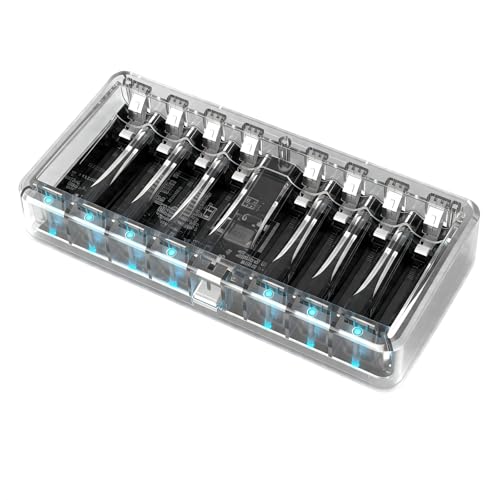
BEVIGOR 8 Bay AA and AAA Battery Charger

BEVIGOR 4 Bay AA and AAA USB-C Battery Charger

BEVIGOR High Capacity AA and AAA Battery Charger

Ansmann Comfort Mini Battery Charger with Repair Mode

Maxmoral USB Charger Cable for 4.8V NiMH RC Batteries
A Closer Look At Each Pick
The Energizer Recharge Pro combines a four-position charger with four rechargeable AA batteries, giving you a usable setup from the start. It handles AA and AAA NiMH cells together, which suits a mixed household containing remotes, small toys, clocks, and flashlights without a complicated charging routine.
For most homes, that ready-made bundle is more convenient than starting with a bare charger. The audible startup signal and red charging light make the process easy to follow, while the yellow indicator provides a useful halfway checkpoint.
Noteworthy Benefits
- Four AA and AAA positions reduce the need for several chargers.
- Four rechargeable AA batteries make the package immediately useful.
- Visual and audible alerts make charging activity easy to recognize.
- Automatic shutoff helps stop charging after completion.
Small Caveats
- The four included batteries are AA cells, so separate AAA cells are required for that size.
- It handles rechargeable NiMH batteries rather than alkaline cells or specialty RC packs.
Quick Facts
Right Fit For
You benefit most from this pick if you want a simple charger-and-battery bundle for ordinary household devices.
Another Choice May Suit
The BEVIGOR 4 Bay AA and AAA Battery Charger with Type-C Charging better serves people who also need C and D cell support.
Moving beyond the Energizer bundle, this BEVIGOR model accepts AA, AAA, C, and D rechargeable cells across four independently controlled positions. That broader format support is useful for flashlights, radios, and larger household devices that use uncommon battery sizes.
The Type-C connection simplifies powering from a compatible wall adapter or other USB setup, although no batteries are included. Independent control means a cell with a different charge level does not need to be forced into a matched pair, which is helpful for gradually rebuilding a collection.
Everyday Wins
- AA, AAA, C, and D support covers more than standard household cells.
- Independent slots accommodate batteries at different charge levels.
- Per-slot indicators make charging progress easier to follow.
- Type-C power offers a familiar connection for a cluttered charging area.
Trade Offs To Consider
- You must supply compatible rechargeable batteries separately.
- Large C and D cells may make the four-position unit less portable than a compact AA and AAA model.
Feature Snapshot
Built With In Mind
This charger suits people maintaining mixed battery sizes in a workshop, recreation room, or busy household.
Where Another Pick Shines
The Ansmann Comfort Mini Battery Charger with Repair Mode is the more portable option for maintaining only one or two cells.
Eight positions give this charger a different rhythm from the four-bay models. Families juggling several sets of rechargeable AA or AAA cells can process more batteries in one session, reducing the chance that one neglected pair holds up the rest.
Individual positions matter here because rechargeable cells do not always begin a session at the same level. You can mix sizes and chemistry where the charging system supports them, which makes the unit practical for toys, sensors, and household electronics with mixed requirements.
A Strong Showing
- Eight positions serve homes with several rechargeable devices.
- Mixed AA and AAA placement avoids unnecessary pairing.
- Individual monitoring supports staggered charging states.
- The larger platform suits a permanent utility-area location.
Where It May Fall Short
- A charger-only package requires you to keep separate NiMH or NiCD cells on hand.
- The eight-position footprint takes more space than the Energizer Recharge Pro and Ansmann Comfort Mini.
- Listing variants reference different battery bundles, so the box contents deserve careful attention.
Who It Suits Best
You get the most from this model in a busy family home with a recurring need to recharge many small cells.
A Better Fit Elsewhere
The Energizer Recharge Pro better serves you with a smaller setup that already includes four AA batteries.
The BEVIGOR 4 Bay AA and AAA USB-C Battery Charger is built around a power source you may already carry. Its 5V, 1A input can draw from a wall adapter, power bank, laptop, or vehicle charger, so it makes more sense for travel than a charger tied to a dedicated wall socket.
Four isolated circuits let AA and AAA NiMH or NiCD cells charge independently. The stated charging time is about three hours for four 1800mAh AA batteries, a useful reference for planning a nightly battery top-up before leaving home.
The Upside
- USB-C input supports several familiar power sources.
- Independent circuits prevent the need to match cells by charge level.
- Four cells can charge together, yet one or two can occupy the unit without wasting capacity.
- Overheat protection adds a sensible layer for unattended charging areas.
Points To Note
- You need a compatible USB-C power source, and it is not included.
- A power bank with limited output may charge the set more slowly than a wall adapter.
Core Details
Made For
This charger fits travelers, commuters, and apartment residents who rely on USB power sources already within reach.
Reach For A Different Pick When
The BEVIGOR 4 Bay AA and AAA Battery Charger with Type-C Charging better serves you with C and D battery collections.
This larger BEVIGOR platform shifts attention from compact portability to batch charging. The listed configuration supports numerous AA and AAA positions with isolated circuits, making it relevant to hobby rooms, classrooms, or workshops where loose rechargeable cells accumulate faster than a four-position charger can process.
A smart charging stage shifts toward a trickle charge near full capacity, which is intended to reduce continued high-rate charging as cells finish. Red and green indicators, automatic shutoff, and thermal protection make the large platform easier to integrate into a permanent charging station.
What Makes Sense
- High slot capacity supports batch maintenance of large battery collections.
- Isolated circuits let cells finish according to their individual states.
- Trickle charging provides a lower-current finishing stage near full capacity.
- Color indicators and automatic shutoff simplify routine monitoring.
Practical Considerations
- Batteries are not included, so the useful capacity depends on your existing collection.
- The footprint and size make the unit less convenient for travel than a four-bay or two-slot model.
- Different listing variants can change the package contents.
Best Suited To
A workshop, classroom, or hobby space with many rechargeable AA and AAA cells benefits most from the larger layout.
Look Elsewhere When
The BEVIGOR 4 Bay AA and AAA USB-C Battery Charger is the better fit for a small travel kit.
The Ansmann Comfort Mini reverses the high-capacity approach with a two-position format and repair-focused charging logic. It suits a small emergency kit, travel pouch, or workbench where conserving space and reviving deeply discharged cells matter more than charging a dozen batteries at once.
Each slot monitors its own battery, so you can charge one AA and one AAA without matching them by age or charge level. Repair mode is a reduced-current precharge for tired cells, while reverse-polarity protection, overcharge control, a safety timer, and defective-cell detection support safer handling.
What Stands Out
- Repair mode addresses deeply discharged rechargeable cells with reduced current.
- Two independent slots accommodate different sizes and charge levels.
- Automatic shutoff and overcharge protection simplify stored-cell charging.
- Reverse-polarity protection helps reduce errors during placement.
Worth Noting
- Two positions are modest for a household with many rechargeable devices.
- Repair mode cannot restore chemistry that has aged beyond useful service, so deeply neglected cells may need replacement.
Technical Highlights
Whose Shelf It Belongs On
This charger fits a compact emergency kit or a travel setup carrying only a few AA and AAA cells.
Swap It Out When
The BEVIGOR 8 Bay AA and AAA Battery Charger better serves a household that routinely needs large batches replenished.
Unlike the household chargers above, the Maxmoral cable serves a specialized radio-control vehicle battery pack. Its 4.8V SM 2P connection targets a four-cell NiMH or NiCD pack, not individual AA or AAA cells, making compatibility with the vehicle connector the first thing to confirm.
The listed input is 5V and 2A, with a 4.8V, 250mA charging output through a 78cm cable. That fixed lower output suits a compatible 1:18 off-road vehicle setup, while overload and short-circuit protection add useful safeguards around the battery connection.
Useful Highlights
- USB input allows connection to a suitable 5V, 2A source.
- The 4.8V output targets a specific RC vehicle battery configuration.
- Overload and short-circuit protection support routine pack charging.
- A 78cm cable provides practical reach between the power source and vehicle.
Details To Watch
- The SM 2P connector is incompatible with ordinary household AA and AAA batteries.
- You must verify battery voltage, cell configuration, connector shape, and polarity before charging.
The Right Fit
This cable fits hobbyists maintaining a 1:18 off-road vehicle with a matching 4.8V NiMH or NiCD pack.
Not Your Match When
The Energizer Recharge Pro is the better option for standard AA and AAA household devices.
What to Check Before Choosing a Charger
Start with the batteries already in your home. NiMH cells are the usual choice for modern household charging, while NiCD compatibility adds flexibility with older rechargeable cells. A charger that supports only one chemistry may be adequate, but a dual-chemistry design can reduce the need to keep separate equipment for older devices.
Slot count should reflect your collection rather than an arbitrary maximum. Two positions suit a compact emergency kit, four covers regular household use, and larger platforms help people maintaining toys, sensors, or hobby gear. Independent slot control is valuable because cells age and discharge at different rates.
Power requirements determine where each charger belongs. Plug-in models offer a simple home setup, while USB-C models can draw from a laptop, power bank, vehicle adapter, or wall adapter. Check the charger’s input requirements and whether a cable or power adapter is included.
Connector and voltage details matter most for specialty packs. The Maxmoral option is for a 4.8V vehicle battery with an SM 2P connection, not a row of loose AA cells. Verify voltage, chemistry, polarity, and connector geometry before connecting any specialized charger.
Common Charging Errors to Avoid
Mistakes Worth Dodging
Alkaline cells and other non-rechargeable batteries do not belong in these chargers. Confirm the chemistry marked on each battery, match the charger’s supported size, and inspect contacts for debris when a cell sits loosely or charges inconsistently.
What the Higher Tier Adds
More slots, repair mode, independent monitoring, and USB power can justify a higher-tier model, but extras do not replace compatibility. You gain practical value when the added feature matches your collection, such as batch capacity for many cells or a compact form for travel.
Frequently Asked Questions
Can one charger handle both AA and AAA NiMH batteries?
Yes, models with compatible AA and AAA positions can handle both sizes. Charging remains independent when each position has its own monitoring circuit.
Does a charger need to include replacement batteries?
No, most standalone chargers require you to supply compatible rechargeable cells. The Energizer Recharge Pro is the exception here because its package includes four AA batteries.
Can these chargers charge alkaline batteries?
No. Alkaline cells are not rechargeable and should remain out of a charger designed for NiMH or NiCD cells.
Is USB charging slower than a wall charger?
It depends on the power source and its output. A suitable wall adapter may charge more quickly than a low-output power bank or laptop port.
Can I charge C or D cells with an AA and AAA charger?
Only with a model that explicitly supports those larger sizes. The BEVIGOR 4 Bay AA and AAA Battery Charger with Type-C Charging includes C and D compatibility.
Final Verdict
Choose the Energizer Recharge Pro for a straightforward home setup with included AA cells, or select the Ansmann Comfort Mini for compact repair-focused charging. Larger BEVIGOR models suit mixed collections, while the four-bay USB-C version favors travel. The Maxmoral cable belongs only with its specified 4.8V RC battery system. Matching the charger to your actual cells matters more than added features.
