


A dead battery rarely announces itself at the most convenient moment. You may find a flashlight dimming, a remote becoming unresponsive, or a household device quitting after months of sitting in a drawer. A compact tester helps you sort usable cells from questionable ones without replacing everything blindly.
The options below cover digital voltage displays, analog scales, magnetic contacts, button-cell support, and rechargeable battery ranges. Most fit mixed battery collections, but the SE BT20 suits people who prefer a simple needle and no power source, while the feature-rich Dlypow model covers the widest stated range.
The Main Contenders
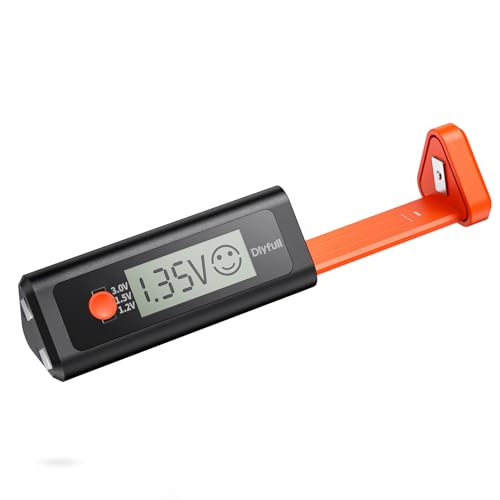
Dlypow Digital Battery Tester with Magnetic End and LCD

Dlyfull Battery Tester for AA AAA C D 9V

DLYFULL Battery Tester for AA AAA C D 9V

Ontel Cord Daddy Pro Cord Organizer Case

SE BT20 Color Coded Analog Battery Tester

Dlypow Magnetic Battery Tester for AAA AA C D 9V
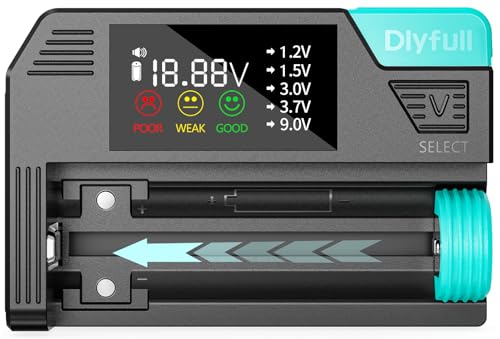
Dlypow Battery Tester for Button Cells and Rechargeables
Taking A Closer Look At The Options
A magnetic contact and digital display give this Dlypow tester a cleaner workflow than a basic needle model. The magnet grips a supported cell in position, which is useful on a cluttered workbench or while sorting batteries found in a kitchen drawer.
The stated coverage includes AAA, AA, C, D, 9V, CR2025, CR2032, LR44, LR41, CR2, and CR123A cells, along with 1.2V rechargeable AA and AAA batteries. For most mixed collections, that combination feels more useful than a tester limited to common full-size cells.
The Helpful Details
- The magnetic end keeps smaller cells steady during a reading.
- The LCD presents the measurement digitally for quick visual checks.
- Button-cell support reduces the need to keep several testers around.
- Rechargeable AA and AAA support helps with frequently reused household cells.
Things To Consider
- Correct placement matters for a stable connection, so the magnetic contact should be aligned carefully.
Key Attributes
Who It Suits Best
You benefit most from this model when your drawer contains button cells, alkaline batteries, and rechargeable AA or AAA cells in equal measure.
Another Choice May Suit
People who prefer an instantly readable needle scale may favor the SE BT20 Color Coded Analog Battery Tester instead.
Dlyfull’s LCD model is built around quick condition sorting, a sensible approach for remotes, toys, clocks, and flashlights. Its display classifies voltage as poor, weak, or good, giving you more context than a simple “passes” or “fails” impression.
Compatibility extends across AA, AAA, C, D, 9V, N, CR123A, CR2, CRV3, 2CR5, and CRP2 formats, plus button cells. The included AAA cell adds convenience for first use, although carrying spare cells in a junk drawer still deserves little enthusiasm.
Everyday Wins
- The LCD turns voltage into easy condition categories.
- Broad cylindrical-cell coverage suits a varied household drawer.
- Button-cell support makes it useful for remotes and small electronics.
- The included AAA cell reduces initial setup work.
Small Caveats
- Condition labels are more helpful than a precise voltage number for casual use.
- The tester needs storage away from moisture and loose batteries.
Feature Snapshot
Made For
This tester suits households that want readable condition guidance for a broad mix of batteries without navigating an analog scale.
A Better Fit Elsewhere
You may prefer Dlypow’s rechargeable-focused model when 18650, 3.7V lithium-ion, and multiple voltage ranges are central to your collection.
The practical case for this DLYFULL model is straightforward: it handles the battery formats most likely to turn up around a home. Place it near a charging station or utility drawer, and remote or flashlight batteries can be checked before they trigger another device failure.
Its LCD provides poor, weak, or good condition guidance, while support extends to N, CR2, CRV3, 2CR5, CRP2, and button cells. Compared with the Dlyfull AA AAA C D 9V, the supplied information describes the same broad format coverage and screen-led approach.
The Case For It
- Common household batteries fit without an adapter.
- Condition labels simplify quick sorting.
- Specialty cylindrical formats add useful coverage.
Practical Considerations
- Confirm terminal polarity before placing a cell in the tester.
- Its LCD requires the unit’s own power source, which can eventually weaken.
- Button cells should remain flat during use to maintain contact.
Built With In Mind
Busy households will appreciate the balance between common full-size formats and less frequent specialty cells.
Reach For A Different Pick When
Collectors of rechargeable and lithium-ion formats should consider Dlypow Battery Tester for Button Cells and Rechargeables.
The Ontel Cord Daddy Pro sits outside the battery-checking category, so treating it as an AA tester would be misleading. It earns a place in this roundup for a different problem: charging cables and small electronics accessories becoming tangled in a drawer, desk, or travel bag.
Its compact zip case gives each cable a defined place and supports portable organization. That makes it more useful before a long flight or commute than after a battery has already stopped working, particularly for people who regularly carry several adapters and leads.
Positive Takeaways
- The zip case keeps grouped accessories together.
- A compact shape suits drawers, desks, and carry-on bags.
- Dedicated storage can shorten the hunt for a misplaced cable.
- Cord wrapping helps reduce loose tangles.
A Few Limitations
- It does not inspect batteries or report voltage.
- Cord capacity is limited, so oversized charger bricks may not fit comfortably.
The Right Fit
You’ll value this case most when travel-day cable clutter is a bigger problem than checking loose household batteries.
Consider Something Else When
Your priority is battery condition guidance, in which case Dlypow Digital Battery Tester with Magnetic End and LCD is the relevant option.
The SE BT20 removes the screen, menus, and selection controls entirely, leaving only a scale, a black body, and a red sliding contact. That straightforward design works well in a garage drawer, travel pouch, or emergency kit where simple operation matters more than detailed voltage data.
It supports AAA, AA, C, D, 9V, and button-cell batteries without requiring its own battery for operation. The honest read is that the needle offers less precision than an LCD, but it also asks you to interpret less while checking a familiar household cell.
A Strong Showing
- The analog scale supports fast visual comparison.
- No separate battery is needed to operate the tester.
- The sliding contact adapts across several battery sizes.
- Its small footprint suits portable kits.
Where It May Fall Short
- The analog scale gives less detail than a digital voltage display.
- Contact pressure must be maintained for a stable needle response.
The Details
Whose Shelf It Belongs On
This model fits beginners, emergency-kit users, and anyone who prefers a mechanical needle over an LCD.
Look Elsewhere When
Precise digital voltage readings matter more to you than simple operation, making DLYFULL Battery Tester for AA AAA C D 9V a better fit.
A magnetic tip is the defining feature here, gripping a supported battery to reduce the wobble that can disrupt a reading. That makes this Dlypow model appealing during a quick check at a workbench, where batteries are often scattered among tools rather than arranged neatly.
The stated range covers AAA, AA, C, D, 9V, and button cells. Its classic analog display contrasts with the LCD models, so you trade exact numeric output for a fast visual assessment that may suit basic household sorting.
Practical Pluses
- Magnetic contact helps stabilize supported cells.
- The large analog display favors quick interpretation.
- One-step operation keeps the workflow uncomplicated.
Less-Strong Areas
- The display provides less numeric detail than an LCD.
- Magnets may also capture small metal debris during drawer storage.
- Rough handling can dislodge loose button cells.
Made For
People who value stable contact and immediate analog feedback will find this format practical for routine checks.
Swap It Out When
Your collection includes several rechargeable chemistries, making Dlypow Battery Tester for Button Cells and Rechargeables the stronger match.
This Dlypow model covers the broadest stated chemistry range in the group, including 1.2V Ni-MH or CD, 1.5V alkaline, 3.0V lithium, 3.7V lithium-ion, and 9.0V cells. For flashlights, camera accessories, or rechargeable equipment, that reach can eliminate much of the format guesswork.
Operation takes three steps: select the voltage range, insert the cell with correct polarity, and read the LCD. The format list includes AAA, AA, C, SC, D, N, 18650, CR123A, LR44, CR2032, CR2450, CR2, and CRV3, making it a sensible choice for a densely mixed collection.
What Makes Sense
- Multiple voltage ranges cover several rechargeable chemistries.
- The LCD displays voltage and battery status.
- Button-cell coverage makes it useful for small household devices.
- 18650 support serves rechargeable flashlight and electronics users.
- A select-and-insert sequence remains approachable for beginners.
Details To Watch
- Selecting the wrong voltage range can produce a misleading reading.
- Polarity must be checked before insertion.
- The range selector adds complexity compared with an analog tester.
Core Details
Who Will Love This
This tester suits you when rechargeable lights, camera batteries, 18650 cells, and button cells outnumber ordinary alkaline batteries.
A Better Fit Elsewhere
For a no-power mechanical scale and a smaller feature set, the SE BT20 Color Coded Analog Battery Tester is the clearer choice.
What Matters Most Before You Choose
Start with the formats you own
A tester that handles AA and AAA cells offers limited value in a drawer full of lithium coin cells or rechargeable 18650 batteries. Write down the formats you actually use, then check those against the compatibility list before considering extra features.
Decide how much detail you need
Voltage is the electrical potential a cell provides. A digital model may show a numeric voltage or a condition category, while an analog tester uses needle movement for a faster visual comparison. Digital detail helps with mixed collections; analog simplicity works well for occasional checks.
Match the tool to your routine
A compact mechanical model suits an emergency kit or travel pouch. An LCD unit with selectable ranges fits a workbench where several battery chemistries pass through your hands. Magnetic contact is useful on a cluttered surface because it reduces movement, but it still requires correct placement.
What Separates Basic And Feature-Rich Testers
Common Shopping Slip Ups
The easiest mistake is checking only the headline sizes. Button cells, rechargeable lithium-ion formats, and specialty cylindrical cells can require different contacts or voltage ranges. Another trap is assuming every tester reports detailed voltage, since some analog models provide only a basic needle reading.
What The Higher Tier Buys
The broader models add selectable voltage ranges, digital status information, and support for rechargeable chemistries. That extra coverage is worthwhile for mixed equipment, but a household using only AAA, AA, C, D, 9V, and common coin cells may get more value from a simpler design.
Frequently Asked Questions
Can an AA battery tester check AAA batteries?
Many models support both sizes, but compatibility varies by design. AA and AAA share the same 1.5V chemistry, while their different diameters require the correct contact position.
Do battery testers need their own battery?
The SE BT20 operates without one because its display is an analog needle scale. LCD models may use a cell or another internal power source to illuminate and process the reading.
Can a tester check rechargeable batteries?
Only models with compatible ranges should be used. The Dlypow Button Cells and Rechargeables model lists Ni-MH, CD, lithium-ion, and several common rechargeable formats.
Why does the correct voltage range matter?
Each range sets the scale used to interpret the battery’s output. An incorrect range can make a weak cell appear healthier or stronger than it is, so the selected setting should match the battery type.
Are button-cell batteries compatible with household testers?
Only when the tester specifically lists button-cell formats. Coin cells are short and require flat terminal contact, so a full-size battery slot alone is not enough.
Final Verdict
Choose a basic analog tool for occasional checks and simple operation. An LCD model suits routine household sorting, while the feature-rich Dlypow option makes the most sense for rechargeable batteries, 18650 cells, and button cells in a large collection. Keep the Ontel case nearby when cable organization matters just as much as battery checks.
